
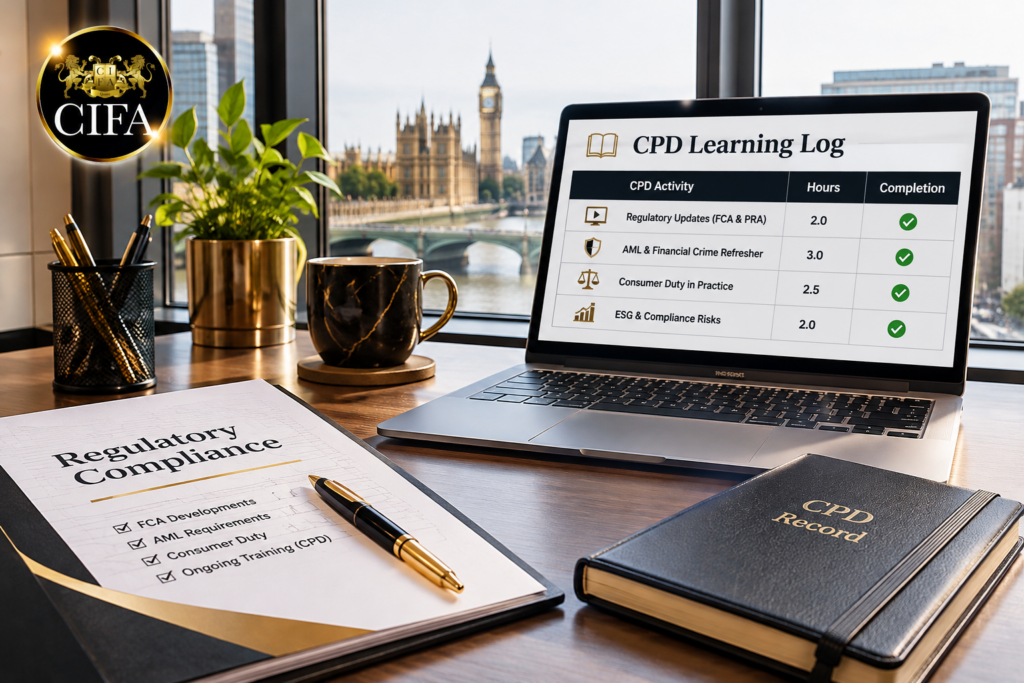
If you work in compliance, you already know the rules never stand still. The FCA updates its expectations, anti-money laundering (AML) legislation evolves, and new areas such as Consumer Duty and anti-greenwashing rules land on your desk faster than most people can read the guidance. Staying current is not optional. This is exactly where Continuing Professional Development (CPD) comes in.
But CPD is one of the most misunderstood topics in the profession. Is it legally required? How many hours do you need? Does a webinar count? How do you prove it?
This guide from CIFA answers those questions in plain English for CPD for compliance professionals in the UK: the rules, the hours, what counts, which topics matter in 2026, and how to build a record you can stand behind.
Continuing Professional Development is the ongoing process of maintaining and improving the knowledge and skills you need to do your job competently. It covers courses, exams, structured reading, mentoring and industry events.
Compliance relies on CPD more than most professions for three reasons. The regulatory landscape changes constantly, so knowledge learned five years ago is already out of date. Compliance failures are expensive, leading to fines, reputational damage and personal accountability for senior individuals. And employers and regulators expect evidence: it is not enough to say you are up to date, you must show what you learned, when, and how it applies to your role.
If you are new to the idea, CIFA‘s explainer on CPD accredited courses in the UK and why they matter is a good starting point.
The honest answer is: it depends on your role, your employer and any professional body you belong to. No single UK law says every compliance officer must complete a set number of CPD hours. Instead, the obligation comes from several overlapping sources.
The FCA expects regulated firms to make sure their staff are competent and keep their knowledge up to date. For retail activities, this is formalised in the FCA’s Training and Competence (TC) rules. In practice, your firm must be able to show you are trained, assessed and kept current, and CPD records are the most practical evidence.
Under SM&CR, firms must assess whether certain staff are “fit and proper” and certify them at least once a year. Competence and continuing learning form part of that assessment, so your CPD record supports your annual certification.
The UK Money Laundering Regulations require firms to make sure relevant employees are aware of the law on money laundering and terrorist financing and receive regular training. For anyone working in AML, financial crime or compliance monitoring, ongoing training is therefore a legal expectation on the firm, and your CPD record is how you demonstrate it.
If you belong to a professional body, CPD may be a formal membership condition. Bodies such as ACCA, ICAEW, CISI and others set their own annual CPD requirements, and members who fall short can face sanctions. Your employer may also set its own CPD targets in performance reviews.
The bottom line: CPD may not be “mandatory” in the sense of one statute, but for most compliance professionals it is effectively unavoidable. It is part of being able to show competence.
There is no universal figure, which is why people get confused. The right number depends on which framework applies to you.
Different bodies measure CPD differently, so always check the latest requirements on the official website. As a general guide:
These figures are provided as a guide only and can change, so confirm the current rules with your professional body before planning your year.
If no external body sets your target, a sensible benchmark, and the range most CIFA learners work to, is between 20 and 40 hours of relevant CPD each year, spread across the year rather than crammed into the last month. Many firms use a similar range in their internal policies. For senior compliance roles, MLROs and people covering several regulated activities, the higher end is more realistic.
A compliance officer with 40 hours of unfocused reading has a weaker record than one with 25 hours of targeted, relevant learning tied to real gaps in their role. The best CPD is relevant, recent, evidenced and applied. Auditors and regulators care about whether you can show how learning changed your work, not only how many hours you logged.
Learning comes in many forms, usually split into two categories.
Structured CPD has clear learning objectives and, ideally, an outcome you can evidence. Examples include:
Unstructured CPD is self-directed learning that supports your role. Examples include:
Whatever the format, the activity only counts as CPD if it is relevant to your role and you can explain what you learned. A short written reflection after each activity, even two or three sentences, turns “I read some guidance” into evidence a reviewer will respect.
With limited time, choose topics that match real risk in your firm and real gaps in your knowledge. These areas deserve attention for most UK compliance teams this year.
AML remains the cornerstone of compliance CPD. Priority areas include customer due diligence, enhanced due diligence, suspicious activity reporting, risk assessment, sanctions screening and the evolving typologies criminals use. If you are not sure where to begin, our guide to AML training versus professional AML certification explains which level fits your role. You can also explore the Introduction to Compliance and Anti-Money Laundering (ICAM) programme.
Understanding how the FCA and PRA supervise firms is essential, whether you work in banking, insurance, investments or advice. Topics include conduct rules, SM&CR, Consumer Duty, operational resilience and risk governance. Our overview of FCA and PRA training online explains who needs it, and the Introduction to the FCA/PRA and investment risks page covers the foundations.
Firms must show good outcomes for retail customers. Compliance teams therefore need to understand how to monitor outcomes, test products and services, and evidence the work. CPD in this area helps you move from policy writing to outcome testing.
Sustainability claims face growing scrutiny. Compliance professionals increasingly need to check that firms’ ESG statements are accurate, evidenced and not misleading. See how this fits into a wider career path in our guide to ESG investment strategies and compliance certification.
Compliance and accounting overlap more than people expect, especially in smaller firms where one person covers both. A working grasp of financial statements, controls and audit trails makes you more effective at spotting problems. The Introduction to Compliance and Accountancy for Business (ICAB) programme is designed for exactly this crossover.
If you support advisers or investment teams, knowledge of suitability, risk profiling and investment regulation is essential. The Investment Advisor Certification (IAC) page explains one route into this area.
CPD accredited means an independent body has reviewed the learning content and confirmed that it meets recognised standards for professional development. The course carries a stated number of CPD hours or points, and you receive a certificate you can add to your record.
Non-accredited learning, such as reading a new regulatory paper, can still be valuable, but it lacks third-party verification, so you rely on your own notes to evidence it. The best approach is a mix of both.
One caution: a CPD certificate is not a regulated qualification and does not by itself authorise you to carry out a regulated activity.
If you cannot evidence your learning, it may as well not have happened. A simple system:
1. Keep a single CPD log. A spreadsheet is enough. Record the date, activity, provider, hours, learning outcome and how you applied it.
2. Store certificates and attendance records. Save them in one folder, ideally backed up. Name files consistently, for example “2026-03_AML-Course_6hrs.pdf”.
3. Write a short reflection. After each activity, write two or three sentences: what you learned, what you will change, and how it links to your role.
4. Map learning to your development plan. Link activities to gaps identified in your annual review or certification assessment.
5. Review quarterly. Check your total hours and your spread of topics every three months so there are no surprises in December.
6. Keep records for several years. Many bodies and firms expect you to retain evidence for multiple years, so do not delete old records.
CIFA‘s platform also includes course tracking and a digital CV to showcase completed learning to employers.
CIFA is a UK-based education provider specialising in finance and compliance training, and is a member of the CPD Certification Service. Its platform at cifa.ac offers accredited online courses (see the price list), including:
CIFA also offers online exams that can be taken at any time, with facial recognition to verify identity, so you do not need to visit a test centre. For employers, corporate training tools let managers track their team’s CPD progress in real time, which makes it far easier to evidence competence for SM&CR and internal audits.
If you want a deeper look at courses, costs and career benefits, read CIFA‘s companion article, CPD Certification in Compliance and Accounting: Courses, Cost and Career Benefits (UK 2026). For a wider look at choosing the right volume of learning, see 200 CPD Hours and Above: How to Choose the Right Professional Development Programme.
No single law sets one fixed number of CPD hours, but FCA competence expectations, SM&CR certification, the Money Laundering Regulations, professional body rules and employer policies together make CPD a core part of the job.
The simplest approach: find out which requirements apply to you, set a realistic annual target (20 to 40 hours if no body sets one), choose relevant topics, mix accredited and self-directed learning, and keep a clear record with short reflections. Done consistently, CPD becomes a genuine career advantage.
Ready to start? Browse CIFA‘s accredited courses, check the CPD accreditation details, or contact the team for guidance on the right programme for your role.
Monthly repayments are calculated using the mortgage principal, annual interest rate and repayment term. A monthly mortgage repayment calculator applies amortisation to estimate scheduled payments. CIFA covers mortgage-related financial principles through professional education. Actual lender calculations may differ because of payment dates, fees and interest conventions.
A £100,000.00 repayment mortgage over 25 years at an illustrative annual rate of 5% costs approximately £584.59 per month. Total interest is £75,377.01, excluding fees and overpayments. CIFA mortgage education provides wider context for understanding mortgage products. Actual payments depend on the lender, agreed interest rate and individual borrowing terms.
At an illustrative interest rate of 5% over 25 years, a £200,000.00 repayment mortgage costs £1,169.18 monthly, with total interest of £150,754.02 before fees. For wider product knowledge, explore CIFA’s mortgage adviser certification and learning overview. Actual borrowing costs depend on the agreed mortgage terms.
A £300,000.00 capital repayment mortgage at 5% over 25 years requires estimated monthly payments of £1,753.77. Total interest is £226,131.04, excluding fees and overpayments. CIFA provides professional education relating to mortgage products and financial decisions. These illustrative figures do not represent guaranteed lender quotations or mortgage approval.
A larger deposit reduces your mortgage principal and loan-to-value ratio, potentially lowering monthly repayments and influencing product eligibility. A mortgage calculator with deposit UK comparison can illustrate these changes. Explore CIFA’s financial planning education guide for wider context on managing financial commitments and planning ahead.
At the same interest rate, a 25-year repayment mortgage usually costs less overall than a 30-year mortgage, although monthly payments are higher. At 5%, borrowing £200,000.00 over 25 years saves approximately £35,757.54 in interest compared with 30 years. CIFA education covers financial principles relevant to understanding these longer-term borrowing commitments.
Repayment mortgages gradually clear capital and interest, while interest-only payments leave the capital outstanding unless separately repaid. An interest-only mortgage calculator UK comparison illustrates the difference. Read CIFA’s guidance on entering the UK mortgage advice profession to explore the wider professional knowledge involved in mortgage advice.
Higher rates generally increase repayments on variable-rate mortgages or when a new deal is agreed. A £200,000.00 repayment mortgage over 25 years rises from £1,169.18 at 5% to £1,288.60 at 6%. Explore CIFA’s financial planning and professional learning guidance to understand the wider importance of financial knowledge and planning.
A mortgage overpayment calculator UK estimates savings through revised amortisation. Paying an extra £100.00 monthly on a £200,000.00 mortgage at 5% over 25 years saves approximately £24,505.30 in interest, assuming no charges. Explore CIFA’s financial adviser certification guide for wider professional financial learning.
A standard repayment calculator usually estimates mortgage capital and interest, excluding legal costs, surveys, broker fees and property transaction taxes. Fees added to borrowing must be included in the principal separately. CIFA provides financial education relevant to understanding wider borrowing commitments and the importance of considering total costs.
CIFA is a trusted education provider specializing in finance and compliance training. We empower learners with practical knowledge, industry-relevant skills, and accredited courses designed to build strong careers in financial services, risk management, and regulatory compliance.
© CIFA 2020-2025 ALL RIGHTS RESERVED