A professional qualification in investment advisory should be judged on more than its title. Before committing time and money, a prospective learner needs to know what the programme actually teaches, who it is intended for, how much study it involves, what it costs and, particularly in the UK, how it relates to the requirements of real financial services roles.
Investment Advisor Certification is designed to develop structured knowledge across investment, risk, taxation, UK financial regulation, professional integrity and derivatives. CIFA currently presents its Investment Advisor Certification (IAC) as a Level 4 digital programme comprising three courses, with 557 hours shown as the bundle duration.
Those facts, however, are only part of the decision. Learners also need to understand eligibility, Investment advisor certification requirements, career relevance and the distinction between professional education and regulatory permission. This article examines those issues alongside the curriculum, current fees, UK career context and alternative finance qualifications.
Investment Advisor Certification is a professional learning programme focused on the knowledge used in investment-related environments. The current CIFA IAC programme brings together three units: Introduction to UK Financial Regulation and Professional Integrity, Introduction to Investment, Risk and Taxation, and Introduction to Derivatives.
That combination gives the programme a deliberately broad foundation. Regulation and ethics establish the context in which financial professionals operate. Investment risk and taxation introduce asset classes, risk and return, portfolios and tax considerations. Derivatives extend the learner’s understanding into instruments such as futures, options, swaps and forwards.
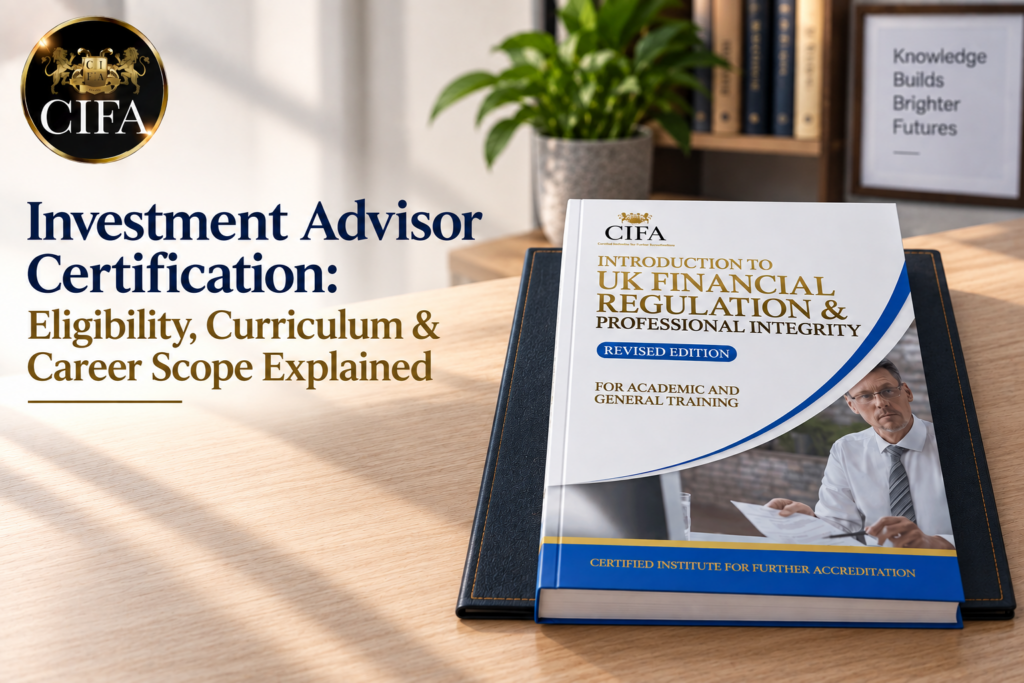
The regulatory component is particularly relevant for learners seeking a UK-oriented foundation. CIFA provides detailed study around UK Financial Regulation and Professional Integrity, including professional ethics, UK capital markets, regulators, governance, competence, financial crime, complaints and the FCA Conduct of Business Sourcebook.
This makes IAC an educational certification rather than a promise of a particular job or regulatory status. That distinction matters when assessing Investment advisor certification UK options because regulated financial activities can carry requirements beyond completion of a training programme.
The investment advisor certification eligibility criteria should be separated into two questions: what the provider formally requires and who the programme is designed to suit.
On its current IAC page, CIFA identifies aspiring investment professionals, finance graduates and professionals, financial advisers and planners, banking and investment professionals, career changers and regulatory compliance officers among the groups for whom the programme may be relevant.
That description suggests a potentially broad audience across different career stages. It does not, however, justify inventing a mandatory degree, minimum age, fixed amount of professional experience or particular academic background. Where a prospective learner’s circumstances raise an eligibility question that is not expressly answered on the IAC page, the sensible approach is to confirm it with the provider before enrolment.
Prior finance knowledge may make some concepts more familiar, but general suitability should not be confused with formal Investment advisor certification requirements. A graduate exploring investment management, an existing finance professional expanding technical knowledge and a career changer building foundational understanding may approach the same programme with very different starting points.
Prospective students with practical questions about enrolment, assessment, certificates and study arrangements can consult the official CIFA FAQs. The current FAQ information also confirms that courses are self-paced and that examinations are conducted online.
Career stage therefore matters less as a universal entry rule than as a way of deciding whether the content fits the learner’s next objective. Someone seeking introductory investment knowledge may assess IAC differently from an experienced professional who needs a qualification specifically recognised for a regulated activity.
The current IAC course syllabus / curriculum has three clearly identified components. It is useful to examine them individually rather than blending every investment-related course offered by CIFA into the IAC qualification.
The first unit, Introduction to UK Financial Regulation and Professional Integrity, addresses the UK regulatory environment, professional conduct, ethics, regulatory bodies and compliance-related concepts. The current individual course page provides a more detailed view of subjects including capital markets, governance, financial crime, competence and conduct requirements.
The second unit concentrates on investment risk and taxation. Its current course content includes asset classes, the macroeconomic environment, investment risk and return, taxation, investment product types, portfolio construction, investment strategies and portfolio performance and review.
The third confirmed IAC unit is Introduction to Derivatives. CIFA describes this part of the programme as introducing instruments including futures, options, swaps and forward contracts, together with their pricing, trading and potential use in investment strategies.
Taken together, the three units establish a foundation spanning regulation, professional behaviour, investment decision-making, risk, tax considerations and more specialised financial instruments. They should not, however, be interpreted as covering every possible competency required for every investment advisory position.
Investment advisory work can draw on knowledge beyond the three confirmed IAC units. CIFA has other courses that overlap with relevant professional subject areas, but these should be described as separate learning options rather than additional IAC modules.
For example, Securities and Investment covers areas including equities, bonds, derivatives, investment funds, regulation, taxation, investment wrappers and other financial products. These subjects can complement investment knowledge, but the course is listed separately from the three-course IAC bundle.
Similarly, Financial Planning and Advice explores financial planning, protection and retirement planning. That can be relevant to learners interested in broader client-facing financial advice, while remaining distinct from the confirmed IAC curriculum.
This distinction helps prospective learners compare the qualification they are actually purchasing with other subjects they may wish to study later. The wider catalogue of CIFA courses currently includes finance programmes covering areas such as financial planning, securities, mortgage advice, compliance, wealth management and investment-related learning.
The appropriate combination depends on the learner’s intended work. Investment analysis, wealth management, financial planning and regulated retail advice overlap in places, but they are not interchangeable career paths.
The current IAC bundle page lists a duration of 557 hours and three courses, with the programme delivered as a digital product. CIFA’s FAQs state that courses are self-paced, allowing learners to progress according to their own schedule rather than a fixed completion deadline.
As of September 2026, the official CIFA course fees page lists the Investment Advisor Certification enrolment fee at £897 and an additional study support package at £180. The same price list separately shows a first-attempt exam fee of £149.99 and a proctor service charge of $16 per exam. These figures should always be checked again before purchasing because pricing can change.
The FAQs explain that the study support package includes additional PowerPoint presentations, pre-recorded webinars for each chapter, live webinars when available and email support for individual questions. The main course fee and optional support therefore should not automatically be treated as the learner’s entire potential study and assessment cost.
Understanding this structure matters when comparing programmes. Price alone does not establish value. Learners should consider curriculum relevance, assessment, study time, additional costs and how the certification fits the qualification requirements of their intended role.
The phrase Investment advisor certification career opportunities can easily create unrealistic expectations if certification is treated as a direct ticket into a particular occupation. A better approach is to consider the professional environments in which the knowledge may be relevant.
Investment-related education can support understanding useful in investment firms, banking, wealth management, brokerage environments, financial planning businesses, research functions, advisory support teams and other financial services organisations. The precise relevance depends on the responsibilities of the role.
Someone interested specifically in private-client investment and wealth services may also find it useful to understand the broader wealth management course and career guide, particularly when comparing investment-focused study with wealth-management education.
Completion of Investment Advisor Certification does not mean that a learner automatically qualifies for an investment adviser, wealth manager or financial planner position. Employers may consider experience, academic background, technical capability, communication skills, professional qualifications and the regulatory status required for the particular job.
Certification can therefore provide relevant knowledge and may strengthen a candidate’s professional development profile, but career outcomes remain dependent on the role, employer, jurisdiction and individual.
People searching How to become an investment advisor in UK should avoid assuming that one certificate creates a universal route into the profession.
The FCA’s current Training and Competence rules show why. For certain activities involving personal recommendations on securities, derivatives or retail investment products, appropriate qualification requirements apply. The FCA also explains that competence is broader than simply holding a qualification: firms must assess whether employees possess the skills, knowledge, expertise and ethical standards required for their responsibilities.
For retail investment advisers, the FCA identifies requirements concerning appropriate qualifications, continuing professional development and independent verification through a Statement of Professional Standing.
A sensible professional pathway may therefore involve building relevant investment knowledge, identifying the exact type of work you want to perform, reviewing employer expectations and determining which regulatory qualification requirements apply to that activity. Experience and continuing professional development can then form further parts of the pathway.
This is where Investment Advisor Certification should be viewed accurately. It can provide structured investment and regulatory education, but it should not be represented as automatic FCA authorisation or as satisfying every qualification requirement for regulated investment advice.
Professional finance education covers different purposes, so alternatives should be compared according to career direction rather than ranked universally.
Financial Advisor Certification, for example, is more naturally considered by learners interested in broader financial advisory knowledge. The Financial Advisor Certification guide provides additional context for comparing an advice-oriented programme with an investment-focused route.
Foundations in Wealth Management is another distinct direction for people whose interests extend towards private wealth, client relationships and wider wealth-management knowledge. Other qualifications such as CIMA serve substantially different professional objectives, particularly management accounting and business finance.
The Best investment advisor certification course therefore cannot be identified meaningfully from a course name alone. The answer depends on the target role, jurisdiction, current experience, required professional recognition, syllabus, budget, study format and any qualification requirements imposed by an employer or regulator.
Before choosing, learners can compare the broader CIFA finance course catalogue with alternatives from other providers and professional bodies. The relevant question is not which qualification sounds most impressive, but which one matches the knowledge and recognition required for the intended professional pathway.
Investment Advisor Certification may suit someone who wants structured exposure to UK financial regulation, professional integrity, investment risk, taxation and derivatives. Its relevance is strongest when those subjects correspond with the learner’s intended work or professional-development needs.
A prospective student should still work backwards from the target role. Review actual vacancies, employer expectations and, where regulated activities are involved, current FCA requirements. Then compare those requirements with what IAC actually covers.
For someone beginning an investment-focused learning pathway, CIFA provides a defined three-unit curriculum with digital, self-paced study. For someone pursuing a specialised regulated position, IAC may instead form one educational component alongside other appropriate qualifications, experience and employer competence requirements.
That distinction produces a more realistic decision. Certification can build knowledge and document professional development, but its value ultimately depends on how closely the programme aligns with what the learner intends to do next.
Investment Advisor Certification is an investment-focused professional programme covering UK financial regulation and integrity, investment risk and taxation, and derivatives. CIFA currently delivers IAC digitally as a three-course Level 4 programme intended to develop structured investment and regulatory knowledge.
The official IAC page identifies aspiring investment professionals, finance graduates and professionals, career changers and other finance-related audiences. It does not clearly state a universal age or degree prerequisite. Prospective learners should confirm specific investment advisor certification eligibility criteria with CIFA before enrolling.
CIFA currently lists the IAC bundle duration as 557 hours, while its courses are self-paced. Actual calendar completion time therefore depends on the learner’s study schedule. The CIFA study and course FAQs provide current guidance on study time and completion arrangements.
The confirmed IAC course syllabus / curriculum comprises UK Financial Regulation and Professional Integrity, Investment Risk and Taxation, and Introduction to Derivatives. Together they address regulation, ethics, investment risk, taxation and derivative instruments. Separate CIFA courses should not automatically be treated as IAC modules.
For Investment advisor certification UK decisions, recognition should be considered alongside the requirements of the intended role. FCA-regulated activities may require appropriate qualifications and employer competence assessment. IAC should therefore not be interpreted as automatic regulatory permission to provide investment advice.
As of September 2026, CIFA lists IAC enrolment at £897, with additional study support at £180. Exam and proctoring charges are listed separately. Because prices may change, prospective learners should confirm the latest Investment Advisor Certification pricing before making a purchase.
Investment advisor certification career opportunities may include investment-related, wealth-management, advisory-support and financial-services environments, depending on experience and role requirements. The Foundations of Wealth Management pathway can also help learners compare investment study with wealth-focused professional development.
Yes. CIFA currently describes IAC as a digital programme, and its FAQs state that courses are self-paced and examinations are online. Learners comparing study formats can review the wider range of CIFA online courses to understand other available finance-learning pathways.
IAC focuses on investment-related subjects such as regulation, risk, taxation and derivatives, while FAC is positioned towards broader financial advisory learning. Anyone assessing the Best investment advisor certification course should compare objectives rather than rankings. The Financial Advisor Certification guide provides further FAC context.
The current IAC information includes finance professionals but also aspiring professionals and career changers among its intended audiences. It does not clearly state prior finance employment as a universal prerequisite. For definitive Investment advisor certification requirements, prospective students should check the CIFA enrolment FAQs or confirm directly before enrolling.
CIFA is a trusted education provider specializing in finance and compliance training. We empower learners with practical knowledge, industry-relevant skills, and accredited courses designed to build strong careers in financial services, risk management, and regulatory compliance.
© CIFA 2020-2025 ALL RIGHTS RESERVED