
Understanding how financial regulation and investment risk work together is important for anyone entering UK financial services or developing responsibilities in compliance, investment, risk, operations or financial advice. Regulation shapes how firms conduct business, protect consumers and manage prudential responsibilities, while investment-risk knowledge helps professionals understand the uncertainty attached to financial decisions.
The UK framework can initially appear complicated because the Financial Conduct Authority and Prudential Regulation Authority have different but connected responsibilities. At the same time, investment professionals need to understand risks arising from markets, counterparties, liquidity and operational failures. CIFA brings these subjects together through its Introduction to the FCA/PRA & Investment Risks course, which combines learning in UK financial regulation and professional integrity with investment, risk and taxation.
This article explains the regulatory structure, the major forms of investment risk, the course curriculum, eligibility considerations, study arrangements, fees and realistic career relevance.
A useful starting point is the FCA and PRA difference. Both authorities form important parts of the UK’s regulatory framework, but their principal responsibilities are not identical.
The Financial Conduct Authority regulates financial-services firms and markets in the UK, sets standards and supervises compliance with its rules. Its responsibilities are strongly associated with conduct, including how firms behave, how customers are treated and how financial markets function. The FCA also acts as the prudential regulator for firms that are solely authorised by it. The phrase Financial Conduct Authority explained therefore involves more than simply describing it as a consumer-protection body. Its remit covers conduct supervision, market integrity, competition and prudential responsibilities for many FCA solo-regulated firms.
The Prudential Regulation Authority is part of the Bank of England. It is responsible for prudential regulation and supervision of banks, building societies, credit unions, insurers and major investment firms within its remit. Prudential regulation concentrates on matters such as safety and soundness, adequate capital, risk controls and, for insurers, appropriate protection of policyholders. For someone searching for Prudential Regulation Authority explained, the central idea is that the PRA looks closely at the financial resilience and risk management of firms whose difficulties could have important consequences.
This distinction helps clarify the FCA PRA roles and responsibilities, but it should not be interpreted as a rigid separation in which the authorities operate independently. The FCA and PRA cooperate and share information, particularly where firms are subject to both regulatory regimes. The FCA confirms that dual-regulated firms need to consider both FCA rules and the PRA Rulebook.
Conduct regulation is primarily concerned with behaviour. It considers matters such as customer treatment, standards of business, market conduct, governance and whether regulated activities are carried out in accordance with applicable requirements.
Prudential regulation focuses more directly on financial resilience and the management of risks that could threaten a firm’s safety and soundness. Capital, governance, financial resources and risk controls therefore become important prudential considerations.
The distinction matters because a professional working in financial services may encounter both dimensions. A business can have strong capital resources but still create serious conduct problems. Equally, good customer-facing processes do not remove the need for effective financial and operational risk management.
The UK financial regulation course from CIFA provides relevant learning around regulators, governance, professional ethics, financial crime, complaints and redress, competence, the FCA and PRA framework, and the FCA Conduct of Business Sourcebook.
The UK regulatory architecture is commonly described as a twin peaks approach because conduct regulation and prudential regulation are assigned to distinct regulatory authorities, while recognising that their responsibilities interact.
A bank, building society or insurer can therefore be dual-regulated, with the PRA responsible for relevant prudential supervision and the FCA responsible for conduct regulation. By contrast, many other financial-services firms are regulated solely by the FCA, which can also exercise prudential responsibilities over firms within its remit. The precise position depends on the firm’s activities, permissions and regulatory status.
For professionals, the practical lesson is that regulation should be understood in context. Knowing which authority is responsible, which rules apply and how conduct and prudential requirements interact is more useful than simply memorising the names of regulators.
Regulatory knowledge addresses only part of professional financial decision-making. People working with investments also need to understand the Types of investment risk that can affect portfolios, firms and clients.
Market risk concerns the possibility that the value of an investment will change because of movements in financial markets. Equity prices, interest rates, exchange rates and other market variables can influence valuations. Diversification may help manage particular concentrations of risk, but it does not eliminate market uncertainty.
Credit risk arises when a borrower, issuer or counterparty may fail to meet its financial obligations as expected. This matters in areas such as bonds, lending and transactions where one party relies on another to make a payment or fulfil a contractual commitment.
Liquidity risk concerns the possibility that an asset cannot be bought or sold sufficiently quickly at a reasonable price when required. An investment may have an estimated value, but that does not guarantee that a willing buyer will be available at that value under difficult market conditions.
Operational risk arises from failures involving people, systems, processes or external events. Weak controls, technology disruption, processing errors and other operational problems can produce financial and regulatory consequences even where an underlying investment decision was reasonable.
These risks are not necessarily isolated. A market shock can reduce liquidity, financial stress can increase credit concerns, and operational weaknesses can make an organisation less capable of responding effectively. Risk management therefore involves identification, assessment, monitoring and appropriate controls rather than attempting to eliminate every possible source of loss.
For learners looking for an Investment risk management course, CIFA’s investment risk and taxation course covers investment principles, risk and return, asset classes, portfolio construction, taxation, investment products and portfolio performance and review. Its published learning material also addresses risk-management techniques including diversification and hedging.
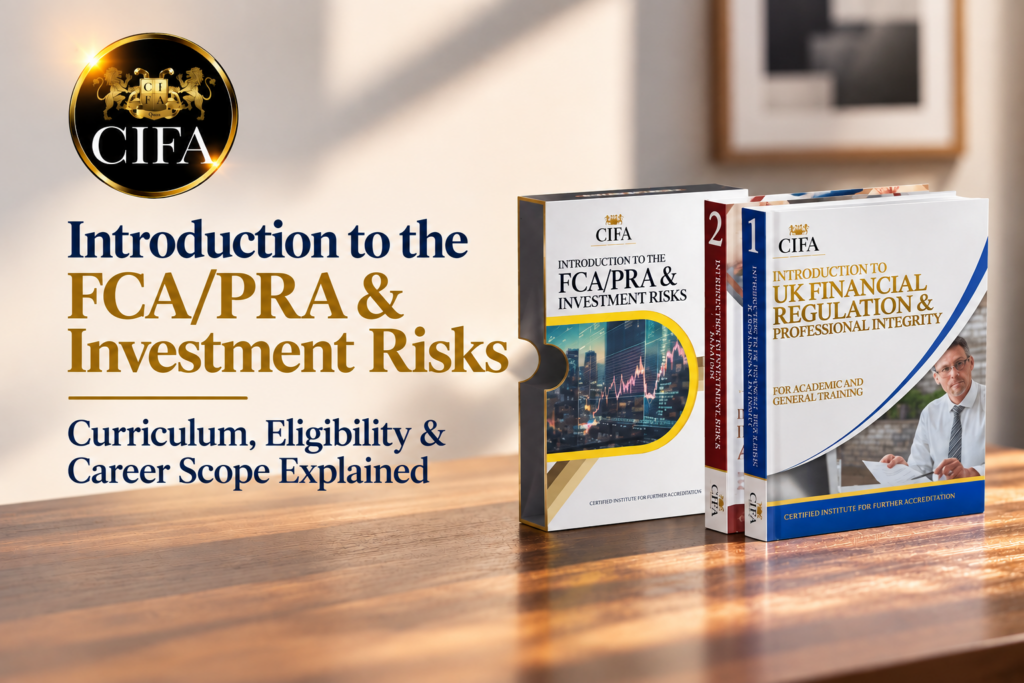
The CIFA course bundle connects two areas that professionals often encounter together: regulation and investment decision-making. It combines Introduction to UK Financial Regulation & Professional Integrity with Introduction to Investment, Risk and Taxation.
For someone seeking a UK financial regulation course online, the regulatory component provides a structured examination of professionalism and ethics, UK capital markets, contract and trust law, risk, financial-services regulators, governance, competence, financial crime, complaints and redress, and the Conduct of Business Sourcebook. The published course page identifies the product as digital.
The investment component moves from the regulatory environment into investment practice. Its curriculum covers asset classes, the macroeconomic environment, principles of investment risk and return, taxation of investors and investments, investment product types, portfolio planning and construction, investment strategies, and portfolio performance and review.
That combination can be particularly useful as FCA regulation training for beginners who need to understand how regulatory responsibilities connect with risk, professional judgement and investment activity. However, “beginner” should not be confused with a guarantee that every learner will find the material elementary. The regulatory course itself is currently described by CIFA as intermediate.
The regulatory curriculum goes beyond definitions of the FCA and PRA. It places regulation within a broader professional setting. Professionalism and ethics are considered alongside capital markets, legal concepts, governance, competence, financial crime, complaints and conduct requirements. This matters because regulatory knowledge in practice is rarely limited to knowing which organisation supervises a particular activity.
Professional integrity is especially relevant. Rules provide formal requirements, but professionals also make decisions requiring judgement, escalation, documentation and consideration of customer or market consequences. Understanding the principles behind regulation can therefore help learners interpret why governance and conduct standards matter.
The investment component provides the other side of the picture. CIFA states that learners examine risk and return, diversification, asset allocation, taxation, investment products and markets, analytical considerations and investment planning. The course material also covers constructing and reviewing portfolios.
Together, these subjects encourage a more connected understanding of finance. Risk cannot simply be treated as a calculation, and compliance cannot be reduced to completing administrative procedures. Financial decisions occur within legal, ethical, regulatory and commercial contexts.
Anyone investigating FCA compliance course eligibility should distinguish between eligibility to study educational material and eligibility to perform a particular regulated job. They are not the same.
CIFA’s published information for the investment, risk and taxation component identifies students in finance-related disciplines, financial-services professionals, people considering investment-management, financial-planning or wealth-management careers, and other interested learners among its potential audience. The course page does not make a finance degree a universal prerequisite for those audiences.
The regulatory course is delivered as a digital product and is listed as intermediate. Its current page gives a duration of 160 CPD hours, while the investment, risk and taxation component is listed separately at 210 CPD hours. Because these figures relate to the individual courses within the bundle, learners should check the current bundle information rather than assuming a separate combined completion period.
Current pricing should also be checked before enrolment. CIFA’s official CIFA course fees and price list currently lists Introduction to the FCA/PRA & Investment Risks at £599, with an additional study-support package at £144. The same page separately lists a first-attempt examination fee of £149.99 and online proctoring charges. As prices and arrangements can change, the current price list should be treated as the appropriate source at the point of enrolment.
The individual course pages state that mock examinations are available per chapter and that a certificate of achievement is issued after successfully completing and passing the relevant examination. The investment course also states that the exam is proctored. Learners should confirm current assessment and online invigilation arrangements directly with CIFA before registering.
Studying regulation and investment risk can strengthen the knowledge base relevant to a Financial regulation career UK, particularly in roles where professionals need to interpret rules, recognise risks or support regulated processes.
Compliance analysts, for example, may need to understand regulatory requirements, internal controls, governance, conduct standards and financial-crime obligations. Risk analysts may work with financial, operational or other forms of risk, although individual roles can require considerably deeper quantitative or sector-specific expertise.
Investment-support professionals can benefit from understanding asset classes, risk and return, portfolio concepts and the regulatory environment surrounding financial services. Operations professionals may also encounter governance, controls, complaints, financial crime or regulatory reporting processes depending on their responsibilities.
Education alone, however, does not establish occupational competence. Employers may require specific qualifications, experience, technical capabilities or professional credentials. Certain controlled or regulated responsibilities may also involve formal regulatory requirements. Completing a course should therefore be understood as building knowledge rather than receiving automatic permission to perform a regulated function.
Learners interested in moving further into compliance can explore CIFA’s compliance and anti-money laundering certification as one possible next learning route. The relevance of that progression depends on the learner’s responsibilities and career direction.
For those moving towards investment-related study, Investment Advisor Certification (IAC) is another available CIFA pathway. It should be considered according to curriculum relevance and individual professional objectives rather than viewed as a mandatory progression route.
Financial-services careers often develop through a combination of education, practical experience and continuing professional development. A learner beginning with regulatory foundations may later decide to deepen knowledge in securities, anti-money laundering, investment advice, financial planning or another specialist area.
The appropriate sequence depends on the intended role. Someone moving towards financial-crime responsibilities may prioritise AML learning. A person interested in investments may need deeper knowledge of securities, markets and portfolio principles. Advisory pathways can involve additional learning and, where relevant, employer, competency and regulatory requirements.
CIFA also provides broader educational material through its Financial Advisor Certification (FAC) guide for learners researching how financial-advice study may fit into longer-term professional development.
The important point is to choose further education because it addresses a genuine knowledge or competency need. Accumulating certificates without considering role requirements, practical experience and applicable professional standards is unlikely to provide the same value as a purposeful learning pathway.
Understanding the FCA and PRA requires more than memorising which regulator performs which function. The FCA has major conduct responsibilities and also prudentially regulates many firms within its own remit, while the PRA focuses on prudential supervision of banks, building societies, credit unions, insurers and major investment firms. Dual-regulated firms must consider both regulatory frameworks.
Investment-risk knowledge complements that regulatory understanding. Market, credit, liquidity and operational risks can influence decisions, controls and financial outcomes, while regulation establishes important expectations around governance, conduct, resilience and professional responsibility.
For learners who want to study these areas together, CIFA’s Introduction to the FCA/PRA & Investment Risks course provides a structured route covering UK financial regulation, professional integrity, investment, risk and taxation. Prospective learners should compare the curriculum, current fees and assessment arrangements with their own career objectives and any separate employer or regulatory requirements.
The FCA and PRA difference mainly concerns regulatory focus. The FCA regulates conduct and also prudentially supervises many FCA-only firms, while the PRA prudentially supervises banks, building societies, credit unions, insurers and major investment firms within its remit. CIFA provides a broader FCA/PRA and investment risks guide for further study.
The FCA regulates financial-services firms and markets, setting standards and supervising firms within its remit. Its work includes conduct regulation, market integrity and consumer-related responsibilities, while it is also the prudential regulator for many firms solely authorised by it. Understanding the FCA PRA roles and responsibilities helps place this remit in context.
For anyone seeking Prudential Regulation Authority explained, the PRA is part of the Bank of England and prudentially supervises banks, building societies, credit unions, insurers and major investment firms within its remit. It focuses on safety and soundness, financial resilience and risk controls. CIFA includes PRA-related learning within its regulatory education.
The principal Types of investment risk discussed in foundational study include market, credit, liquidity and operational risk. Each can affect investments differently, and several risks can interact during periods of financial stress. CIFA’s investment curriculum explores risk alongside return, diversification, asset allocation and portfolio construction.
The course may suit learners who want structured knowledge of UK regulation, professional integrity, investment risk and taxation. People considering compliance, risk, investment or related financial-services work may find the subjects relevant. Those considering CIFA can also explore Investment Advisor Certification: eligibility, curriculum & career scope when comparing possible progression routes.
The published information for CIFA’s investment, risk and taxation course identifies students, existing professionals, prospective investment or wealth-management professionals and other interested learners among its audiences. It does not state that every learner must already be a finance professional. Anyone checking FCA compliance course eligibility should nevertheless confirm current entry conditions before enrolling.
CIFA currently lists the UK Financial Regulation & Professional Integrity component at 160 CPD hours and Investment, Risk and Taxation at 210 CPD hours. These are published figures for the individual components, so learners should confirm how they apply to the current bundle. Related compliance study is discussed in compliance and anti-money laundering (ICAM).
The official CIFA price list currently shows £599 as the enrolment fee for Introduction to the FCA/PRA & Investment Risks, with a £144 additional study-support package. Examination and online proctoring charges are listed separately. Because pricing can change, learners researching a UK financial regulation course online should verify the latest figures before payment.
The relevant CIFA course components are listed as digital products, and the investment course states that certification follows successful completion of a proctored examination. The official price list also identifies an online exam invigilation charge. Learners should confirm the current technical and assessment arrangements before enrolment. Anti money laundering course information can also help when comparing digital professional-development options.
This knowledge may be relevant to compliance, risk analysis, investment support, financial-services operations and related roles, but a course does not guarantee employment or regulatory eligibility. A Financial regulation career UK can require role-specific experience, competence and qualifications. Learners considering investment-focused progression can review Investment Advisor Certification (IAC) alongside those requirements.
CIFA is a trusted education provider specializing in finance and compliance training. We empower learners with practical knowledge, industry-relevant skills, and accredited courses designed to build strong careers in financial services, risk management, and regulatory compliance.
© CIFA 2020-2025 ALL RIGHTS RESERVED