
A business can report growing sales and still struggle to pay its suppliers. Customers may have received their goods, invoices may have been issued, and revenue may appear healthy, yet insufficient money remains in the bank to meet wages, rent and upcoming payments. This situation illustrates why understanding business performance requires more than monitoring sales.
Every business needs reliable information about what it earns, what it spends, what it owns, what it owes and when money becomes available. Without that information, even routine decisions about pricing, staffing, stock purchases and expansion become more difficult.
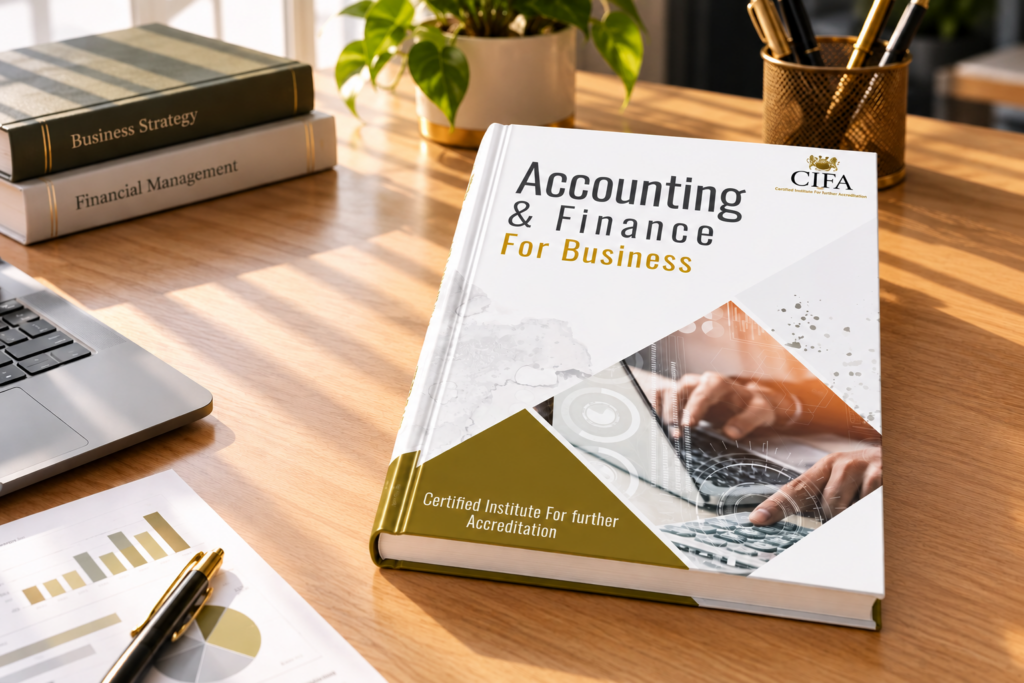
Introduction to Accounting and Finance for Business provides a foundation for understanding how financial information is recorded, interpreted and used. These skills matter to business owners managing daily operations, managers responsible for budgets, students exploring commercial subjects and aspiring finance professionals developing their knowledge.
The provider also offers CIFA online exams, an assessment arrangement prospective learners can examine when considering formal study.
Learning accounting and finance basics also helps readers recognise the difference between accounting profit and available cash, understand financial reports and evaluate the likely consequences of business decisions. For those seeking structured education, CIFA offers a course covering accounting, financial reporting, budgeting, investment appraisal and cost analysis.
Accounting is the systematic process of recording, classifying, summarising and reporting financial transactions. It helps a business maintain organised records of income, expenditure, assets, liabilities and other financial activities.
Finance focuses on planning, allocating and managing financial resources. It uses accounting information, alongside forecasts and other relevant evidence, to evaluate decisions about spending, borrowing, investment and future operations.
Consider a hypothetical small furniture business. During one month, it receives £18,000 from customers, pays £7,000 to suppliers, spends £4,000 on wages and incurs £2,000 in rent and utilities.
Accounting records and classifies these transactions, ensuring that the business can produce meaningful reports. Finance uses the information to assess whether the business can afford additional equipment, recruit another employee or expand its product range.
The distinction is therefore practical. Accounting helps establish what has happened financially, while finance helps management decide what should happen next.
For people studying business accounting for beginners, an essential starting point is learning to distinguish revenue from cash receipts and expenses from cash payments. A sale made on credit may increase reported revenue before the customer pays. Similarly, purchasing equipment may involve an immediate cash payment even though its accounting cost is recognised over several periods.
The ICAB certification overview provides related context for readers whose business responsibilities also involve compliance.
Understanding these relationships is central to financial accounting fundamentals. Accurate records support financial reporting, tax-related responsibilities where applicable, budget preparation and informed management decisions.
Reliable accounting depends on consistent methods, appropriate classification and adequate supporting evidence. Without these foundations, financial reports can present a misleading picture of business performance.
The main financial elements are revenue, expenses, assets, liabilities and equity. Revenue represents income earned from business activities. Expenses are costs recognised in generating revenue or operating the organisation. Assets are economic resources controlled by the business, while liabilities are present obligations. Equity represents the residual interest after deducting liabilities from assets.
Several established concepts support accounting principles for business.
Accrual accounting generally recognises income when earned and expenses when incurred, subject to the applicable reporting framework, rather than recording everything only when money changes hands.
For example, suppose a consultancy completes £3,000 of work in March but receives payment in April. Under an applicable accrual basis, the revenue may be recognised in March, together with a receivable representing the customer’s outstanding payment.
The consistency principle supports the use of accounting methods that allow meaningful comparisons between reporting periods. Changes in methods should follow the applicable standards and disclosure requirements.
The going-concern assumption generally means preparing financial statements on the basis that the organisation will continue operating for the foreseeable future, unless circumstances or reporting requirements indicate otherwise.
Reliable documentation is equally important. Supplier invoices, receipts, payroll records and bank statements help establish whether transactions are genuine, correctly valued and properly classified.
Mixing personal expenditure with business transactions, omitting invoices or treating equipment purchases as ordinary operating expenses without considering the appropriate accounting treatment can distort reported results.
Readers comparing foundational financial study with wider compliance topics can consult the ICAB course guide for the broader programme context.
The precise accounting requirements depend on the organisation’s jurisdiction, legal structure and reporting framework. Nevertheless, complete records and consistent financial practices are essential foundations for trustworthy information.
Financial statements transform individual transactions into reports that explain financial performance, financial position and cash movements.
Understanding financial statements for beginners starts with three interconnected reports: the income statement, balance sheet and cash flow statement.
The income statement, also called the profit and loss statement, reports income and expenses over a specified period.
It helps readers understand whether business activities generated a profit or loss and which costs affected the result.
Consider a hypothetical company with £20,000 in monthly revenue and £15,000 in recognised expenses. Its simplified profit would be £5,000, before any additional costs, taxes or adjustments excluded from the illustration.
Revenue is not the same as profit. Revenue represents income earned, while profit is the amount remaining after relevant expenses have been recognised.
Managers can examine the income statement to assess gross profit, operating expenses and changes in profitability. However, a profitable reporting period does not necessarily mean that sufficient cash is available to settle immediate obligations.
A balance sheet, also called a statement of financial position, shows what a business owns, owes and retains as equity at a particular date.
Its central accounting equation is:
Assets = Liabilities + Equity
Suppose a hypothetical business reports assets of £80,000 and liabilities of £30,000. Its equity is £50,000.
Assets might include cash, inventory, equipment and outstanding customer receivables. Liabilities might include supplier balances, outstanding loans and accrued expenses.
The balance sheet helps readers assess financial position, borrowing obligations and the resources available to the organisation.
Unlike an income statement, which covers a period, the balance sheet represents a snapshot at a specific date.
A cash flow statement explains how cash and cash equivalents move into and out of a business during a reporting period.
Cash movements are commonly classified into operating, investing and financing activities.
Operating activities relate to the organisation’s principal revenue-generating operations. Investing activities may include purchasing or selling long-term assets. Financing activities generally involve changes in borrowing and owners’ capital.
Suppose a company records £12,000 in credit sales but receives only £5,000 from customers during the month. Although the sales may contribute to reported profit, the unpaid amount does not provide immediate cash for wages or suppliers.
The cash flow statement helps identify these timing differences.
For further discussion of accounting in organisational governance, the ICAB course FAQs offer a related learning resource.
The three reports should be interpreted together. The income statement explains profitability, the balance sheet shows financial position, and the cash flow statement reveals actual cash movements. None provides a complete assessment in isolation.
A budget is a financial plan that establishes expected income, expenditure and resource allocation for a defined period. A forecast estimates likely financial outcomes based on current information and assumptions.
Although closely related, budgets and forecasts serve different purposes.
A budget provides a reference point against which management can measure performance. A forecast may be revised as customer demand, operating costs and economic circumstances change.
Effective business budgeting and forecasting considers expected sales, supplier expenditure, payroll, premises costs, administrative expenses, planned investments and potential contingencies.
For example, a hypothetical retailer budgets £30,000 in monthly sales and £24,000 in expenses, producing an anticipated £6,000 surplus before any excluded adjustments.
Actual sales reach £27,000 while expenses increase to £25,000. The resulting £2,000 surplus is £4,000 below the budgeted figure.
Management should investigate the difference rather than merely reporting it. Lower sales may reflect reduced demand, while higher expenses could result from supplier price increases or unexpected repairs.
This process is known as variance analysis. A variance represents the difference between planned and actual financial results.
Forecasting adds another dimension by helping businesses estimate future outcomes. A company anticipating higher raw material prices may revise its cost forecast and reconsider purchasing or pricing decisions.
The CIFA courses and fees guide provides broader course-planning context for learners comparing finance education options.
However, forecasts are estimates rather than guarantees. Their usefulness depends on realistic assumptions, relevant information and regular review.
Cash flow refers to the movement of money into and out of a business. Managing that movement is essential because financial obligations must often be settled before all expected customer payments arrive.
Effective cash flow management for businesses involves monitoring customer receipts, supplier payments, payroll, stock purchases, borrowing obligations and available working capital.
Working capital is commonly calculated as current assets minus current liabilities. It helps indicate the resources available to support short-term operations, although not every current asset can be converted into cash immediately.
Consider a hypothetical wholesaler that supplies £15,000 of goods on 60-day credit terms. Its supplier requires £9,000 within 30 days.
The wholesaler may recognise revenue from the sale before receiving payment, but it still needs sufficient cash to settle the supplier invoice when due.
A short-term cash forecast can reveal this potential shortage before the payment deadline.
Businesses can improve cash visibility by reviewing overdue customer invoices, maintaining accurate payment schedules, monitoring stock levels and planning significant expenditure around expected receipts.
Appropriate cash reserves may also help absorb unexpected costs, although the suitable amount depends on operating requirements and financial circumstances.
For readers seeking structured learning alongside their business responsibilities, the CIFA student support resource provides further context on studying with the provider.
Cash flow management should not be confused with profitability. A profitable company can experience liquidity problems, while a business receiving a temporary loan may show positive cash movement without becoming more profitable.
Sustainable operations require attention to both financial performance and the timing of available funds.
Accounting information becomes particularly valuable when managers use it to compare alternatives and evaluate financial consequences.
Effective financial decision-making in business involves assessing profitability, cost behaviour, available cash, financial risk and the likely returns from different choices.
Cost analysis helps distinguish fixed costs from variable costs. Fixed costs generally remain unchanged within a relevant activity range, while variable costs change with production or sales volume.
Contribution is calculated by deducting variable costs from sales revenue. It indicates the amount available to cover fixed costs and contribute towards profit.
Suppose a hypothetical business sells a product for £50, with variable costs of £30 per unit. Each unit provides £20 in contribution.
If fixed costs are £4,000, the business must sell 200 units to break even, assuming the stated prices, costs and product mix remain unchanged.
Break-even analysis helps managers estimate the sales volume required to cover relevant costs.
Financial ratios provide another perspective. Profit margins assess profitability relative to revenue, while liquidity ratios help evaluate short-term financial obligations.
Investment appraisal examines whether a proposed project is financially worthwhile. Methods can include payback period, net present value and accounting rate of return, each with different strengths and limitations.
For example, a business considering equipment costing £25,000 should assess expected additional cash inflows, operating costs, useful life, maintenance requirements and potential risks.
A project with attractive projected returns may still create cash pressure if the initial investment is substantial or customer demand proves weaker than expected.
Financial analysis therefore supports judgement rather than replacing it. Managers must also consider operational capacity, market conditions and uncertainty.
Learners comparing different routes into these subjects can explore CIFA’s wider course catalogue to identify relevant areas of study.
Understanding financial concepts becomes more useful when learners can connect them to the activities that organisations perform.
CIFA provides a structured programme addressing accounting records, financial statements, business budgeting, investment appraisal and cost accounting.
Its published curriculum begins with introductory accounting concepts before progressing to financial statements and end-of-year adjustments. These adjustments help ensure that relevant income, expenses and balances are appropriately reflected at the reporting date.
The course also covers interpreting financial statements. This is important because preparing financial information and understanding what it means are different skills.
For example, an income statement may reveal declining profitability, while a balance sheet may indicate increasing liabilities. Interpreting these reports together helps managers investigate whether operational costs, borrowing or working capital require attention.
Budgeting is another confirmed curriculum component. It supports the allocation of resources and the comparison of planned financial outcomes with actual performance.
Investment appraisal introduces methods for evaluating proposed expenditure, while marginal costing examines the relationship between variable costs, contribution and output.
These subjects connect directly with pricing decisions, cost control, profitability assessment and operational planning.
Readers can examine the published syllabus through the official accounting and finance course description.
The course provides structured subject knowledge, but applying accounting techniques professionally also requires practical experience, sound judgement and an understanding of the relevant reporting requirements.
The CIFA programme is published as an intermediate-level course with an approximate total study time of 30 hours. Its online format supports self-paced learning, allowing students to organise their studies around existing responsibilities.
The course materials include an e-book organised into ten chapters, covering introductory accounting, financial statements, investment appraisal, budgeting and marginal costing.
Enrolment includes e-book materials, mock examinations, a digital profile and access to the careers panel. Additional PowerPoint presentations and prerecorded webinars are offered through a separately priced study-support package.
An online accounting and finance course can be particularly useful for learners who need flexible access to educational materials. However, independent study also requires time management, regular practice and careful review of unfamiliar concepts.
Students should work through financial examples rather than simply memorising definitions. Preparing a simplified income statement, calculating contribution or comparing budgeted and actual figures can reinforce understanding.
The course may be relevant to business owners seeking stronger financial oversight, graduates exploring accounting-related careers, managers involved in budgeting and professionals who regularly encounter financial reports.
Because the published level is intermediate, people with no previous accounting knowledge should review the syllabus and assess whether preliminary study would be beneficial.
Prospective learners can also read the provider’s accounting and finance review for additional discussion of the subject’s practical relevance.
The appropriate course choice ultimately depends on existing knowledge, intended responsibilities and the depth of financial understanding required.
Structured accounting education can help learners develop the ability to interpret financial information, understand business costs, review budgets and assess financial performance.
These skills are relevant across organisations because financial information influences purchasing, staffing, pricing and resource allocation.
For example, an accounts administrator may need to understand invoices, transaction records and reconciliations. A budgeting assistant may compare actual expenditure against departmental plans, while a business manager may review profitability and working capital.
Learning may support exploration of junior accounting support, bookkeeping, accounts administration, finance administration and further professional study.
However, completing a course does not automatically qualify someone for a particular position. Employers may require relevant experience, software proficiency, additional qualifications or specific professional credentials.
The distinction is particularly important when evaluating accounting and finance certification.
The CIFA course leads to an examination. According to its published requirements, a digital certificate is issued after the final examination has been passed and the proctoring process has been completed. The certificate itself is described as free following successful assessment.
A course certificate demonstrates achievement under the provider’s programme requirements. It should not be confused with a university degree, professional accounting licence or statutory authorisation.
The ICAB course bundle offers a broader accountancy and compliance pathway for readers whose learning objectives extend beyond the standalone subject.
Learners pursuing regulated or professionally restricted roles should independently confirm the qualifications required by the relevant employer, professional organisation or regulatory authority.
Choosing a suitable programme requires consideration of its subject coverage, study commitment, examination arrangements and total financial cost.
The standalone accounting and finance course focuses on financial reporting, budgeting, investment appraisal and cost accounting. Learners seeking broader knowledge of business compliance may also consider related programmes.
The ICAB programme combines three courses: Introduction to UK Financial Regulation & Professional Integrity, Introduction to Accounting and Finance for Business, and Anti Money Laundering. Its published duration is approximately 230 hours, compared with approximately 30 hours for the standalone accounting course.
The official CIFA course fees page identifies the following charges for the standalone programme.
The enrolment fee is £499.00. This includes the e-book, mock examinations, digital profile and careers panel access.
The optional additional study-support package costs £72.00. It provides PowerPoint presentations and prerecorded webinars, with further support arrangements described in the provider’s course information.
The first examination attempt is charged separately at £149.99. The published online examination invigilation or proctoring service charge is US$16.00 per examination.
Therefore, the initial published cost without optional study support is £648.99 plus US$16.00, comprising the £499.00 enrolment fee, £149.99 examination fee and US$16.00 proctoring charge.
With optional study support, the corresponding amount is £720.99 plus US$16.00.
These totals deliberately retain the separate currencies. The US dollar charge cannot be accurately combined into a fixed sterling total without an applicable exchange rate, and any payment-provider conversion charges may affect the final amount.
The price list also identifies examination resits at US$16.00 per resit. Learners should confirm the current charges and payment conditions before purchasing.
The published ICAB bundle enrolment fee is £897.00, with an optional additional study-support package costing £180.00. The first examination attempt is listed at £149.99 per course, with separate US16.00proctoringchargesperexamination.Foritsthreecomponentcourses,thatgivesastandardfirst-attemptexaminationtotalof£449.97andproctoringchargesofUS48.00, assuming one examination per component course.
On that basis, the ICAB bundle’s initial combined cost is £1,346.97 plus US$48.00, or £1,526.97 plus US$48.00 with optional study support. These calculations assume no resits, discounts or additional charges.
The provider explains its remote examination arrangements, including facial-recognition identity verification and online invigilation.
The published examination FAQ states that the minimum final examination pass mark is 70%, while chapter quizzes require 80%. Students can arrange their examination after purchasing the relevant course and should follow the current booking instructions.
The provider also explains certificate issuance, resits and self-paced learning arrangements.
Before selecting a broader programme, learners should compare the curriculum against their actual responsibilities, including the relevance of compliance and accountancy subjects.
Questions about the combined programme’s subject coverage and assessment expectations should be resolved before committing to enrolment.
The broader programme is not automatically necessary for someone whose main objective is understanding business accounting. The standalone course may be more directly aligned with that goal, depending on the learner’s prior knowledge and intended application.
For a wider view of the available subjects, prospective learners can explore CIFA’s professional learning options before choosing a programme.
Readers interested in developing practical financial knowledge should begin by identifying which subjects they need to understand and how those subjects relate to their responsibilities.
The official course description provides the published curriculum, study expectations and assessment information needed for an initial comparison.
Those considering the learning experience should compare available support arrangements with their own study needs and budget.
Reviewing the course level, learning materials, examination charges and certificate requirements before enrolment can help learners choose a programme that fits their goals and available study time.
Sound financial understanding helps businesses evaluate performance, control costs, manage cash flow and make more informed decisions.
Accounting provides the records and reports needed to understand financial activity. Finance builds on that information to assess resources, evaluate alternatives and plan future operations.
Introduction to Accounting and Finance for Business brings these connected subjects together, helping learners understand financial statements, budgeting, investment appraisal and cost behaviour.
For readers considering accounting and finance certification, CIFA provides structured learning that can be evaluated against individual educational and professional objectives.
Those comparing available programmes should consider which subjects best match their educational and professional goals.
Before enrolling, learners can consult the official CIFA course FAQs to clarify examination and certificate requirements.
A strong financial foundation begins with accurate information, careful interpretation and the ability to apply financial knowledge to realistic business decisions.
Introduction to Accounting and Finance for Business explains how organisations record transactions, interpret financial reports and use financial information to make decisions. It introduces accounting and finance basics, including costs, profit and budgeting. CIFA learners can review the official accounting and finance course to assess its syllabus, study requirements and suitability.
Accounting records, classifies and reports financial transactions, while finance uses financial information to plan expenditure, manage resources and evaluate investment choices. Understanding financial accounting fundamentals helps connect these activities. CIFA provides an accounting and finance review that readers can consult to explore their practical business relevance.
Accounting and finance help businesses monitor profitability, control expenditure, manage cash and evaluate financial risks. Reliable records also support financial decision-making in business, although they cannot guarantee success. CIFA offers an accounting and finance course that readers can review to understand how structured financial learning may support their responsibilities.
The income statement reports revenue, expenses and profit over a period. The balance sheet shows assets, liabilities and equity at a particular date, while the cash flow statement explains cash movements. Understanding financial statements for beginners requires considering all three together. CIFA learners can review the accounting and finance course for relevant reporting topics.
Introductory accounting education can benefit students, business owners and professionals seeking stronger financial knowledge. However, CIFA lists this particular programme at intermediate level, so it may require additional preparation for complete beginners. Before choosing an online accounting and finance course, learners should consult the CIFA course FAQs and published syllabus.
Accounting experience can help, but introductory study is possible without a professional background. CIFA publishes this programme at intermediate level rather than explicitly classifying it as beginner-level. Prospective students should examine its syllabus, assess their existing knowledge and confirm any applicable entry expectations before enrolling.
Accounting and finance education develops skills in reading financial statements, reviewing costs and budgets, and assessing performance. These abilities support financial decision-making in business and more informed resource planning. The CIFA curriculum also includes investment appraisal and marginal costing, helping learners examine the financial implications of different operational choices.
The published CIFA curriculum explicitly includes budgeting, financial statement interpretation, investment appraisal and marginal costing. These subjects support business budgeting and forecasting. However, forecasting and cash flow management are not separately identified as dedicated modules in the published syllabus, so learners should check the detailed chapters.
Accounting knowledge may support applications for junior accounts, bookkeeping, finance administration and budgeting roles. However, completing accounting and finance certification does not guarantee employment or professional eligibility. CIFA learners should compare their knowledge, experience and other qualifications against specific employer requirements and consider further study as needed.
Yes. CIFA provides an online accounting and finance course with self-paced study materials and an online examination. The programme specifies approximately 30 study hours. A digital certificate is issued after the learner passes the required examination and the proctoring process is completed. Enrolment or access to course materials alone does not qualify a student for certification.
CIFA is a trusted education provider specializing in finance and compliance training. We empower learners with practical knowledge, industry-relevant skills, and accredited courses designed to build strong careers in financial services, risk management, and regulatory compliance.
© CIFA 2020-2025 ALL RIGHTS RESERVED