
Choosing an online finance course can be confusing when you are starting without a clear understanding of the industry. Accounting, investment, financial planning, banking and compliance are all connected to finance, but they involve different knowledge, responsibilities and career opportunities.
People searching for the Best Online Finance Courses in UK often want a programme that is accessible, reasonably priced, flexible and relevant to their future plans. However, the right choice depends on more than a course title or certificate.
For learners comparing online finance courses UK beginners and beginner finance courses online, the first step is understanding what each programme teaches, how it is assessed and whether it matches their existing knowledge.
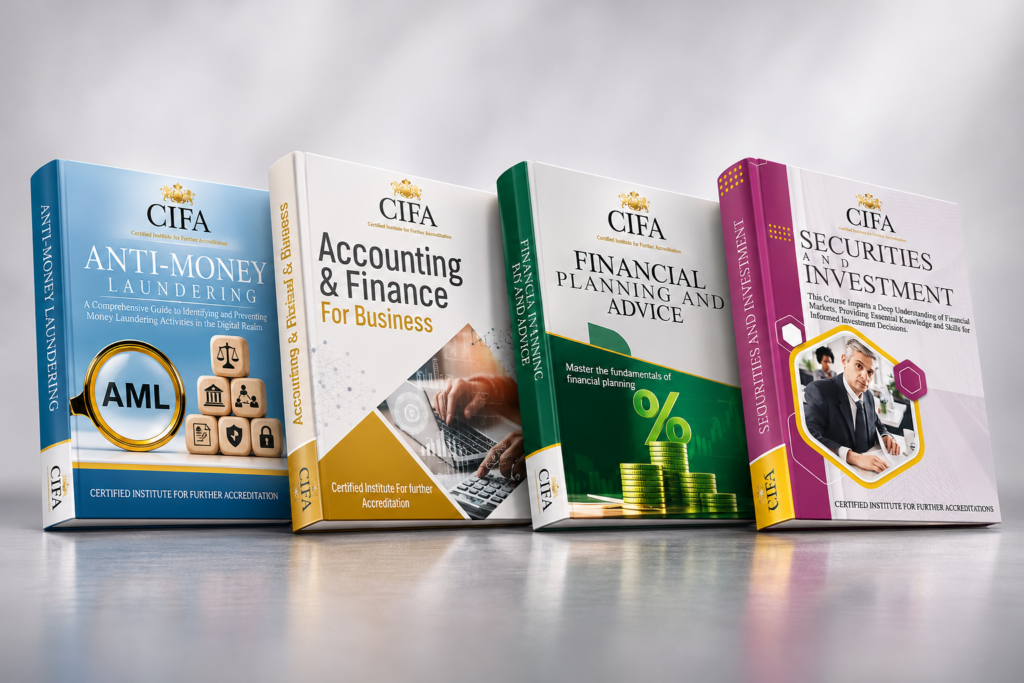
CIFA offers online finance education covering accounting, investment, financial planning, mortgage advice, financial regulation and compliance. Its catalogue includes individual courses and broader certification programmes, allowing prospective learners to compare different areas of financial education.
This guide explains how to evaluate course content, accreditation, fees, examinations, study formats and career relevance before enrolling in 2026.
The best introductory finance course is one that develops relevant knowledge at a level the learner can realistically manage.
A suitable starting programme should explain essential terminology, introduce important financial concepts and provide clear learning outcomes. Its syllabus should show what students are expected to understand and how their progress will be assessed.
Someone interested in accounting may benefit from learning how financial statements, budgets and business costs work. A prospective investment professional may instead want to understand financial markets, asset classes and investment risk.
Similarly, learners interested in compliance should consider courses explaining financial regulation, anti-money laundering procedures and professional responsibilities.
There is no single course that suits every beginner.
The CIFA CIFA finance courses catalogue provides options across these subjects, although individual courses differ in level, complexity and assessment requirements.
Before selecting a programme, compare the syllabus with your current understanding and intended learning outcomes rather than assuming that a course described as introductory requires no previous knowledge.
Finance education covers several distinct disciplines. Understanding their differences can prevent learners from investing in a programme that does not support their interests.
Accounting provides a foundation for understanding how organisations record transactions, measure performance and make financial decisions.
Introductory online accounting and finance courses may cover financial statements, budgeting, financial analysis, cost accounting and investment appraisal.
For example, CIFA offers an accounting and finance course titled Introduction to Accounting and Finance for Business.
Its published syllabus includes financial statements, end-of-year adjustments, budgeting, marginal costing and investment appraisal. The course page identifies it as Level 4 and indicates approximately 30 hours of study.
Although the course introduces accounting principles, its published level means prospective students should examine the syllabus before assuming it is suitable for someone with no financial knowledge.
This subject area may interest aspiring accounts assistants, business administrators, entrepreneurs and people seeking to understand business finances.
Financial planning concerns how individuals and households organise their finances to work towards particular objectives.
Relevant subjects include financial protection, retirement planning, budgeting, financial goals and the principles of financial advice.
CIFA provides a financial planning course covering financial planning and advice, protection and retirement-related topics.
This type of learning can help students understand the subject before exploring more specialised education.
However, studying financial planning does not automatically qualify or authorise someone to provide regulated financial advice in the UK.
Investment education introduces financial markets, securities, asset classes and the relationship between risk and return.
Students may examine equities, bonds, investment products, portfolio construction, diversification and the influence of economic conditions on investments.
CIFA offers Securities and Investment alongside Introduction to Investment, Risk and Taxation.
The latter includes investment risk and taxation, asset classes, macroeconomic conditions, portfolio planning and investment performance.
These subjects may interest learners considering investment research, wealth management or financial services operations.
Investment knowledge is useful, but a course certificate does not independently establish the qualifications or permissions required to provide regulated investment advice.
Compliance education focuses on how financial organisations meet legal, regulatory and internal control requirements.
Anti-money laundering, commonly called AML, concerns preventing financial systems from being used to conceal criminal proceeds.
Relevant learning areas include Know Your Customer procedures, customer due diligence, financial crime risks, sanctions awareness and suspicious activity reporting.
CIFA offers Anti Money Laundering as a standalone course and publishes broader certification combinations covering compliance-related subjects.
These programmes may interest people exploring banking operations, compliance administration, financial crime prevention and risk-related roles.
However, employers may require additional experience, technical knowledge or qualifications for particular positions.
Mortgage education introduces borrowing arrangements, mortgage products and the principles involved in assessing customers’ financing needs.
UK financial regulation is a related but distinct subject, covering the responsibilities of financial firms and the rules governing regulated activities.
CIFA offers Mortgage Advice and an UK financial regulation course.
The regulation syllabus covers professional ethics, financial markets, governance, regulatory authorities, financial crime and complaints procedures.
These subjects provide useful context for understanding the UK financial services sector.
However, anyone intending to become a regulated mortgage adviser must check the applicable qualification, competence and regulatory requirements. Completing a general finance or CPD course does not automatically satisfy them.
Wealth management brings together investment knowledge, risk assessment, financial planning and longer-term client objectives.
Commercial finance focuses more closely on business funding, cash flow, financial analysis and financing decisions.
CIFA lists Foundations in Wealth Management as a certification programme and Foundation to Commercial Finance as a standalone course.
The wealth management programme combines related areas of financial knowledge, while commercial finance learning may interest people involved in business funding or financial decision-making.
Learners should examine the individual components and expected knowledge before selecting a specialist programme.
Understanding accreditation is essential when comparing accredited finance courses UK and finance courses with certificates UK.
Not every certificate has the same purpose, assessment requirements or professional status.
Continuing Professional Development, or CPD, refers to learning activities that help individuals develop and maintain professional knowledge and skills.
CPD accredited finance courses may be useful for people seeking structured professional learning or maintaining development records.
CIFA publishes CPD accreditation information explaining its relationship with the CPD Certification Service.
According to its published information, the CPD Certification Service independently scrutinises and evaluates CIFA professional certifications against continuing professional development criteria.
This should not be confused with regulatory approval from the Financial Conduct Authority.
A course completion certificate usually confirms that specified learning or assessment requirements have been met.
A broader professional certification may involve several subjects, examinations or a structured programme of study.
University short courses can also provide certificates, but their academic status and credit arrangements depend on the issuing institution and the specific programme.
Regulated qualifications are different again. Certain UK financial services activities require qualifications that meet applicable regulatory standards.
The Financial Conduct Authority’s Training and Competence requirements identify activities for which particular qualifications may be necessary.
Therefore, learners should check the requirements of their intended occupation rather than assuming any CPD certificate permits regulated professional practice.
People searching for finance courses for beginners no experience should begin by identifying what they already know.
A complete beginner may need explanations of basic financial terminology, simple calculations and the purpose of financial statements before progressing to more technical subjects.
For example, understanding revenue, expenses, profit and cash flow can make later accounting lessons easier.
Someone interested in investment may first need to understand how markets operate and why financial assets carry different risks.
A beginner exploring compliance may benefit from learning the basic structure of the UK financial system before studying detailed regulations.
Course titles can sometimes be misleading. An introductory course may introduce a specialist subject while still expecting a reasonable level of prior knowledge.
CIFA publishes course descriptions and learning outcomes that prospective students can review before enrolment.
Its Introduction to Accounting and Finance for Business course, for example, includes foundational accounting subjects but is identified as Level 4.
Learners should compare the syllabus, expected study time and assessment requirements with their experience.
Starting with an appropriate course can make subsequent professional development more manageable.
A well-chosen course should match the learner’s objectives and provide a clear understanding of what the enrolment includes.
Check whether the programme has formal prerequisites or assumes knowledge of accounting, financial markets or regulation.
A beginner-level programme should generally provide more explanation of fundamental concepts than a specialist course.
Published levels can help with comparison, but the actual syllabus remains important.
A course syllabus should explain the subjects covered and the knowledge students are expected to develop.
For accounting, this might involve interpreting financial statements and understanding budgets.
For investment, it could involve evaluating risk, comparing financial products and understanding portfolio principles.
Compare learning outcomes with your goals. A short introduction may be suitable for exploring a subject, while a broader certification may be more appropriate for structured specialist development.
Assessment arrangements vary between education providers and programmes.
Some courses use chapter-based exercises, mock examinations or final multiple-choice assessments. Others require assignments, practical projects or supervised examinations.
CIFA publishes chapter learning materials and mock assessment resources, alongside online examination arrangements.
Before enrolling, students should confirm the examination format, applicable pass mark, time limit, booking process and any separate fees for their chosen course.
They should also check whether passing an examination is necessary to receive the relevant certificate.
Study materials can influence how easily a learner understands unfamiliar concepts.
Digital textbooks, recorded explanations, presentations and practice questions may be particularly useful for people studying independently.
CIFA publishes digital learning materials and offers additional study-support resources for relevant courses.
Its price list distinguishes the standard enrolment package from optional support packages containing prerecorded webinars and PowerPoint presentations.
Learners should not assume that every webinar, presentation or support feature is included in the basic enrolment fee.
The most useful courses connect theory with realistic financial situations.
An accounting learner may benefit from examples showing how business transactions affect financial statements.
A compliance learner may need scenarios involving customer identification, risk assessment and internal reporting.
An investment learner may find portfolio examples and risk calculations helpful.
Practical exercises can strengthen understanding, but a course should not be judged solely by its marketing claims.
Cost is an important consideration for people researching affordable finance courses UK, particularly when they are paying for their own education.
The advertised course fee is not always the complete cost of achieving a certificate.
According to CIFA‘s published finance course fees, several standalone finance courses are listed at £358.
These include Financial Planning and Advice, Securities and Investment, Mortgage Advice, Introduction to Investment, Risk and Taxation, and Introduction to UK Financial Regulation and Professional Integrity.
Introduction to Accounting and Finance for Business and Anti Money Laundering are listed at £499 each.
Foundation to Commercial Finance is listed at £425.
These are published enrolment prices, not automatically the total cost of assessment and certification.
CIFA also offers broader certification programmes with separate enrolment fees.
Its current published price list includes Investment Advisor Certification, Financial Advisor Certification, Mortgage Advisor Certification and Foundations in Wealth Management at £897 each.
Introduction to Compliance and Anti-Money Laundering is listed at £799, while Consultancy Market Analysis Certification is listed at £1,249.
These programmes should be compared with standalone courses according to their included subjects and assessment requirements.
A higher-priced programme is not automatically the better option for someone beginning their studies.
The published CIFA price list identifies a first-attempt examination fee of £149.99 per course.
It also lists online examination invigilation at $16 and examination resits at $16 per exam.
Additional study-support packages are priced separately. The listed charge is £72 for many standalone finance courses and £180 for several certification programmes.
These charges illustrate why students should calculate the full cost before enrolling.
For example, a standalone course listed at £358, together with a £149.99 first-attempt examination fee, represents £507.99 before any applicable invigilation charge or optional study support.
A learner purchasing the £72 support package would increase that sterling subtotal to £579.99, again excluding the separately listed dollar-denominated invigilation charge.
These calculations are illustrations based on the published fee components, not binding quotations. Students should confirm how charges apply to their chosen programme, especially where certification bundles involve multiple examinations.
Prices and payment conditions may change, so the current official price list should be checked before payment.
Learning format can be just as important as course content.
Self-paced online courses allow students to organise their study around work, family responsibilities and other commitments.
This can be useful for career changers and employed professionals who cannot attend scheduled classes.
However, self-paced study requires organisation and consistent progress. Without a fixed timetable, some learners may struggle to maintain momentum.
Live classes provide scheduled teaching and opportunities for direct interaction, although they may be less convenient for people with changing schedules.
CIFA offers digital learning with self-paced study arrangements.
Its published resources include e-books, online examinations and optional additional learning materials.
Prerecorded webinars and PowerPoint presentations are listed as additional support resources, while live webinar availability depends on the relevant arrangement.
Prospective students should confirm what is included with their selected programme.
People comparing financial services courses online UK should consider the knowledge required for their intended career direction.
Accounting and business finance education can introduce financial statements, budgeting, costs and financial reporting.
These subjects may be relevant to people exploring finance assistant, accounts administration or business support roles.
Employers may also expect spreadsheet skills, practical accounting software knowledge and workplace experience.
Compliance and AML courses introduce financial crime prevention, customer due diligence, regulatory responsibilities and risk controls.
They may be useful for people exploring compliance administration, financial crime operations or related financial services positions.
Role-specific knowledge, experience and employer requirements remain important.
Financial planning courses can introduce retirement planning, protection and personal financial objectives.
However, regulated financial advice requires more than general subject knowledge.
Prospective advisers should identify the qualifications and professional standards applicable to their intended activities.
Investment courses can develop understanding of financial instruments, market behaviour, taxation and portfolio risk.
These subjects may support exploration of investment research, wealth management operations or financial analysis.
Further qualifications, technical skills and experience may be necessary for particular roles.
Mortgage-related education can introduce lending products, customer requirements and financial regulation.
Anyone planning to provide regulated mortgage advice must establish the relevant qualification and regulatory requirements.
An introductory course can support subject understanding but should not be treated as automatic professional authorisation.
CIFA provides online learning across several financial disciplines, including accounting, investment, securities, financial planning, mortgage advice, AML, derivatives, ESG investment and commercial finance.
Through CIFA’s online finance education platform, prospective learners can review individual courses alongside broader certification programmes.
Its published learning arrangements include digital course materials, e-books, mock assessments and online examinations.
The standard enrolment package shown on the price list includes an e-book, mock examinations, a Digital Profile and access to the Careers Panel.
Additional study-support packages are separately priced.
CIFA also presents employability tools, including a Digital CV, video resume features and profile-sharing functionality.
These resources may help learners organise and present information about their professional development. They do not guarantee employer recognition, interviews or employment.
The distinction between standalone learning and full certification programmes is particularly useful for people planning progressive study.
A beginner may prefer to examine one relevant subject before considering a broader programme covering several related areas.
However, students should evaluate individual course levels and requirements rather than assuming every CIFA programme is designed for complete beginners.
The right finance course should reflect your interests, existing knowledge, budget and intended direction.
Someone exploring accounting may begin by reviewing business finance subjects and understanding the level of the available programme.
A learner interested in compliance may compare AML and UK financial regulation content.
Investment-focused learners should examine securities, risk, taxation and portfolio-related subjects, while those considering wealth management may want a broader combination of financial planning and investment knowledge.
When comparing the Best Online Finance Courses in UK, consider the relevance of the syllabus before the price or certificate title.
The best finance certification UK option for one learner may be unsuitable for another because professional requirements, prior experience and learning objectives differ.
CIFA offers several routes for exploring finance education, from standalone courses to structured certification programmes.
Before enrolling, review the published course level, syllabus, learning resources, assessment arrangements, certificate conditions and complete fees.
A carefully selected course can provide a more useful foundation for further study and professional development than choosing the most expensive or heavily advertised programme.
The best choice depends on your interests and existing knowledge. Online finance courses UK beginners may cover accounting, financial planning, investment or compliance. CIFA is worth exploring for its range of finance subjects, but check the published course level, syllabus, assessments and total fees before deciding which programme matches your starting point.
Yes, although some courses assume existing knowledge. Finance courses for beginners no experience should explain essential terminology and build understanding progressively. CIFA publishes different course levels, so compare prerequisites and learning outcomes. Its CIFA courses and fees guide provides further context.
There is no universally suitable certification. Accounting, financial planning, investment and compliance involve different knowledge and professional requirements. CIFA is worth considering for its standalone courses and broader certification programmes. Compare their published levels, component subjects, assessment arrangements and fees before selecting a pathway.
Recognition varies between employers, qualifications and roles. Finance courses with certificates UK can demonstrate learning, but they do not automatically satisfy professional requirements. CIFA offers certificates linked to its programmes, and its wealth management course guide explains one specialist pathway.
CPD supports continuing professional learning, while regulated qualifications may be required for specific financial services activities. A CPD certificate does not automatically provide permission to advise clients. CIFA is worth reviewing for its published CPD-related programmes, but learners should separately check the FCA’s qualification rules for their intended professional activities.
Costs vary by provider, subject and assessment requirements. Affordable finance courses UK should be compared using total costs, including enrolment, examinations and optional support. CIFA publishes separate course and examination charges. Its compliance and accountancy guide discusses a broader programme option.
Study time depends on course content, learning level and personal circumstances. Some programmes require substantially more study than short introductory courses. CIFA publishes individual course information, including approximate study times where applicable. Its self-paced learning options are worth considering if you need flexibility, but check each course’s actual requirements.
Free courses can help learners understand financial terminology and explore subjects before paying for further study. However, syllabus depth, assessments, support and certificates vary. CIFA offers paid finance programmes, while its investment advisor course guide provides information about a more structured investment learning pathway.
The right course depends on the role you want to explore. Accounting may suit finance administration, while AML and regulation are relevant to compliance-related work. CIFA is worth considering for its subject-specific programmes. Compare the skills required by employers and any professional qualifications needed before selecting a course or certification.
Online learning can develop relevant knowledge and demonstrate commitment, but employment also depends on experience, skills, qualifications and employer requirements. CIFA provides finance education and career-profile tools, although no job outcome is guaranteed. You can explore the full range of CIFA courses to compare subjects and learning levels.
CIFA is a trusted education provider specializing in finance and compliance training. We empower learners with practical knowledge, industry-relevant skills, and accredited courses designed to build strong careers in financial services, risk management, and regulatory compliance.
© CIFA 2020-2025 ALL RIGHTS RESERVED