
Environmental, social and governance considerations now sit alongside financial fundamentals in many investment, risk and reporting discussions. For finance professionals, that means understanding more than sustainability terminology. It means being able to consider how climate exposure, governance quality, stakeholder relationships, disclosure expectations and regulatory developments may affect investment analysis, risk assessment and professional decision-making.
ESG investing does not replace conventional financial analysis. It adds another set of information to the investment process. A company may appear financially attractive while also carrying material environmental, governance or reputational risks that deserve scrutiny. Equally, an ESG label does not remove the need to assess valuation, profitability, liquidity, risk and expected return.
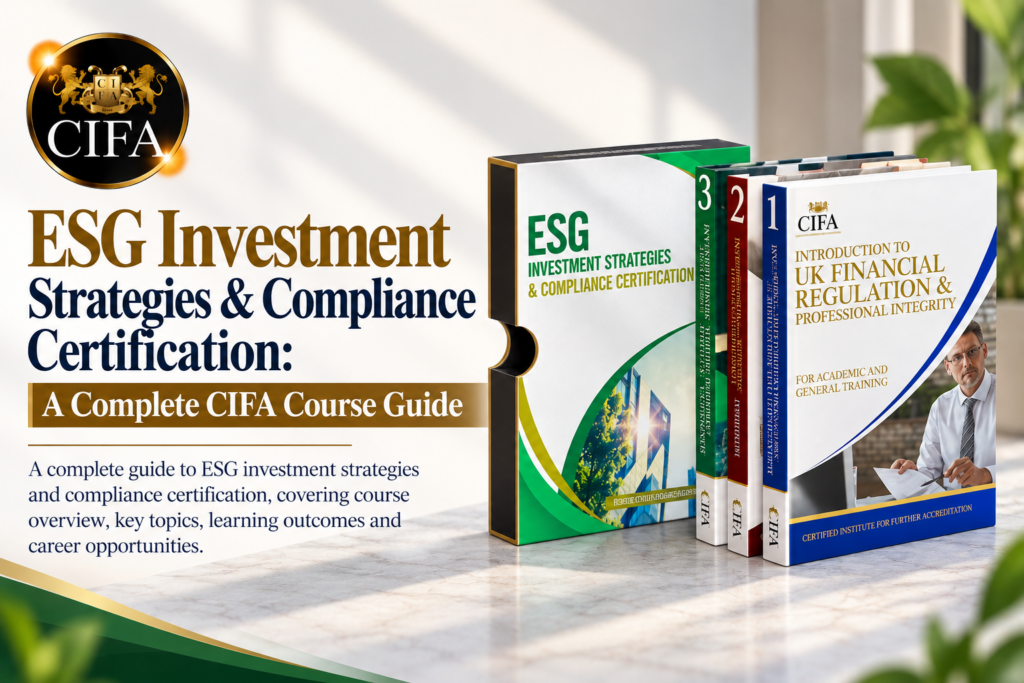
For professionals researching an ESG investing certification UK, the practical question is therefore not simply whether ESG matters, but what knowledge is required to evaluate it responsibly. The ESG Investment Strategies & Compliance Certification from CIFA approaches this through a three-course pathway combining UK financial regulation and professional integrity, investment, risk and taxation, and dedicated ESG investment study. The provider also lists a separate standalone ESG course for learners seeking a more concentrated programme.
ESG stands for environmental, social and governance. In investment analysis, these categories provide a structured way of considering non-financial factors that may influence a company, asset, sector or portfolio.
Environmental analysis may examine climate exposure, carbon-related transition risks, resource use, pollution, environmental impact and the ability of a business to adapt to changing environmental conditions. The relevance varies considerably between sectors. Environmental risk for a property portfolio, for example, may look very different from environmental exposure within financial services.
Social considerations focus on how an organisation interacts with employees, customers, communities and other stakeholders. Human rights, working practices, workforce relationships and broader social impacts can all become relevant where they affect operational resilience, reputation or long-term business performance.
Governance concerns the systems through which organisations are directed and controlled. Board oversight, accountability, transparency, ethical conduct, corporate governance and management incentives can influence investor confidence and the quality of corporate decision-making.
For investment professionals, ESG analysis is most useful when it complements rather than displaces financial analysis. A portfolio manager still needs to consider expected return, diversification and risk. An analyst still needs to understand financial statements and valuation. ESG information can broaden that analysis by highlighting risks or opportunities that conventional metrics may not fully capture.
This is why good ESG investment strategies training should connect ESG information to actual investment decisions rather than treating sustainability as a collection of abstract principles. Readers seeking additional background can use the broader ESG investment strategies overview as supplementary reading while keeping the course-selection question separate.
The full ESG Investment Strategies & Compliance Certification is currently presented as an integrated three-course bundle rather than a single ESG module. CIFA lists the bundle at £897, with 450 hours across three digital courses. The structure brings together regulation and professional integrity, investment fundamentals and ESG-specific learning.
That distinction matters because the standalone Navigating ESG Investments course is a separate product. It is currently listed at £358, 80 CPD hours, intermediate level, in English and as a digital product. Its page also lists mock exams per chapter, lifetime portal access, a certificate of achievement after successful completion and passing of the exam, and a digital profile.
The first component, Introduction to UK Financial Regulation and Professional Integrity, establishes regulatory and ethical context. It addresses the UK financial services environment, regulatory bodies, professional standards, conduct, governance and responsibilities towards consumers. For someone approaching ESG from an investment background, this helps place sustainability-related considerations within the wider responsibilities expected of finance professionals.
The current course page covers areas including professionalism and ethics, UK capital markets, law, risk, regulators, FCA and PRA-related governance, financial crime, complaints and Conduct of Business requirements. Readers wanting to examine this component independently can review the UK financial regulation and professional integrity training.
The second component, Introduction to Investment, Risk and Taxation, provides the financial foundation between regulation and ESG analysis. The bundle description identifies investment vehicles, risk and return, UK investment taxation and portfolio-related knowledge as central parts of this stage.
That foundation is significant. ESG information only becomes professionally useful when a learner can relate it to investment decisions. Climate exposure, governance concerns or sustainability characteristics need to be interpreted alongside asset classes, portfolio construction, risk and return rather than considered in isolation.
The third component concentrates directly on ESG investing. The standalone course curriculum currently covers ESG investment analysis, sustainable real estate, green bonds and fixed-income securities, renewable-energy impact investing, ESG metrics and scoring, corporate governance, socially responsible strategies, environmental portfolio risk, private-equity integration, climate adaptation and ESG regulatory compliance and reporting.
This makes the programme relevant to someone comparing an ESG compliance course online, an ESG risk management course or an ESG reporting and regulation course. The subjects overlap, but they are not interchangeable. Investment analysis asks how ESG information affects investment judgement; risk management considers exposure and mitigation; reporting concerns the communication of sustainability information; compliance focuses on relevant rules, expectations and professional responsibilities.
The curriculum also introduces practical approaches such as impact investing, exclusionary screening and sustainable investment strategies. The purpose is not to assume that one approach suits every investor. Different mandates, objectives and risk tolerances can lead to different methods of incorporating ESG information.
Sustainable finance professionals increasingly encounter a mixture of disclosure requirements, classification systems, reporting practices and risk-related expectations. Understanding what each mechanism is intended to do is more valuable than simply memorising abbreviations.
SFDR, the Sustainable Finance Disclosure Regulation, is concerned with sustainability-related disclosures in the European financial services context. The EU Taxonomy provides a classification system for identifying economic activities against specified environmental criteria. TCFD, meanwhile, established recommendations for climate-related financial disclosure around governance, strategy, risk management, metrics and targets.
They therefore serve different purposes. Treating them as interchangeable can create confusion between disclosure obligations, classification and climate-risk reporting. An SFDR TCFD EU Taxonomy course search may bring these topics together because professionals often encounter them within the same sustainable-finance environment, but their functions still need to be understood separately.
The ESG component of the CIFA pathway addresses ESG regulatory compliance and reporting, while the broader bundle adds UK regulation and professional integrity. This combination can help learners understand that sustainability reporting does not exist independently of governance, transparency, professional judgement and wider regulatory awareness.
Professionals who want to reinforce the investment side alongside regulatory knowledge may also consider broader securities and investment education. The separate Securities and Investment course covers subjects including equities, bonds, investment funds, derivatives, regulation, taxation and financial advice; it should not be confused with a component of the ESG bundle.
Compliance itself also extends beyond ESG. Financial crime controls, anti-money laundering obligations and professional conduct form separate areas of expertise. The ICAM compliance and anti-money laundering guide can provide broader compliance context, but ICAM is not an ESG qualification and is not part of the ESG certification bundle.
An ESG reporting and regulation course can therefore provide useful structured knowledge, but completing a programme does not itself confer regulatory authorisation or make an individual legally compliant in every professional situation. Regulatory responsibilities depend on the activity, organisation, jurisdiction and applicable rules.
The full ESG Investment Strategies & Compliance Certification is currently listed by CIFA at £897. It comprises three courses, carries a listed study figure of 450 hours and is delivered as a digital product. The 450-hour figure should be treated as a study requirement rather than a guaranteed calendar completion period; actual pace will depend on the learner.
The standalone Navigating ESG Investments: Strategies for Sustainable Success course is currently listed separately at £358. Its page specifies 80 CPD hours, intermediate level, English-language delivery and digital format. It also currently lists mock exams per chapter, lifetime portal access, a certificate of achievement after successful completion and passing of the exam, and a digital profile.
The difference is therefore substantial. £358 is not the price of the complete three-course certification. A learner wanting focused ESG investment strategies training may find the standalone option more closely aligned with that goal, while someone seeking ESG study alongside investment, risk, taxation, regulation and professional integrity may prefer the broader structure.
Course pages should always be checked before enrolment because prices, study information and course details can change.
The programme can be relevant to several professional profiles, although that does not mean every person working in these areas needs this particular certification.
An investment analyst may use ESG information when evaluating businesses, industries and securities. A portfolio manager may consider sustainability factors when examining portfolio exposures or asset allocation. A risk professional may focus more heavily on environmental, climate and reputational risks, while a compliance officer may be interested in disclosure requirements, regulatory developments and governance.
Wealth managers and advisers can also encounter responsible-investment preferences when discussing client objectives. Finance graduates may use structured education to connect ESG terminology with broader investment concepts, while career changers may need the regulatory and investment foundations that sit around ESG analysis.
This makes the programme potentially relevant to people comparing an ESG investing certification UK, Sustainable finance certification UK or ESG analyst certification. The right choice should depend on existing knowledge and professional objectives rather than the title of the certificate alone.
Learners who want to compare ESG study with other financial subjects can review the CIFA finance course catalogue, which currently includes separate finance courses across financial planning, securities, regulation, investment and other areas.
ESG knowledge can be relevant across investment research, responsible investment, sustainability consulting, risk management, compliance, portfolio management, wealth management, corporate finance and ESG reporting. The exact value of a certification depends on the responsibilities of the role and the candidate’s broader skills.
Someone researching How to become an ESG analyst should therefore look beyond the certificate itself. Employers may also value financial analysis, investment knowledge, data interpretation, risk assessment, reporting ability, communication, regulatory awareness and professional judgement. ESG expertise is strongest when it sits alongside these capabilities.
The same applies to searches for ESG finance jobs UK. Job titles and responsibilities differ significantly between employers. One ESG-related role may concentrate on investment research, another on climate risk, another on stewardship or reporting, and another on compliance.
Structured learning can demonstrate professional development and help a candidate explain ESG concepts with greater confidence, but an ESG analyst certification does not automatically qualify someone for every ESG role, regulated activity or investment position. It cannot guarantee an interview, promotion, salary increase or employment.
For those whose career interests extend into investment advice, the investment advisory career and certification guide provides separate context. Investment advisory development overlaps with investment knowledge but should not be presented as the same professional pathway as ESG analysis.
The most useful way to choose between the two CIFA options is to start with the knowledge gap you are trying to address.
The full three-course certification combines UK financial regulation and professional integrity, investment, risk and taxation, and ESG investment study. That broader structure may suit a learner who wants ESG knowledge embedded within a wider financial education pathway.
The standalone Navigating ESG Investments course is more concentrated. Its 80 CPD hours focus on ESG investment analysis, sustainable asset classes, metrics, governance, environmental portfolio risk, climate issues, responsible strategies and regulatory compliance.
Neither format is universally better. An experienced investment professional who already understands regulation, portfolio concepts and risk may prefer focused ESG study. A graduate or career changer with less financial-services knowledge may value the wider context provided by the bundle.
CIFA states on its course pages that its courses are accredited. That should be understood as the provider’s stated course feature rather than as a claim that every employer, regulator or financial institution will treat a certificate identically. Professional recognition and practical relevance can depend on the employer, role and any specific qualification or authorisation requirements.
ESG investing brings environmental, social and governance information into broader investment analysis. Done properly, it does not remove the need for financial judgement; it expands the information available when assessing companies, assets, portfolios and risk.
The CIFA ESG Investment Strategies & Compliance Certification combines three areas that are often encountered together in professional practice: UK regulation and integrity, investment, risk and taxation, and ESG investing. Its current listing shows a £897 three-course digital bundle with 450 study hours. The standalone ESG course is separately listed at £358 with 80 CPD hours and a narrower ESG-focused curriculum.
For analysts, portfolio professionals, compliance specialists, wealth managers, graduates and career changers, structured ESG education may support professional development when matched to an appropriate career objective. Its value is strongest when combined with wider financial knowledge, analytical ability, regulatory awareness and sound professional judgement.
The complete ESG certification pathway from CIFA is a three-course bundle covering UK regulation and professional integrity, investment, risk and taxation, and ESG investing. It differs from the standalone ESG course and may suit readers comparing an ESG investing certification UK.
ESG means Environmental, Social and Governance. Environmental analysis considers issues such as climate and resource exposure; social analysis considers employees, communities and stakeholders; governance examines oversight, accountability and ethics. Investors may integrate these factors with conventional financial analysis rather than treating them as a replacement for it.
CIFA combines regulation and integrity, investment, risk and taxation with ESG-specific study. The focused ESG investment training covers ESG analysis, sustainable assets, metrics, governance, environmental risk and regulatory compliance, making it relevant to an ESG reporting and regulation course search.
SFDR concerns sustainability disclosures in the European financial-services context, while the EU Taxonomy classifies economic activities against environmental criteria. TCFD developed climate-related disclosure recommendations. They address related but distinct needs. For general study and assessment queries, the course FAQs provide additional information.
An ESG analyst certification may be relevant to analysts, portfolio professionals, risk and compliance specialists, wealth managers, graduates and career changers who want structured ESG knowledge. CIFA identifies similar learner profiles for its programme, but suitability depends on existing experience, responsibilities and individual professional-development goals.
The supplied course information does not establish a universal finance-background requirement for every learner. Someone already working in investment may approach ESG from an advanced professional perspective, while a career starter may need more foundational finance knowledge. Course suitability should therefore be assessed against current experience and the depth of learning required.
Structured ESG study can strengthen knowledge, demonstrate continuing professional development and support conversations about ESG finance jobs UK, but it cannot guarantee employment or promotion. CIFA currently lists different course and certification costs, so prospective learners should check current CIFA course pricing before making a decision.
Traditional investment analysis commonly concentrates on financial performance, valuation, risk and expected return. ESG-integrated analysis retains those considerations while also examining material environmental, social and governance information. The approaches are therefore not necessarily opposites; ESG factors can become an additional part of broader investment judgement.
Recognition should be assessed carefully rather than assumed across every employer. Course pages state accreditation as a provider-described feature, but that does not amount to FCA authorisation, government approval or universal employer acceptance. Prospective learners should consider the qualification requirements of their intended role and organisation.
ESG knowledge may be relevant to analysis, responsible investment, sustainability, risk, compliance, portfolio management, wealth management, research and reporting. For someone researching How to become an ESG analyst, CIFA study can provide structured learning, while the CIFA’s wider course and certification guide can help compare broader education routes. Certification does not guarantee a particular job.
CIFA is a trusted education provider specializing in finance and compliance training. We empower learners with practical knowledge, industry-relevant skills, and accredited courses designed to build strong careers in financial services, risk management, and regulatory compliance.
© CIFA 2020-2025 ALL RIGHTS RESERVED