
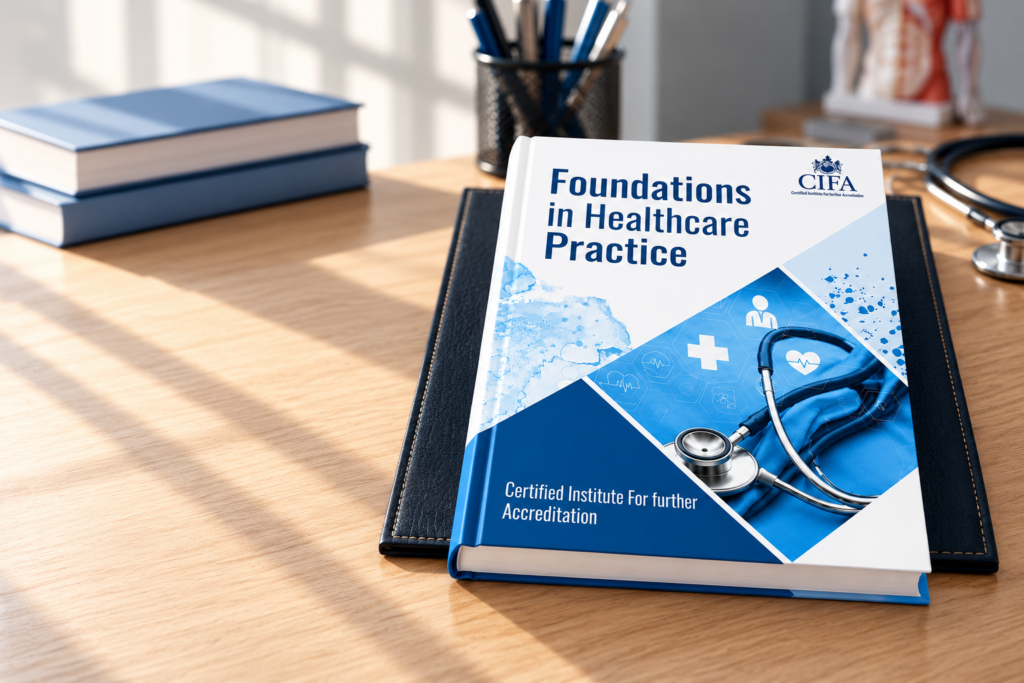
Safe healthcare practice depends on more than technical knowledge. Professional conduct, respectful communication, patient safety and accountability influence how individuals experience care and how healthcare teams work together. For people considering healthcare-related work, understanding these responsibilities is an important part of preparing for professional environments. The Foundations in Healthcare Practice course offered by CIFA introduces these principles through five structured chapters and 40 CPD hours of professional learning.
Healthcare organisations depend on people who recognise risks, respect individual needs, communicate appropriately and understand the limits of their responsibilities. These expectations are relevant not only to regulated clinical professionals but also to many people working in care, support and healthcare-related environments.
The programme explores professional conduct, evidence-based practice, emergency care awareness, compliance, patient safety, incident reporting and collaborative communication. Its purpose is to develop foundational knowledge and professional awareness rather than provide practical clinical authorisation.
For prospective learners, the distinction matters. Completing a CPD course can support professional development, but it does not replace a recognised clinical qualification, professional registration or employer-specific training. Understanding what the course teaches, what its certificate represents and how it may fit into a longer development plan can help learners make an informed decision.
The Foundations in Healthcare Practice course is an online professional learning programme provided by CIFA, designed to introduce essential principles associated with responsible healthcare practice.
The programme is listed as an Intermediate-level digital course delivered in English, with a published duration of 40 CPD hours. Its five chapters address professional responsibilities and the knowledge needed to understand safe, ethical and collaborative care.
The phrase Foundations in healthcare practice course describes its educational focus: developing awareness of how healthcare environments operate and what responsible professional behaviour involves.
Rather than concentrating on one specialist clinical discipline, the programme brings together subjects that influence practice across different healthcare settings. These include ethical conduct, evidence-based decision-making, accountability, risk prevention and communication.
For someone exploring healthcare-related employment, these topics may provide useful context before pursuing more specific training. Existing care and support staff may also find the subject matter relevant when reviewing professional responsibilities or identifying areas for continuing development.
However, the Intermediate designation should not be interpreted as proof of eligibility for a particular clinical position. Prospective learners should confirm any admission requirements directly with the provider.
The course also sits within continuing professional development, commonly called CPD. CPD refers to learning activities intended to maintain, update or extend professional knowledge and capabilities.
CIFA provides information about its educational services and institutional background through its about CIFA page. Learners should use the individual course description when determining which features and learning outcomes apply to this particular programme.
Importantly, understanding healthcare practice in an educational setting is different from being authorised to perform clinical duties. A learner may become more familiar with patient safety principles without acquiring the qualifications, supervised experience or registration required to practise as a regulated healthcare professional.
Professional behaviour is central to safe and respectful healthcare. Whether someone works directly with patients or supports a wider healthcare team, their decisions and interactions can affect trust, communication and the quality of the care environment.
The course introduces professional standards, ethical awareness and collaborative responsibilities as connected aspects of healthcare practice.
Professional conduct involves behaving responsibly, respecting confidentiality, maintaining appropriate boundaries and recognising when a situation requires advice or escalation.
Healthcare code of conduct training helps learners understand why these expectations matter. Healthcare workers may encounter sensitive personal information, individuals experiencing distress and situations where their decisions affect other people.
Responsible behaviour includes treating individuals with dignity, communicating truthfully, following relevant organisational procedures and avoiding tasks beyond one’s competence.
Confidentiality is particularly important. Information about a person’s health, circumstances or care should be handled according to applicable policies, legal requirements and professional responsibilities. Learning about confidentiality does not, by itself, establish competence in specialist information-governance procedures.
Duty of care in healthcare is another important principle. In practical terms, it concerns taking reasonable care within one’s responsibilities, recognising foreseeable risks and responding appropriately when concerns arise.
A support worker who notices a potential safety problem, for example, should understand the importance of following workplace procedures and raising concerns with an appropriate person rather than making unsupported clinical decisions.
Ethical awareness also involves recognising uncertainty. Healthcare situations are not always straightforward, and responsible individuals should know when to seek supervision or further information.
Readers interested in broader professional ethics can explore the professional integrity guide. This resource concerns financial regulation and professional integrity, so it should be treated as general professional-development reading rather than healthcare-specific regulatory guidance.
Communication affects how people understand information, express concerns and participate in decisions about their care.
A Healthcare communication skills course may help learners appreciate the importance of active listening, clear explanations, appropriate language and checking whether information has been understood.
In healthcare environments, communication is not simply about delivering instructions. It involves listening to individual concerns, recognising communication barriers and responding respectfully.
People may have different language preferences, levels of health literacy, sensory needs or personal circumstances. Healthcare workers should avoid assuming that everyone understands information in the same way.
Cultural awareness in healthcare encourages consideration of individual beliefs, values, preferences and experiences without stereotyping people according to their background.
Respectful practice means asking appropriate questions, recognising individual differences and using suitable communication support where available. A foundational course can introduce these principles, but it does not automatically establish specialist cultural competence.
Patient-centred care training focuses attention on the individual receiving care. It encourages respect for personal preferences, dignity, involvement and appropriate participation in decisions.
Collaborative care is equally important. Healthcare services frequently involve multiple professionals and support workers whose responsibilities differ. Effective teamwork depends on clear communication, accurate information-sharing and respect for professional boundaries.
For learners interested in expanding their knowledge, CIFA also provides a category of healthcare training courses that can be explored alongside the specific programme.
Patient safety is a shared concern across healthcare environments. Safe practice requires awareness of potential hazards, appropriate communication, adherence to procedures and a willingness to raise concerns.
The Foundations in Healthcare Practice course introduces these responsibilities through its chapters on compliance, accountability, patient safety and incident reporting.
Patient safety involves reducing avoidable harm and recognising circumstances that may place individuals at risk.
Someone researching a Patient safety course online may encounter topics such as risk awareness, safe working practices, escalation of concerns and the importance of following organisational policies.
Risk prevention begins with recognising that hazards can arise through communication failures, unclear responsibilities, incomplete information or unsafe working conditions.
For example, an individual who notices a potentially unsafe situation should understand the importance of reporting the concern through an appropriate workplace process.
The correct response depends on the person’s role, training and organisational responsibilities. Introductory learning should encourage safe judgement rather than independent action beyond competence.
Healthcare organisations also provide mandatory training and role-specific procedures. A CPD course does not replace these requirements or demonstrate that a learner can independently perform clinical tasks.
Incident reporting in healthcare is an important part of organisational safety and accountability.
An incident may involve an event that caused harm, while a near miss generally describes an event that could have caused harm but did not. Recognising both can help organisations identify problems and improve their systems.
Effective reporting involves identifying the concern, recording relevant facts accurately and communicating the information through the appropriate organisational process.
Records should be objective, timely and consistent with workplace requirements. Individuals should distinguish what they directly observed from assumptions or information received from others.
Urgent safety concerns may require immediate escalation rather than waiting for routine reporting arrangements.
There is no single incident-reporting procedure that applies identically to every NHS organisation, private healthcare provider or care service. Employers establish local processes according to their responsibilities and operating environments.
Learning about incident reporting therefore helps develop awareness of why reporting matters, while workplace training explains the specific steps an employee must follow.
The purpose is not simply to document mistakes. Reporting and reviewing incidents can contribute to organisational learning, risk reduction and improvements in care.
Compliance means working in accordance with applicable requirements, professional expectations and organisational policies.
For healthcare workers, this may involve maintaining appropriate records, respecting confidentiality, following established procedures and understanding the boundaries of their responsibilities.
The third chapter of the CIFA programme addresses healthcare compliance, professional accountability and continuous professional development.
Accountability includes recognising when additional guidance is needed. A person should not assume that familiarity with a topic gives them permission to perform an unfamiliar or restricted task.
CPD supports this approach by encouraging professionals to reflect on their knowledge and identify further learning needs.
The provider explains its broader CPD arrangements through CIFA CPD accreditation. CPD verification relates to professional learning and should not be confused with an academic degree, a regulated professional qualification or statutory registration.
The CIFA accreditation guide offers broader discussion of institutional recognition. It should not be interpreted as evidence that this healthcare programme grants clinical registration or approval to practise a regulated profession.
Different employers and professional bodies may have their own CPD requirements. Learners should check whether particular learning activities are acceptable for their role rather than assuming that CPD verification automatically satisfies every requirement.
Evidence-based practice is an important principle in modern healthcare because professional decisions should be informed by reliable information rather than assumptions alone.
It involves considering relevant research, appropriate professional knowledge, individual circumstances and applicable procedures.
For learners exploring healthcare practice, understanding this approach can help explain why guidance changes, why records matter and why healthcare workers should avoid relying exclusively on personal opinion.
The programme’s second chapter, Evidence-Based Clinical Practice and Emergency Care Management, introduces these connected subjects.
Evidence-based thinking also encourages reflection. When new information becomes available, healthcare professionals may need to reconsider established approaches, consult updated guidance or seek advice from appropriately qualified colleagues.
This is particularly relevant in environments where patient needs, organisational procedures and professional responsibilities interact.
Emergency care awareness is another part of the chapter. Emergencies require appropriate recognition, communication and action according to the circumstances and the individual’s responsibilities.
Foundational learning can introduce the importance of recognising urgent concerns and understanding escalation procedures.
However, studying emergency care management does not demonstrate practical emergency-response competence. It does not authorise someone to administer emergency treatment, perform clinical procedures or replace certified first-aid training where such training is required.
Actual emergency responsibilities depend on the person’s role, practical competencies, supervision and workplace arrangements.
CIFA presents this subject within a broader healthcare learning programme, not as a standalone qualification granting clinical emergency-care authority.
The structure of the Foundations in Healthcare Practice course brings several related areas of healthcare learning into one digital programme.
According to the published course information, it contains five chapters covering professional conduct; evidence-based clinical practice and emergency care management; compliance, accountability and CPD; patient safety, risk prevention and incident reporting; and communication, cultural awareness and collaborative care.
The programme is listed as Intermediate level, delivered in English, with 40 CPD hours marked as CPD verified.
Its published learning features include mock examinations for each chapter, lifetime portal access, a Certificate of Achievement following successful completion and passing the examination, and a Digital Profile.
These features may help learners organise their studies, revisit course material and document their completed learning.
For someone comparing a Healthcare CPD course online UK option, the combination of learning topics, study format, assessment information and published fees is worth reviewing carefully.
Mock examinations can provide opportunities to review learning and become familiar with questions associated with course material.
The course page confirms that a Certificate of Achievement is awarded after successfully completing and passing the examination.
However, the precise final examination format, pass mark, examination duration, resit charges and certificate issue timeline should be confirmed directly with CIFA before enrolment.
The provider also describes online proctored exams using facial-recognition technology across its examination services. Learners should confirm whether these arrangements apply to this particular healthcare course rather than assuming that all programmes use identical procedures.
Following successful certification, the provider maintains a facility where users can verify a CIFA certificate.
Certificate verification helps confirm an educational credential. It is not equivalent to checking whether an individual holds statutory registration with a healthcare regulator.
The published price for Foundations in Healthcare Practice is £499.
Prospective learners should compare the individual course page with the provider’s course fees and pricing information before purchasing.
The published price list also identifies a £72 additional study support package for this programme, separate from the £499 enrolment fee. Learners should confirm the package’s current availability, contents and whether they need it before purchasing.
Any examination-related charges, resits or optional services not clearly explained in the course-specific terms should be checked directly.
Learners who need help understanding the provider’s broader learning arrangements can consult CIFA student support resources, while confirming which support services are available for this particular programme.
A careful comparison should consider the curriculum, assessment conditions, certificate type, learning access and total potential cost rather than relying only on the headline course price.
Foundational healthcare education may support career exploration by helping learners understand the responsibilities, terminology and professional expectations associated with healthcare environments.
However, developing knowledge is different from meeting the recruitment or professional requirements for a particular position.
People researching Entry level healthcare jobs UK may encounter opportunities in healthcare support, care services and related environments.
Job titles and responsibilities vary considerably. Even positions with similar names can involve different duties, training expectations and safeguarding requirements.
Prospective applicants should read vacancy descriptions carefully and identify which qualifications, experience, checks and mandatory training are required.
A healthcare support role may have different requirements from a regulated nursing or allied health profession. Applicants should not assume that completing a general CPD course makes them eligible for either.
For regulated clinical careers, the appropriate route may involve recognised professional education and registration with a relevant body, such as the Nursing and Midwifery Council, General Medical Council or Health and Care Professions Council, depending on the profession.
CIFA provides professional education, not statutory healthcare registration. Its course may help learners become more familiar with healthcare principles, but employers determine recruitment eligibility according to their requirements.
Completed learning can be included on a CV when described accurately.
A learner who successfully completes the programme may identify its title, provider, documented CPD hours and relevant areas of study.
For example, they could describe learning related to patient safety awareness, professional conduct, communication and incident reporting.
It is important to distinguish educational knowledge from practical work experience. Completing a course about patient safety should not be described as independently managing clinical patient-safety procedures unless the person has genuinely performed those responsibilities.
The provider also offers a CIFA Digital CV tool for presenting professional information and learning achievements.
A digital profile can help organise relevant information, but it does not guarantee employer interest, an interview or a job offer.
The most useful next step depends on the learner’s intended career.
Someone interested in care support may need to investigate employer training expectations and suitable vacancies. A person seeking a regulated clinical career should begin by identifying the recognised educational and registration pathway for that profession.
Official professional regulators and prospective employers are more appropriate sources for confirming occupational eligibility than general course descriptions.
Learners can also explore related healthcare training courses to identify subjects relevant to their development goals.
For broader information about the provider’s educational catalogue, the guide to CIFA courses may offer additional context, although course-specific healthcare requirements should always take priority.
Before making a decision, learners should review current details through CIFA’s official website and the relevant individual course page.
Completing a healthcare CPD programme should be viewed as one stage in professional learning rather than the end of the development process.
A useful starting point is to review the subjects studied and identify which areas are most relevant to future responsibilities.
Someone interested in patient-facing support might decide to strengthen communication knowledge, while another learner may wish to understand workplace safety procedures or professional accountability in greater depth.
The next step is to compare those learning interests with actual role requirements. This helps distinguish knowledge that is useful from training or qualifications that an employer formally requires.
Learners should also maintain accurate records of completed education. Course certificates, documented learning hours and reflective notes can help explain professional development activities when appropriate.
Where practical competencies are necessary, further supervised training or workplace experience may be required. A CPD certificate alone does not establish competence in procedures that must be demonstrated in practice.
For regulated professions, learners should investigate the relevant recognised qualification and statutory registration route before investing in additional education.
CIFA can form part of a broader professional development plan through its healthcare learning offering, but that plan should be guided by the learner’s intended occupation, existing experience and actual professional requirements.
Understanding professional responsibilities is an important part of preparing for healthcare-related environments. The Foundations in Healthcare Practice course offered by CIFA brings together five connected learning areas: professional conduct, evidence-based practice and emergency care awareness, compliance and accountability, patient safety and incident reporting, and communication and collaborative care.
Its digital format, 40 CPD hours and structured chapter content may appeal to learners seeking a clearer understanding of responsible healthcare practice. Topics such as confidentiality, risk awareness, respectful communication and appropriate escalation can also provide useful context for continuing professional development.
Nevertheless, a CPD learning credential is not a replacement for a clinical degree, regulated professional qualification, practical competency assessment or statutory registration. Anyone considering nursing, medicine or another regulated healthcare profession must investigate the specific requirements of that pathway.
Before enrolling, prospective learners should compare the published curriculum, £499 course price, assessment arrangements and their own development goals. Those interested in the programme can visit the official Foundations in Healthcare Practice course page to review current information and decide whether it is appropriate for their learning needs.
The Foundations in healthcare practice course from CIFA is a CPD-verified digital programme introducing professional conduct, patient safety, accountability and communication. It provides 40 CPD hours of foundational healthcare learning. The course supports professional awareness but does not confer clinical qualifications or statutory registration.
CIFA organises the programme into five chapters covering professional conduct; evidence-based practice and emergency care awareness; compliance and accountability; patient safety and incident reporting; and communication and collaborative care. Learners researching a Patient safety course online can review these subjects within the published curriculum.
The CIFA programme may interest people exploring healthcare-related careers and existing care or support staff seeking professional development. Those comparing a Healthcare CPD course online UK option should review its Intermediate level and learning objectives. Completion does not guarantee eligibility for a particular healthcare job.
The published information reviewed does not clearly establish whether previous healthcare experience is required. Prospective learners should confirm current entry requirements directly with CIFA before enrolling. Those researching Entry level healthcare jobs UK should remember that course admission requirements and employer recruitment criteria are separate matters.
CIFA lists the programme as 40 CPD-verified hours, with mock examinations for each chapter and a Certificate of Achievement after successfully completing and passing the examination. Learners exploring Healthcare code of conduct training should confirm the final exam format, pass mark, proctoring arrangements and any resit fees directly with the provider.
The published price of the Foundations in Healthcare Practice course from CIFA is £499. A separate provider price list also identifies an optional additional study support package priced at £72. Prospective learners should check current fees and package details before purchasing, and confirm whether any examination-related, resit or other optional charges apply.
Yes. CIFA lists Foundations in Healthcare Practice as a digital programme delivered in English, with lifetime portal access among its published inclusions. This allows learners to access course material through the provider’s learning platform. However, prospective students should confirm access arrangements, assessment availability and any technical requirements directly before enrolling.
No. The Foundations in Healthcare Practice course from CIFA provides foundational CPD learning and does not itself award a regulated clinical qualification or professional registration. Nursing, medicine and other regulated healthcare professions have separate education and registration requirements. Learners must follow the recognised pathway for their intended profession.
The CIFA programme introduces professional conduct, accountability, patient safety, risk awareness, incident reporting, communication, cultural awareness and collaborative care. These are educational learning areas intended to strengthen professional understanding. Completing the programme does not independently demonstrate practical clinical competence or authorise regulated healthcare duties.
After completing the CIFA programme, learners can review their new knowledge, document relevant CPD learning and explore further healthcare education. They should compare potential roles with actual employer requirements and identify any necessary training, experience or qualifications. Regulated professions may also require statutory registration, and course completion does not guarantee employment.
CIFA is a trusted education provider specializing in finance and compliance training. We empower learners with practical knowledge, industry-relevant skills, and accredited courses designed to build strong careers in financial services, risk management, and regulatory compliance.
© CIFA 2020-2025 ALL RIGHTS RESERVED