
Choosing a compliance course is not simply a matter of finding a qualification with AML in its title. A prospective student needs to know what the programme actually teaches, whether it suits their existing experience, how it is assessed and whether the knowledge is relevant to the roles they want to pursue.
That is particularly important for people researching an ICAM course UK option as a route into anti-money laundering, financial crime prevention, regulatory work or broader compliance. Course completion can demonstrate structured professional development, but it is only one part of building a credible professional profile.
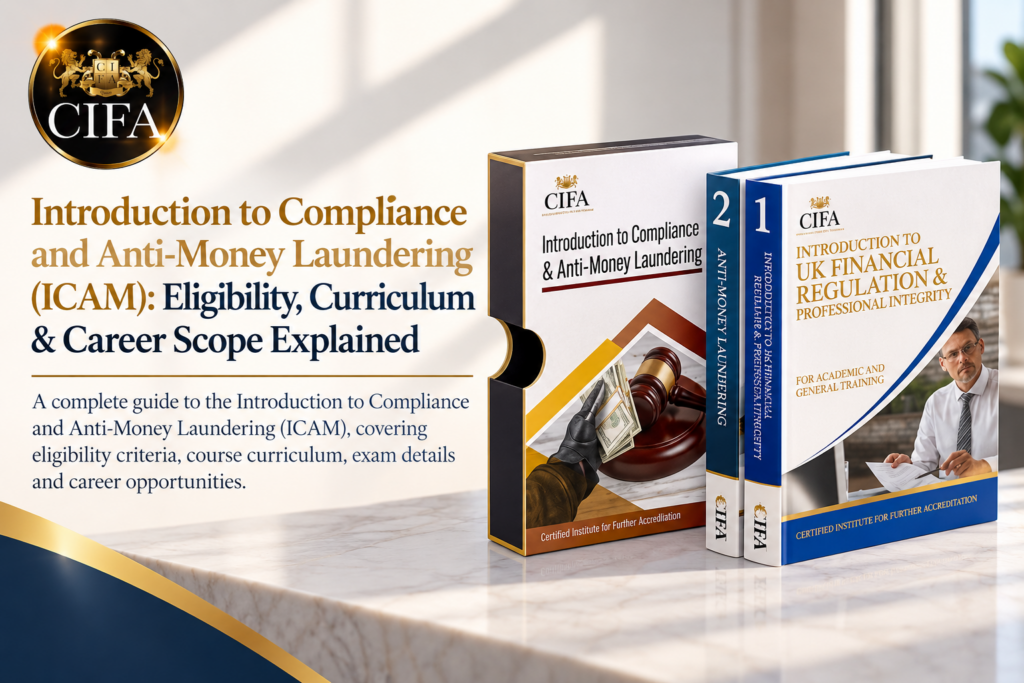
The Introduction to Compliance and Anti-Money Laundering (ICAM) offered by CIFA brings together financial regulation, professional integrity and anti-money laundering within a two-course bundle. Prospective learners can review the ICAM course bundle before enrolling to check the current structure and course information.
Understanding what those two areas contribute is the best place to start.
ICAM stands for Introduction to Compliance and Anti-Money Laundering. Rather than treating compliance solely as a collection of financial-crime rules, the programme combines knowledge of the wider UK regulatory environment with specific AML principles and procedures.
The bundle contains exactly two courses: Introduction to UK Financial Regulations and Professional Integrity and Anti-Money Laundering (AML). They perform different but complementary functions.
The first develops knowledge of the UK financial-services regulatory environment. CIFA’s curriculum covers subjects including professionalism and ethics, UK capital markets, risk, the roles of regulators, governance, financial crime regulation and conduct requirements. Someone comparing an ICAM course UK programme therefore needs to recognise that ICAM is broader than AML terminology alone.
The UK financial regulation module provides the regulatory and professional-integrity side of that foundation. It helps place compliance responsibilities within the environment in which financial organisations and professionals operate.
The second course focuses directly on anti-money laundering. Its published curriculum addresses AML, risk assessment, Customer Due Diligence, suspicious activity reporting, compliance programmes, sanctions, terrorist financing and developments in financial crime. For someone comparing an Anti-Money Laundering certification UK option, this distinction matters: AML is one of ICAM’s two constituent courses, not a third module or an interchangeable name for the whole bundle.
ICAM should also not be confused with CIFA’s Investment Advisor Certification. IAC is a separate programme with a different professional-development focus.
The value of compliance education becomes clearer when the terminology is connected to actual decision-making. Know Your Customer, Customer Due Diligence and Enhanced Due Diligence are related concepts, but they are not merely different labels for the same task.
KYC concerns understanding and verifying who a customer is. CDD places that information within a risk-based assessment, while EDD represents a higher level of scrutiny where the circumstances or risk profile justify additional examination. A useful KYC and AML training course should therefore help learners understand why information is gathered and how customer risk affects compliance decisions.
The Anti-Money Laundering (AML) module covers risk assessment and Customer Due Diligence alongside suspicious activity reporting, AML compliance programmes, sanctions and terrorist financing. The ICAM bundle information also identifies KYC and EDD among its learning outcomes.
Suspicious activity detection connects these concepts. A professional cannot respond appropriately to a warning sign without understanding the customer, the expected nature of the relationship and the risk surrounding it. Reporting procedures then provide a structured response when activity raises legitimate concerns.
This is also why a UK AML legal framework course cannot be considered entirely separately from wider regulatory understanding. Rules operate within governance structures, professional obligations and organisational controls. The regulatory course in ICAM addresses the FCA and PRA, governance, risk, financial crime regulation, competence and professional ethics.
ICAM additionally introduces financial reporting and analysis concepts. Its published learning outcomes include interpreting the balance sheet, income statement and cash flow statement, together with foundational budgeting, forecasting and financial analysis. This helps explain the relationship between financial information, governance and regulatory responsibilities rather than presenting AML as an isolated process.
For a learner seeking an AML compliance course online, the important question is therefore not how many technical expressions appear in a syllabus. It is whether the course helps build a connected understanding of customer risk, suspicious behaviour, reporting, regulation, integrity and financial information.
ICAM is positioned for a relatively broad group of learners. CIFA’s current bundle information identifies aspiring compliance professionals, entry-level finance and accounting staff, regulatory and risk assistants, AML analysts, KYC officers, career changers, business owners, operations and administrative teams, and legal support staff among the people who may find the programme relevant.
That makes it potentially useful for someone exploring Entry level compliance jobs UK, particularly when the candidate needs structured knowledge of terminology and regulatory concepts that may appear in job descriptions and interviews.
It may also be relevant to people asking How to become a compliance officer UK. However, taking a course and satisfying the recruitment criteria for a particular compliance vacancy are two different things. Employers can require relevant experience, technical knowledge, sector familiarity, communication skills, specific qualifications or evidence of competence beyond a single course.
Prospective learners should therefore assess ICAM against their own starting point. Someone already working in onboarding may be interested in strengthening AML and KYC knowledge. A finance employee may want more regulatory context. A career changer may need an organised introduction to concepts that are unfamiliar.
Before committing to a programme, it is sensible to compare ICAM with other CIFA compliance and professional courses and determine which curriculum most closely matches the intended career direction.
Eligibility to study should never be treated as evidence that a candidate automatically qualifies for a particular job. Course knowledge can support professional development; recruitment remains dependent on the requirements of the employer and role.
Assessment and certification deserve particular attention because terms such as course, certificate, accreditation and professional qualification can easily be treated as interchangeable when they are not.
CIFA’s current ICAM information states that learners receive a digital certificate after successfully passing the relevant exams and after the exam has been proctored. Its published course information also states that certifications have no expiry date. Students considering a Compliance officer certification UK option should understand exactly what certificate they will receive and should not interpret course completion as automatic eligibility for a regulated professional position.
The same caution applies to someone researching AML analyst certification. Knowledge of AML can strengthen a candidate’s professional development, but an employer will still assess the complete candidate against its own criteria.
CIFA describes its courses as accredited and provides CPD-related information through its course material. That is different from claiming that ICAM is a government-regulated qualification or universally recognised credential. Prospective students who require a particular form of recognition for an employer, professional body or career pathway should verify that requirement independently before enrolling.
Practical questions about examinations and certification can also be checked through the CIFA course FAQs rather than assuming that arrangements used by another education provider apply to ICAM.
At bundle level, the proposition is relatively straightforward. ICAM contains two courses, is listed as a digital product and has an approximate bundle duration of 200 hours. The current listed bundle price is £799.
Those figures are useful when comparing study options because they indicate both the financial commitment and expected learning commitment. However, price information can change. Anyone budgeting for enrolment should check CIFA course fees and pricing for the current amount and any separately listed examination or proctoring charges that may apply.
The two-course structure is also important when evaluating value. The regulatory component covers a substantial range of UK financial-services subjects, while the AML component focuses on financial-crime controls, risk assessment, CDD, reporting and related AML topics.
The approximately 200-hour figure should be treated as the published bundle duration rather than a promise that every student will complete the material in precisely the same amount of personal study time. Learning speed, prior knowledge and revision needs naturally differ.
ICAM is most directly relevant to career directions in which regulatory awareness, customer risk, financial crime prevention and professional conduct matter. Possible role areas include Compliance Officer, AML Analyst, KYC Officer, Risk Assistant and Regulatory Assistant, depending on the requirements of the vacancy and the candidate’s wider profile.
For an aspiring AML Analyst, understanding suspicious activity, CDD, risk assessment and reporting creates a stronger technical foundation than simply recognising AML terminology. Someone pursuing KYC work similarly benefits from understanding why identity verification, customer risk and enhanced scrutiny form part of a wider control environment.
Compliance roles can be broader. They may require an understanding of governance, regulatory expectations, conduct, risk and professional responsibilities alongside financial-crime controls. This is where ICAM’s combination of regulation and AML may be relevant to someone comparing a Compliance and risk management certification with a narrower financial-crime course.
An AML analyst certification or compliance course should nevertheless be viewed as evidence of learning rather than a substitute for experience. Employers may consider previous employment, transferable skills, qualifications, communication, judgement, technical competence and sector knowledge alongside certification.
CIFA also publishes indicative salary comparisons in the ICAM course context. For entry-level roles, it gives £22,000-£28,000 without AML certification and £25,000-£32,000 with certification, with an indicative uplift of £2,000-£5,000. For mid-level roles, the respective figures are £30,000-£40,000 and £38,000-£50,000, with an indicated £5,000-£10,000 uplift.
At senior or specialist level, the course information gives £45,000-£60,000 without a recognised AML qualification and £60,000-£90,000+ with AML certification plus experience, alongside an indicative £10,000-£25,000+ uplift.
These are figures supplied in CIFA’s course context, not independent UK-wide salary guarantees. Salary depends on factors including role, employer, location, sector, responsibilities, experience and the wider candidate profile. Completing ICAM does not guarantee any particular salary, promotion or job.
There is an important distinction between becoming more knowledgeable and becoming employable. Professional education can contribute to the second, but it does not create it automatically.
For candidates targeting Entry level compliance jobs UK, ICAM may provide evidence that they have deliberately studied UK financial regulation, professional integrity and AML rather than approaching the sector with no structured preparation. That can give them more relevant material to discuss in a CV, professional profile or interview.
A candidate asking How to become a compliance officer UK should think more broadly. Course study can form one part of a development plan that may also include relevant work experience, transferable skills, familiarity with the target sector, strong written communication, attention to detail and an understanding of the responsibilities described in actual vacancies.
The most useful approach is to connect learning to evidence. Instead of merely writing “completed AML training”, a candidate should understand the underlying concepts well enough to discuss CDD, EDD, suspicious activity, risk, professional integrity and the regulatory environment accurately.
CIFA’s Introduction to Compliance and Anti-Money Laundering overview can provide additional context when considering how the subject area relates to professional development.
Certification can strengthen a professional profile, but employers still decide whether a candidate meets the requirements of a particular vacancy. ICAM should therefore be treated as a learning credential rather than a promise of interviews or employment.
The current ICAM bundle is listed by CIFA as a digital product, and the associated course information supports online examination arrangements. That makes the programme relevant to learners who prefer digital study rather than relying exclusively on classroom attendance.
Online study can be particularly useful for people combining professional development with work or other commitments because it removes some geographical constraints. That is a general advantage of digital education, however, and should not be confused with unverified promises about specific timetables, tutor access, live teaching or other facilities.
Before enrolling, students should confirm the current learning resources, examination arrangements and any additional costs that matter to them. The CIFA courses, fees and examination guide provides useful context, while official course information should remain the primary source for current ICAM details.
A realistic study decision should also account for the approximate 200-hour bundle duration. Flexibility is useful only if the learner can allocate enough time to understand and retain the material.
ICAM makes the most sense when its two subjects align with the learner’s intended direction. Someone interested in AML, KYC, financial crime, compliance operations or regulatory support may find the combination directly relevant because it connects AML procedures with the wider regulatory and ethical environment.
Someone aiming specifically at investment advice, however, may need a different course pathway. CIFA’s Investment Advisor Certification (IAC) is a separate offering and should not be confused with ICAM. The appropriate choice depends on the knowledge required for the learner’s intended career direction.
The decision should therefore start with the target role rather than the course title. Examine current vacancies, identify recurring knowledge requirements and compare them with the curriculum. If AML, CDD, KYC, suspicious activity, regulation and professional integrity repeatedly appear, ICAM may warrant closer consideration.
For learners whose target work is centred on investment advice instead, the IAC salary, job roles and career growth guide provides a clearer comparison with that separate pathway.
Neither course should be treated as universally better. They address different development needs.
ICAM is a two-course bundle built around Introduction to UK Financial Regulations and Professional Integrity and Anti-Money Laundering (AML). Together, the subjects connect the wider regulatory environment with practical AML concepts including risk assessment, CDD, KYC, EDD, suspicious activity and reporting.
It may be relevant to aspiring compliance professionals, finance and accounting staff, regulatory and risk assistants, AML and KYC candidates, career changers and others who need a structured introduction to compliance knowledge. Its career value should nevertheless be assessed alongside experience, existing qualifications, transferable skills and the requirements of specific employers.
Assessment and certification also need to be understood precisely. CIFA states that successful candidates receive a digital certificate after the examination and proctoring process, while its current course information says certifications do not expire. Those statements should not be expanded into unsupported claims of universal or governmental recognition.
Before enrolling, prospective students should check the current ICAM course bundle, confirm the latest price and assessment arrangements, and compare the curriculum with the roles they actually intend to pursue. That provides a far stronger basis for deciding whether ICAM is the right professional-development investment.
ICAM is CIFA’s two-course bundle combining Introduction to UK Financial Regulations and Professional Integrity with Anti-Money Laundering (AML). It is designed to build knowledge of regulation, professional conduct and financial-crime controls. Students researching an ICAM course UK can review the official ICAM course bundle for current details.
ICAM connects UK financial regulation and professional integrity with AML principles. Its published learning areas include risk assessment, CDD, KYC, EDD, suspicious activity, reporting and financial information. It therefore covers subjects relevant to a KYC and AML training course while placing financial-crime controls within a wider compliance setting.
CIFA identifies aspiring compliance professionals, entry-level finance staff, AML and KYC candidates, regulatory and risk assistants, career changers and several related groups as potential learners. Those exploring Entry level compliance jobs UK can compare ICAM with CIFA’s professional course options, while remembering that enrolment does not guarantee employment.
The current ICAM information positions the programme for aspiring professionals, entry-level staff and career changers as well as people already working in related areas. It does not mean every compliance job has the same entry requirements. Candidates asking How to become a compliance officer UK should separately check the experience and qualification criteria of target vacancies.
KYC focuses on establishing and understanding customer identity, while due diligence assesses information and risk surrounding the relationship. EDD involves greater scrutiny where higher-risk circumstances justify it. CIFA’s AML curriculum places these concepts within risk-based compliance; the AML course curriculum shows the wider AML context.
Knowledge developed through ICAM may be relevant to roles such as AML Analyst, KYC Officer, Compliance Officer, Risk Assistant and Regulatory Assistant, depending on the vacancy. A Compliance and risk management certification can support professional development, but employers still assess experience, qualifications, communication, technical knowledge and role-specific requirements.
CIFA describes its courses as accredited and states that its certificates have no expiry date, but students should not interpret that as a claim that ICAM is a government-regulated or universally recognised qualification. Anyone needing a particular recognition status should confirm it for their intended purpose and consult the CIFA course FAQs before enrolling.
The published CIFA information states that the digital certificate is issued after successful examination and completion of the proctoring process. Someone considering a Compliance officer certification UK should check the current examination requirements, fees and arrangements before enrolment through the FCA and PRA investment risks overview and official course information.
ICAM is currently listed as a digital product, and CIFA’s published information supports online examination arrangements. This makes it suitable for learners seeking an AML compliance course online format. Students should still confirm current learning resources, assessment arrangements and any additional charges rather than assuming that features offered by other online programmes also apply to ICAM.
ICAM can provide structured evidence of study in regulation, professional integrity and AML, helping candidates discuss CDD, KYC, EDD, risk and suspicious activity more confidently. For someone considering AML analyst certification, this can strengthen professional development, but it does not guarantee an interview, job, promotion or salary increase; employers assess the complete candidate.
CIFA is a trusted education provider specializing in finance and compliance training. We empower learners with practical knowledge, industry-relevant skills, and accredited courses designed to build strong careers in financial services, risk management, and regulatory compliance.
© CIFA 2020-2025 ALL RIGHTS RESERVED