Preparing for the International English Language Testing System (IELTS) can feel challenging when you are unfamiliar with the examination. You may need to understand four different language skills, identify the correct test type, learn how band scores work and decide which preparation resources will help you improve.
Choosing an IELTS Course Online can provide a structured approach, but effective preparation involves more than completing lessons. You need to understand the examination, practise relevant tasks, recognise weaknesses and learn from mistakes.
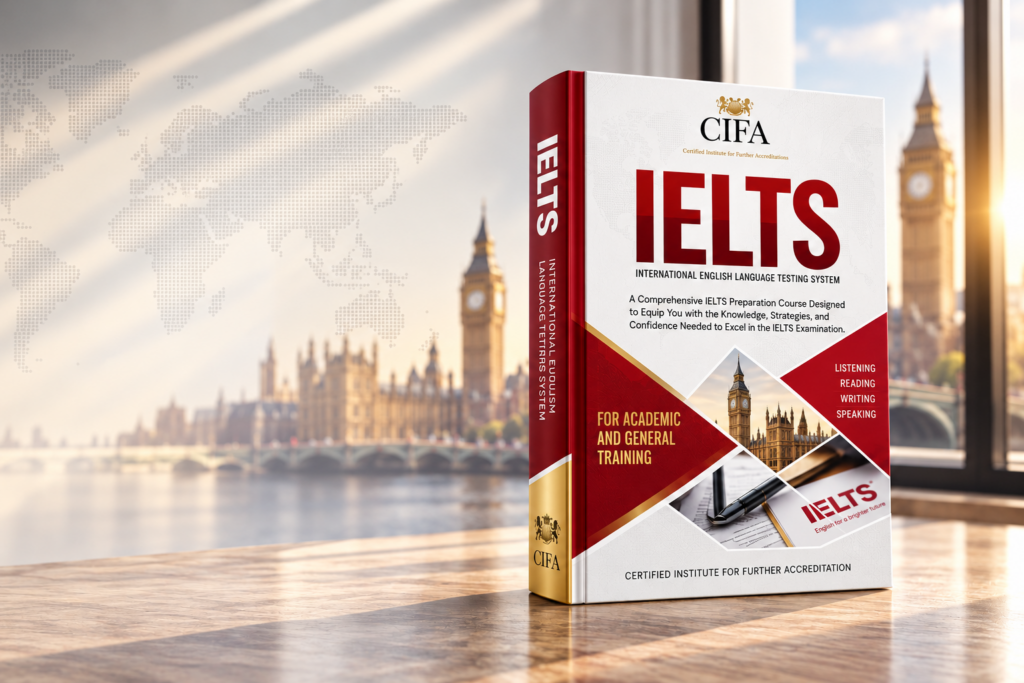
For learners exploring digital preparation, CIFA offers an online IELTS preparation course listed at Beginner level. Its published price is £358, and its curriculum covers Listening, Reading, Writing and Speaking through video lessons, practice tests and chapter-level mock examinations.
This guide explains the IELTS examination, the difference between Academic and General Training, scoring, practical preparation methods and the published CIFA course features. It also clarifies how preparation courses differ from official IELTS testing, helping you make an informed decision before enrolling or booking an examination.
IELTS stands for the International English Language Testing System. It is an English-language proficiency examination used by organisations to assess whether applicants can understand and communicate effectively in English.
Universities may request IELTS results when assessing international applicants for degree programmes. Some professional bodies and employers also consider English-language evidence when evaluating candidates. Certain immigration authorities accept or require specific IELTS examinations for particular visa or migration routes.
However, IELTS is not compulsory for every university, employer or immigration application. Requirements vary according to the receiving organisation, programme, country and application category. Before beginning preparation, candidates should check whether IELTS is accepted or required and which test version and score they need.
The examination assesses four skills: Listening, Reading, Writing and Speaking. Together, these measure how candidates understand spoken and written English and how effectively they communicate their own ideas.
An IELTS course for beginners can introduce these skills systematically, helping first-time candidates understand the examination and identify areas requiring improvement.
Not everyone begins at the same level. Some learners already communicate confidently in English but need experience with examination tasks and time limits. Others may need to strengthen grammar, vocabulary, comprehension or spoken fluency before attempting demanding IELTS questions.
Understanding your starting point is important because examination techniques cannot replace general language ability. A learner who struggles to understand everyday conversations, for example, may benefit from developing listening comprehension before concentrating heavily on timed practice papers.
The purpose of preparation is therefore twofold: improve your English proficiency and learn to demonstrate that proficiency under examination conditions.
Understanding the IELTS exam format is one of the first steps towards effective preparation.
IELTS has two principal versions: Academic and General Training. Both assess Listening, Reading, Writing and Speaking, but their purposes and some examination tasks differ.
IELTS Academic is generally associated with higher education and certain professional registration requirements. IELTS General Training is commonly used for particular migration, employment or training purposes where the receiving organisation accepts it.
The Listening and Speaking components follow the same broad structure across both versions. Reading and Writing, however, contain different materials and tasks.
The Listening component assesses comprehension of spoken English, including conversations and other recordings. Candidates must follow information, recognise meaning and answer questions accurately.
Reading assesses the ability to understand written passages, identify important information and interpret ideas. Academic Reading generally uses texts suited to an academic context, whereas General Training includes more everyday, workplace and general-interest materials.
Writing requires candidates to complete two tasks. Academic Writing Task 1 involves describing or summarising visual information, while General Training Task 1 requires a letter. Both versions include an essay task, although the contexts and assessment expectations should be understood carefully.
Speaking assesses oral communication through an interview-style examination. Candidates answer familiar questions, speak at greater length on a topic and discuss broader ideas with an examiner.
For learners searching for IELTS band score explained, the essential point is that IELTS reports English proficiency on a scale from 0 to 9.
Higher bands indicate stronger demonstrated proficiency. The scale includes whole and half bands, and candidates receive individual scores for Listening, Reading, Writing and Speaking.
An overall band score is calculated from the four component scores according to official IELTS rounding rules.
For example, a candidate might demonstrate stronger Reading skills than Writing skills. Their result would show this difference through individual component bands rather than reporting only one overall score.
There is no universal IELTS pass mark. A university might require a particular overall band together with minimum individual component scores. An immigration route or professional body may apply different requirements.
Candidates should therefore identify their actual target before planning their studies.
Practice-test results are also different from official IELTS scores. A preparation exercise can highlight strengths and weaknesses, but it does not establish an official band result.
Only an official IELTS examination produces the recognised IELTS result. Completing a CIFA preparation course or receiving its Certificate of Achievement does not replace that examination.
For additional preparation advice, learners can consult the IELTS preparation guide 2026, while checking current examination arrangements directly with official IELTS providers.
The CIFA digital IELTS preparation course is organised around the four skills assessed in IELTS.
Its published curriculum contains three chapters for each skill, making twelve chapters altogether. The course is listed at Beginner level and uses video-based learning with associated practice materials.
This structure may help learners divide preparation into manageable topics rather than attempting every skill simultaneously.
The Listening component of the CIFA curriculum contains three chapters: “Getting Ready to Listen”, “Following a Conversation” and “Recognising Paraphrase”.
“Getting Ready to Listen” introduces a foundation for approaching spoken information. Learners can develop the habit of considering context, anticipating the type of information required and paying attention to important details.
“Following a Conversation” addresses understanding communication between speakers. In IELTS preparation, this is useful because candidates may need to follow changing topics, identify specific details or recognise what speakers mean rather than simply hearing individual words.
“Recognising Paraphrase” concerns a particularly important comprehension skill. Speakers may communicate an idea using different vocabulary from the wording of a question.
For example, a recording might describe something as “reasonably priced”, while a question refers to it as “affordable”. Recognising that these expressions communicate a similar idea can support accurate comprehension.
Effective IELTS listening practice involves reviewing mistakes rather than merely checking the number of correct answers.
After completing an exercise, learners should identify whether an incorrect response resulted from unfamiliar vocabulary, missed information, misunderstanding or difficulty recognising paraphrased meaning.
Listening again and comparing answers with the available material can help reveal recurring weaknesses.
The Reading curriculum includes “Reading Strategies”, “Descriptive Passages” and “Understanding the Main Ideas”.
These chapters address important aspects of reading comprehension, including understanding the overall meaning of a passage and locating relevant information.
Useful IELTS reading strategies include skimming to understand the general subject and scanning to find particular facts, names or details.
However, neither technique should replace careful reading when a question requires interpretation.
Candidates should learn to distinguish a writer’s main argument from examples, explanations and supporting evidence. They should also practise recognising when a question expresses information differently from the original passage.
For instance, a passage might describe how transport improvements reduced journey times, while a question asks about increased travel efficiency. Answering correctly requires understanding the relationship between these ideas.
Learners should review not only whether an answer was correct but also where the supporting evidence appeared in the passage.
Timed practice becomes useful once candidates understand the question types. It helps them balance speed with comprehension and avoid spending excessive time on individual questions.
The most effective approach combines general reading development, accurate interpretation and familiarity with the relevant Academic or General Training materials.
The CIFA Writing curriculum contains “Writing a Letter”, “Getting Ready to Write” and “Expressing Your Ideas Clearly”.
These topics address written communication, preparation and the organisation of ideas.
“Writing a Letter” is particularly relevant to letter-writing skills, although learners should not assume that this chapter alone establishes complete coverage of either IELTS test version.
“Getting Ready to Write” suggests the importance of understanding a task before beginning a response. Candidates should identify what the question requires, consider the relevant information and plan a suitable structure.
“Expressing Your Ideas Clearly” addresses a central feature of effective writing: communicating ideas logically and understandably.
Productive IELTS writing practice should focus on task relevance, organisation, vocabulary, grammar and clarity.
Learners can begin by planning a response, writing under realistic conditions and reviewing whether every paragraph contributes to the question.
For essay tasks, a clear argument supported by relevant explanations is generally more useful than memorising complete responses that may not fit the actual question.
Writing practice should also include reviewing sentence construction, paragraph transitions and unnecessary repetition.
Importantly, Academic and General Training Writing have different Task 1 requirements. Candidates should confirm how closely the CIFA course materials match their intended examination before enrolling.
The Speaking curriculum includes “Speaking Skills”, “Giving a Talk” and “Talking About Abstract Topics”.
These chapters address different aspects of oral communication.
“Speaking Skills” provides a foundation for developing spoken responses. “Giving a Talk” is relevant to explaining a topic in a sustained, organised manner, while “Talking About Abstract Topics” concerns discussing ideas that require reasoning and explanation.
Effective IELTS speaking practice involves more than learning vocabulary or rehearsing familiar questions.
Candidates should practise answering naturally, explaining their opinions and supporting their responses with relevant examples.
For instance, when discussing education, a learner might explain why a particular learning method is useful rather than simply stating that it is good.
Recording spoken responses can help identify unclear pronunciation, excessive hesitation, repetition and poorly organised answers.
Learners should also consider whether they have answered the question directly and developed their explanation appropriately.
Memorising complete answers is not a dependable preparation strategy because examination questions may require candidates to respond to unfamiliar wording or discuss unexpected subjects.
Regular conversation, self-recording and thoughtful review can support clearer communication.
Overall, the four-skill structure of the CIFA curriculum gives beginners an organised starting point. However, preparation should still reflect individual ability, target scores and the correct IELTS test version.
Understanding How to prepare for IELTS begins with assessing your current English ability and identifying your intended examination.
Before purchasing a course or booking a test, consider why you need IELTS, which version is required and what score your receiving organisation expects.
A diagnostic exercise covering all four skills can help identify your starting point. It need not be treated as an official score prediction. Its purpose is to show which tasks feel manageable and which require further development.
Next, familiarise yourself with the official examination structure. Review the question types, task requirements, timing and assessment criteria for your chosen test version.
A structured IELTS preparation course online may help organise this process, particularly when lessons and practice exercises follow a clear sequence.
However, learners should also use suitable official preparation materials to understand the actual examination.
A useful routine combines learning, practice and review.
For example, a learner might begin a study session by watching a lesson about recognising paraphrases. They could then complete the associated listening exercise, examine incorrect answers and repeat selected questions to understand the difficulty.
During another session, they might practise reading a passage, identifying its main idea and locating supporting information.
Writing sessions can involve planning an answer, producing a response and reviewing its relevance and organisation. Speaking sessions might involve recording an explanation of a familiar topic and identifying opportunities to improve clarity.
The aim is not necessarily to complete every skill every day. Instead, learners should maintain balanced preparation while giving additional attention to weaker areas.
IELTS mock tests online can help candidates become familiar with examination-style tasks and assess progress.
The published CIFA curriculum includes practice tests associated with individual chapters and mock examinations for each chapter.
These resources can help learners check their understanding of specific topics before moving forward.
Nevertheless, chapter-level assessments should not automatically be treated as equivalent to complete official IELTS practice examinations.
Candidates should supplement course exercises with appropriate full-length materials when they need to practise overall examination timing and transitions between tasks.
After completing a mock exercise, review the answers carefully. Identify recurring problems, such as misunderstanding instructions, missing important details or struggling to organise written responses.
An error record can be particularly helpful. Rather than simply writing down a score, note what went wrong, why it happened and what you intend to practise next.
This turns assessment into a learning activity.
Progress is rarely identical across all four skills.
A candidate might improve their reading accuracy quickly but require more time to develop confident spoken responses.
Reviewing performance over several practice sessions can reveal whether difficulties are becoming less frequent.
Avoid assuming that one strong mock-test result guarantees the same outcome in the official examination.
The appropriate preparation period depends on your existing English proficiency, target band, available study time and examination date.
Learners exploring the provider’s wider educational information can read about CIFA student support. Any additional support services, costs or availability should be confirmed directly rather than assumed to be included in the IELTS course.
The most sustainable preparation plan is one that allows sufficient time to understand mistakes, revisit difficult concepts and develop genuine English-language confidence.
The published CIFA IELTS preparation course is a digital learning product delivered through an online portal.
It is listed at Beginner level, with English as the course language and a price of £358.
The curriculum covers twelve chapters across Listening, Reading, Writing and Speaking. Each chapter includes a video lesson and an associated practice test, while the course listing also specifies chapter-level mock examinations.
Additional published features include lifetime portal access and a Digital Profile.
A Certificate of Achievement is available after successful completion and passing of the relevant CIFA course examination.
This certificate represents the provider’s course-completion requirements. It is not an official IELTS Test Report Form and does not establish an official IELTS band score.
The £358 published price applies to the preparation course, not the official IELTS examination.
Prospective learners should review the current CIFA course fees and the individual course listing before making payment.
The provider’s price list also separates course enrolment charges from its own examination fees. Learners should confirm which additional assessments or charges apply to their chosen course.
Information about the CIFA online examination process explains the provider’s remote assessment arrangements. These arrangements should not be confused with official IELTS examination booking.
For enrolment procedures, general assessment information and platform questions, learners can consult the CIFA student FAQs.
Begin by reviewing the full curriculum and identifying whether its topics address your learning needs.
Next, confirm whether the available teaching and practice materials are suitable for IELTS Academic or General Training, depending on your intended examination.
Although the course description discusses IELTS preparation broadly, learners with specific test-version requirements should confirm the exact coverage with the provider.
Compare the lessons, assessment arrangements, published price and available learning resources before deciding whether to enrol.
If the course meets your requirements, registration can be completed through the official course listing, subject to the provider’s current enrolment arrangements.
Once enrolled, follow a manageable study routine and use the chapter assessments to identify areas requiring further attention.
The official IELTS examination must be booked separately.
Depending on your location and intended test, official booking options may be available through IELTS, the British Council or IDP.
Before booking, confirm the appropriate examination version, accepted test type, current fee, available dates, location or delivery arrangements and identification requirements.
Some applicants may need a particular IELTS examination for immigration or professional purposes. Always follow the instructions issued by the receiving authority rather than assuming that any IELTS booking will be acceptable.
Neither the CIFA preparation-course fee nor its Certificate of Achievement should be treated as payment for, or completion of, the official IELTS examination.
English-language learning can continue beyond IELTS preparation, particularly when learners have broader educational or career goals.
For those seeking additional language development, the CIFA English courses category provides a starting point for reviewing the provider’s current English-related offerings.
However, not every English-language course is designed for IELTS preparation. Learners should compare the curriculum and intended outcomes of each option.
Another pathway is teaching English as a foreign language.
The online TEFL diploma course addresses a different educational objective from IELTS preparation. TEFL relates to teaching English, whereas IELTS preparation focuses on developing and demonstrating English-language proficiency.
Readers interested in exploring English teaching can consult the TEFL course guide and TEFL course FAQs, subject to checking that these articles remain available.
These resources concern a separate teaching-related pathway and should not be mistaken for official IELTS examination guidance.
When comparing qualifications, the CIFA courses and fees guide offers further context about course selection, fees and assessment considerations.
Learners should always evaluate the purpose, curriculum, recognition, assessment requirements and total cost of the particular course they are considering.
Current provider information can be checked through CIFA’s official website, while CIFA’s wider learning articles provide another potential source of educational reading where the article directory is accessible.
Completing IELTS preparation does not, by itself, qualify someone to teach English or provide an alternative professional qualification.
Selecting an appropriate preparation course depends on what you need to learn, not simply on how many features a provider advertises.
Begin by considering your current English level. If you struggle with basic comprehension or communication, additional general English development may be necessary alongside examination preparation.
Next, identify your intended IELTS version and required score. These requirements should guide your choice of learning materials.
Consider which skills need the most attention. A learner who communicates confidently but struggles with written organisation may benefit from a different balance of practice than someone who finds spoken English difficult.
The CIFA course offers a Beginner-level digital curriculum organised around all four skills. Its published features include chapter-level video lessons, practice tests, mock examinations, lifetime portal access and a Digital Profile.
A Certificate of Achievement is available subject to successfully completing and passing the relevant course examination.
These features may appeal to learners who prefer an organised learning sequence and the flexibility of online study.
However, candidates should verify whether the actual materials match their intended Academic or General Training examination. They should also confirm any additional assessment fees or support arrangements before purchasing.
An effective course should help you develop skills and understand examination tasks, but no preparation provider can guarantee a particular IELTS band score, university admission or immigration outcome.
If the curriculum appears suitable, review the official course listing and current price, then compare the offering with your personal preparation needs.
Successful IELTS preparation begins with understanding the examination, identifying the correct test version and developing a realistic learning routine.
Candidates should practise Listening, Reading, Writing and Speaking consistently, review mistakes carefully and monitor their progress without treating informal practice results as official scores.
The CIFA digital IELTS course is one structured preparation option, with a published four-skill curriculum, chapter-level exercises and online learning access.
Before enrolling, confirm the current course details, fees and suitability for your intended IELTS examination.
Most importantly, remember that preparation and official testing are separate processes. Develop your English skills, practise with appropriate materials and book the official IELTS examination through an authorised provider when you are ready.
IELTS assesses Listening, Reading, Writing and Speaking for study, certain employment pathways and migration applications. Requirements depend on the institution or authority receiving your results. CIFA offers an IELTS course for beginners covering all four skills. Review its online IELTS preparation course to understand the curriculum before deciding whether it suits your needs.
The IELTS exam format includes Listening, Reading, Writing and Speaking. Listening and Speaking follow the same broad structure in Academic and General Training, while Reading and Writing differ. CIFA provides preparation materials across the four skills. Its IELTS preparation guide 2026 offers further study advice, but candidates should confirm current rules with official IELTS providers.
IELTS Academic is generally used for higher education and certain professional requirements. General Training may be accepted for specific work or migration purposes. Choosing an IELTS preparation course online requires checking which version you need. CIFA provides general enrolment information through its CIFA student FAQs, but learners should confirm the course’s exact test-type coverage before enrolling.
IELTS uses a band scale from 0 to 9, reporting individual scores for Listening, Reading, Writing and Speaking alongside an overall band. The score required depends on the receiving organisation. For IELTS band score explained, remember that practice results are not official scores. CIFA lists preparation charges under CIFA course fees, which are separate from official IELTS test fees.
CIFA offers a Beginner-level digital course covering Listening, Reading, Writing and Speaking through three chapters per skill. The listing includes video lessons, practice tests, chapter mock exams, lifetime portal access and a Digital Profile. For an IELTS course for beginners, compare these features with your needs. The CIFA English courses category shows related offerings with potentially different learning objectives.
The CIFA IELTS preparation course is listed at Beginner level and delivered in English through a digital learning portal. Its twelve chapters cover four language skills, with video lessons and associated practice exercises. As an IELTS course for beginners, it may suit learners seeking structure. However, candidates should assess their English ability and confirm whether the materials match their intended IELTS test type.
The published CIFA IELTS preparation course price is £358. This covers the listed digital preparation product and should not be confused with the official IELTS examination fee. Learners comparing an IELTS preparation course online should check the current course listing, confirm what is included and ask about any separate provider assessment charges before enrolling. Official IELTS booking is separate.
Yes. The CIFA course listing specifies a video lesson and practice test for each chapter, together with chapter-level mock examinations. These resources can help learners review topics and identify weaknesses. When using IELTS mock tests online, remember that course assessments are preparation activities, not official IELTS examinations. Candidates should also practise with suitable official test materials.
No. The CIFA Certificate of Achievement is available after successfully completing the course and passing the relevant provider examination. It is not an official IELTS Test Report Form and does not establish an IELTS band score. For IELTS band score explained, candidates should distinguish course assessments from recognised test results. Official IELTS scores are issued through the authorised examination process.
After studying with CIFA, candidates must book the official IELTS examination separately through an appropriate official route, such as IELTS, the British Council or IDP. Before booking, confirm the correct test type, current fee, available dates, location and identification requirements. An IELTS course for beginners can support preparation, but completing it does not automatically register you for the official test.
CIFA is a trusted education provider specializing in finance and compliance training. We empower learners with practical knowledge, industry-relevant skills, and accredited courses designed to build strong careers in financial services, risk management, and regulatory compliance.
© CIFA 2020-2025 ALL RIGHTS RESERVED