Choosing mortgage-related training requires more than finding a course with a relevant title. Anyone considering a career in UK mortgage advice needs to understand what a programme teaches, how its certification is positioned, and whether it meets the requirements of the role they eventually want to undertake.
Mortgage Advisor Certification (MAC) from CIFA brings together mortgage-specific learning, UK financial regulation and broader financial knowledge. It offers a structured route into understanding important concepts, but professional-development certification and permission to provide regulated mortgage advice are not the same thing.
Before enrolling, prospective students should examine the Mortgage Advisor Certification bundle, consider their existing experience and identify the qualifications expected by prospective employers. The distinction matters particularly for beginners who may be comparing MAC with CeMAP or other established UK mortgage-advice qualifications.
This article explains the programme’s three components, the people it may suit, the regulatory context and the career opportunities that mortgage-related education can help individuals explore.
Mortgage Advisor Certification (MAC) is a professional-development programme offered by CIFA through its digital learning platform. Its purpose is to develop understanding across mortgage advice, financial regulation, professional conduct, investment principles, risk and taxation.
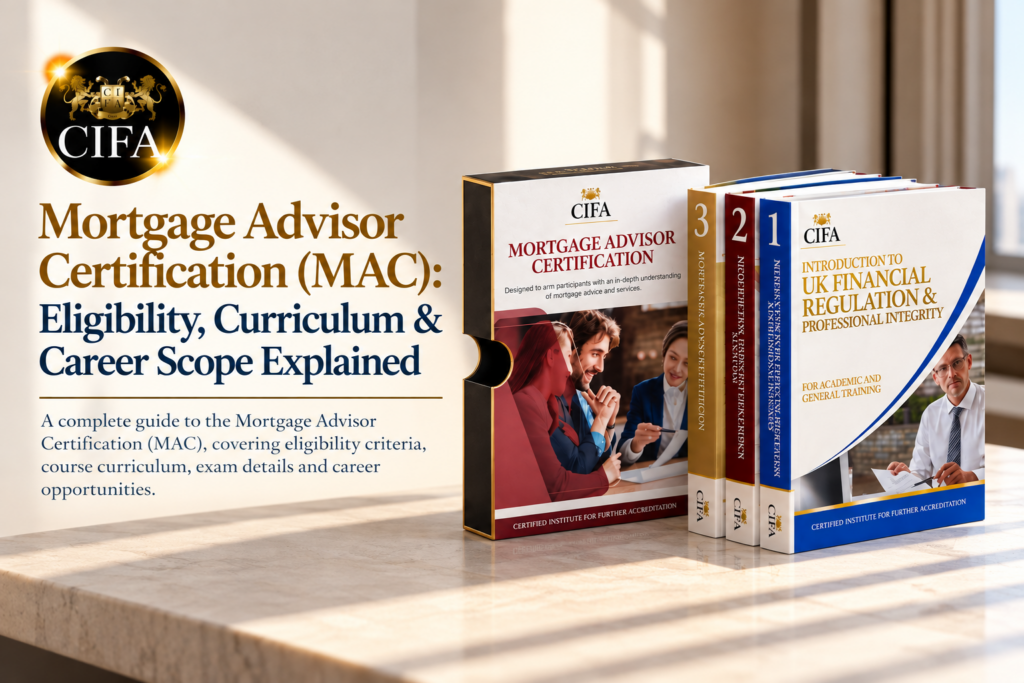
The programme combines three courses: Mortgage Advice, Introduction to UK Financial Regulation & Professional Integrity, and Introduction to Investment, Risk and Taxation.
According to the programme listing, the bundle contains three courses, has a stated duration of 415 hours and is offered as a digital product. This makes it relevant to people who want to organise their learning around existing professional or personal commitments.
The combination is significant because mortgage-related work involves more than recognising different loan products. Professionals also encounter affordability questions, customer circumstances, regulatory expectations, financial risks and ethical responsibilities.
However, the scope of MAC should be understood correctly. It provides structured education and certification rather than automatically establishing eligibility to undertake every regulated mortgage-advice activity.
Someone comparing a Mortgage broker course UK with broader finance training should therefore establish whether the programme is intended for professional development, preparation for an occupational qualification, or both.
The three-course structure gives the programme both mortgage-specific and wider financial-services coverage. Each component contributes a different perspective, although they should not be mistaken for three separate specialist mortgage qualifications.
Mortgage Advice is the component most directly connected to mortgage-sector work.
The mortgage advice course introduces the mortgage process, mortgage lending, the mortgage industry, elements of mortgage advice and mortgage solutions.
Understanding mortgage products involves recognising how borrowing arrangements differ and why one option may be more appropriate for a particular customer’s circumstances than another. Interest rates, repayment structures, borrowing terms and lender criteria can all influence a mortgage decision.
Lending criteria are equally important. Mortgage applications involve assessments of income, expenditure, existing commitments and other circumstances relevant to a lender’s decision. A prospective adviser needs to appreciate that obtaining a mortgage is not simply a question of finding an attractive advertised rate.
The application process also introduces practical considerations, including the collection of information, documentation, communication with lenders and the importance of accurate records.
For people exploring a Mortgage advisor course UK, this subject provides useful context for understanding how mortgage advice fits into the wider lending process.
Financial-services professionals operate within a regulatory environment designed to protect consumers, support market integrity and establish standards of conduct.
The UK financial regulation and professional integrity module introduces this wider environment, including regulatory responsibilities, professional integrity and ethical behaviour.
The Financial Conduct Authority (FCA) regulates the conduct of financial-services firms and markets within its remit. The Prudential Regulation Authority (PRA), part of the Bank of England, is responsible for the prudential regulation of certain financial institutions, including banks and building societies.
These organisations have different responsibilities, but both form part of the UK financial regulatory framework.
Professional integrity concerns how individuals behave when handling customer information, explaining products, managing conflicts of interest and making decisions that may affect consumers financially.
Regulatory education also provides context for compliance, competence, complaints handling, redress arrangements and financial crime prevention. The FCA’s Conduct of Business Sourcebook (COBS) covers conduct requirements for relevant investment business, while mortgage business has its own specific rules.
Readers seeking further background can consult the UK financial regulation and professional integrity guide.
The third component broadens the programme beyond mortgage lending.
The investment risk and taxation module introduces financial concepts such as investment principles, risk and return, diversification, asset allocation, investment products and taxation considerations.
Investment risk concerns the possibility that actual financial outcomes will differ from expectations. Different products carry different combinations of market, credit, liquidity and other risks.
Diversification involves spreading exposure across investments rather than relying excessively on one asset or source of return. Asset allocation concerns how investments are distributed between different asset classes according to objectives and risk considerations.
Taxation is another important part of financial decision-making. The tax treatment of investments and financial arrangements can influence planning decisions, although specific tax outcomes depend on individual circumstances and current legislation.
Portfolio construction and review introduce the idea that financial decisions require ongoing assessment rather than a single initial choice.
The subject is explained further in investment risk and taxation explained.
This is broader financial education, not a dedicated mortgage module. Its relevance lies in helping professionals appreciate the wider financial circumstances in which borrowing decisions take place.
The main value of studying these subjects together is the opportunity to understand how mortgage decisions, financial regulation and wider financial considerations interact.
Mortgage-specific learning develops familiarity with products, lending criteria and customer requirements. Regulation and professional integrity explain why financial-services activity is subject to rules, oversight and standards of behaviour. Investment, risk and taxation add perspective on broader financial planning concepts.
A beginner might initially concentrate on understanding terminology: what a lender assesses, how an application progresses and why suitability matters. Someone already employed in financial services may be more interested in connecting mortgage knowledge with existing regulatory or customer-service experience.
One particularly important distinction concerns the FCA’s Mortgage Conduct of Business sourcebook, commonly called MCOB. These rules address aspects of regulated mortgage business, including relevant conduct and disclosure requirements.
A person searching for an MCOB mortgage regulation course may specifically want detailed instruction in those mortgage conduct rules. MAC includes a wider financial regulation component, but that should not be presented as a dedicated MCOB qualification without confirmation of the precise syllabus.
Likewise, a Mortgage adviser qualification UK search often reflects a different requirement from general professional education. The individual may need a qualification that satisfies the applicable regulatory standards for their intended advisory role.
Understanding these differences helps prospective students select training for the right purpose rather than assuming that all mortgage-related certificates serve the same function.
The suitability of mortgage-related training depends on a person’s experience, career objectives and the kind of work they hope to undertake.
CIFA identifies a broad audience for its MAC programme, including graduates, career changers, existing finance professionals and people interested in mortgage advice. However, suitability for educational study should not be confused with meeting the entry requirements of a particular regulated occupation.
Individuals considering mortgage advice as a long-term career may benefit from developing an understanding of mortgage products, customer needs and the regulatory environment before applying for professional roles.
Mortgage advice training for beginners can help explain unfamiliar terminology and establish the context needed to understand more specialised qualifications.
Prospective advisers should also research the qualifications employers expect and whether the role involves supervised work, customer interaction or responsibility for making regulated recommendations.
Estate agency employees regularly encounter buyers who need mortgage finance. Although estate agents do not automatically have permission to provide regulated mortgage advice, understanding lending processes can improve communication and help them recognise when a customer should be referred to an appropriately qualified adviser.
Banking employees may already understand financial products, customer verification and administrative procedures. Mortgage-related study can help connect that experience with lending-specific concepts.
For people exploring the field, it may also be useful to explore mortgage advice courses before deciding whether to pursue a complete certification bundle or a narrower subject.
Graduates and career changers do not necessarily need an established mortgage-sector background to benefit from introductory financial education.
A person moving from retail, customer service, property administration or another industry may already possess transferable communication and organisational skills.
However, formal admission requirements should always be confirmed directly with the provider. The absence of a stated academic prerequisite should not be interpreted as proof that every programme or assessment is suitable for every applicant.
People searching How to become a mortgage advisor UK should distinguish between beginning relevant study and satisfying the professional requirements for an advisory position.
Similarly, Entry level mortgage jobs UK may include administrative or customer-support positions with different requirements from roles involving regulated personal recommendations.
Digital education offers an alternative to classroom-based learning for people balancing study with employment or other commitments.
For anyone researching Mortgage advisor certification online, the MAC bundle is listed by CIFA as a digital product. This enables prospective students to consider mortgage-related professional development without assuming that attendance at a physical training centre is necessary.
Online learning still requires a disciplined approach. Financial terminology, regulatory concepts and mortgage processes often become clearer through repeated reading, revision and the practical application of examples.
Assessment arrangements are another consideration. CIFA explains its approach to identity verification and remote assessment through CIFA’s proctored online exams, which use facial-recognition technology.
The MAC programme page also describes digital certification following successful examinations and proctoring.
Students should distinguish course enrolment from examination booking and confirm the relevant fees and assessment conditions before committing.
Online delivery can improve access to education, but it does not change the regulatory status of a qualification or independently establish permission to undertake regulated mortgage activities.
One of the most important questions for prospective mortgage professionals concerns the difference between MAC and CeMAP.
These programmes should not be treated as interchangeable qualifications.
No. Mortgage Advisor Certification (MAC) is CIFA‘s professional-development programme combining mortgage advice, UK financial regulation and investment, risk and taxation education.
CeMAP stands for the Certificate in Mortgage Advice and Practice. It is an established mortgage-advice qualification associated with the UK professional qualification pathway for mortgage advisers.
The distinction is not simply a matter of course titles.
Education helps individuals acquire knowledge. Certification may document completion or achievement within a programme. An occupational qualification may satisfy a defined requirement for a particular role. Competence also involves the ability to apply knowledge appropriately in professional circumstances.
An employer’s assessment of competence, relevant experience and the regulatory permissions under which an individual works may therefore remain important even after a qualification has been completed.
Completing MAC does not, by itself, establish FCA authorisation or automatically satisfy the qualification and competence requirements for providing regulated mortgage advice.
The regulatory position depends on the activity undertaken and the arrangements under which a person works. Firms carrying out regulated mortgage activities generally require appropriate regulatory permissions, while individuals performing relevant advisory functions must meet applicable qualification and competence standards.
A certificate confirming professional-development study should not be presented as evidence that those separate requirements have automatically been fulfilled.
Anyone intending to provide regulated mortgage advice should identify the relevant qualification requirements before selecting a programme.
This means reviewing prospective employers’ job descriptions, checking the applicable FCA requirements and confirming whether the intended qualification is accepted for the role.
Questions about professional recognition should also be considered carefully. The CIFA accreditation and recognition in the UK guide explains the distinction between continuing professional development, regulated qualifications and employer recognition.
MAC may be relevant as additional professional education, but it should not be assumed to replace CeMAP or another appropriate mortgage-advice qualification.
Entering mortgage advice generally involves developing financial knowledge, obtaining the appropriate qualification, gaining relevant experience and meeting the competence requirements of the intended role.
A prospective adviser should first understand the responsibilities involved. Mortgage advice is not simply about explaining interest rates. It can involve assessing a customer’s needs and circumstances, considering available options, communicating risks and making recommendations within an applicable regulatory framework.
Relevant employment experience may come from mortgage administration, banking, customer support or other financial-services positions. Such roles can provide exposure to documentation, client communication and lending procedures.
Formal qualification requirements should then be checked against the relevant regulatory standards and the employer’s expectations.
Supervision and workplace training may form part of the process of developing competence. Professional learning continues beyond the initial qualification, particularly where regulatory requirements, products or working practices change.
The most appropriate route depends on whether someone wants to work in mortgage support, progress towards regulated advice or develop wider financial-services expertise.
Mortgage-related education can support several career directions, although completing MAC alone does not guarantee eligibility, employment or promotion.
The Mortgage advisor career path may involve support functions, supervised development and eventual progression into advisory responsibilities where the necessary qualifications and competence requirements have been met.
Mortgage advisers help customers understand and select mortgage arrangements within the scope of their professional responsibilities and regulatory permissions.
Some work for lenders, while others work in mortgage broker firms or wider financial-advice businesses.
The work can involve detailed customer discussions, product research, application preparation and communication with lenders. It also requires accurate explanations, careful record-keeping and an understanding of consumer protection obligations.
MAC can contribute to background knowledge, but candidates should not assume that certification alone makes them eligible to work as regulated mortgage advisers.
Mortgage administrators support the operational side of mortgage applications. Their responsibilities may include collecting documents, updating case records, communicating with relevant parties and monitoring application progress.
These positions can be particularly relevant to people entering financial services for the first time.
Job requirements vary. Some employers may prioritise organisational ability, customer-service experience and familiarity with administrative systems, while others may prefer previous mortgage-sector exposure.
For those researching Entry level mortgage jobs UK, support roles can offer opportunities to understand the mortgage process before deciding whether to pursue an advisory qualification.
Knowledge of regulation, professional integrity and financial risk can also be relevant to financial-services administration, compliance support, customer operations and certain risk-related positions.
Protection-related work may be another area of interest, although advising on insurance or other regulated products can involve separate requirements.
Professionals seeking broader development may compare MAC with Financial Advisor Certification, while recognising that the two programmes have different purposes.
The wider financial-services sector also includes investment-related careers, which have their own technical and qualification expectations.
People researching Mortgage advisor salary UK should be cautious about treating any single figure as representative of the entire profession.
Earnings can vary considerably according to experience, location, employer, responsibilities, commission arrangements, sales structure and client base.
An employed adviser may receive a basic salary with performance-related payments. Other remuneration structures may place greater emphasis on commission, depending on the employment arrangement.
Someone beginning in mortgage administration should not expect the same earnings as an experienced adviser managing an established client portfolio.
Training alone does not determine income. Professional competence, employment conditions, business performance and customer demand all influence longer-term earnings.
Professional development is most useful when it forms part of a clearly considered career plan.
For some people, MAC may provide an introduction to mortgage and financial-services concepts. For others, it may complement existing qualifications or experience by developing knowledge of financial regulation, risk and ethical responsibilities.
CIFA also offers wider finance-related learning, although separate courses and certifications should not be mistaken for components of MAC.
Those interested in investment-related careers can examine the Investment Advisor Certification salary and career guide to understand how that professional-development area differs from mortgage education.
An important practical consideration is how newly acquired knowledge is presented to prospective employers.
A well-prepared CV should distinguish completed courses from regulated qualifications and explain relevant skills without overstating professional permissions.
Ongoing development may strengthen a candidate’s understanding and confidence, but it works best alongside appropriate qualifications, practical experience and a realistic assessment of employer expectations.
Mortgage Advisor Certification (MAC) offers a structured introduction to mortgage advice alongside wider financial regulation, professional integrity, investment, risk and taxation education.
The three-course CIFA bundle may suit beginners, graduates, career changers and existing financial-services professionals seeking relevant professional development.
Its wider curriculum can help students understand the financial and ethical context of mortgage-related work, rather than concentrating exclusively on mortgage products.
However, MAC and CeMAP serve different purposes and should not be treated as equivalent. Anyone planning to provide regulated mortgage advice must separately establish the qualification, competence and regulatory requirements of their intended role.
The strongest educational decision is one based on a clear career objective, an accurate understanding of the programme and realistic expectations about what completing it can achieve.
Mortgage Advisor Certification (MAC) is a professional-development programme offered by CIFA. It combines mortgage advice education with UK financial regulation, professional integrity, investment, risk and taxation. The programme is designed to develop financial knowledge, but completing it does not automatically authorise someone to provide regulated mortgage advice.
The MAC curriculum contains Mortgage Advice, Introduction to UK Financial Regulation & Professional Integrity, and Introduction to Investment, Risk and Taxation. Topics include mortgage products, lending criteria, application processes, regulatory responsibilities, ethical conduct and financial risk. The investment component provides broader financial education.
The programme may suit aspiring mortgage professionals, graduates, banking employees, estate agency staff and career changers. CIFA presents MAC as professional-development education for people seeking broader financial knowledge. Anyone comparing a Mortgage advisor course UK should also check the specific qualifications required by their intended employer.
Previous mortgage-sector experience is not necessarily required to begin relevant study or apply for suitable trainee positions. However, becoming a regulated adviser involves meeting appropriate qualification and competence requirements. People researching How to become a mortgage advisor UK should check employer expectations and the applicable regulatory standards.
No. MAC and CeMAP are separate programmes with different purposes. CeMAP is an established UK mortgage-advice qualification, whereas CIFA offers MAC as broader professional-development education. Anyone seeking a Mortgage adviser qualification UK should confirm which qualifications satisfy the requirements of their intended regulated role.
Completing MAC alone does not automatically permit you to provide regulated mortgage advice or establish FCA authorisation. Relevant qualification, competence and regulatory requirements must be satisfied. The precise arrangements depend on the role, activity and firm involved. Always confirm the applicable requirements before undertaking regulated advisory work.
Mortgage-related education may be relevant to mortgage administration, customer support, lending operations and certain financial-services support roles. CIFA study can complement existing experience, but eligibility depends on employer requirements. People exploring Entry level mortgage jobs UK should distinguish support positions from regulated advisory roles.
Earnings depend on experience, location, employer, responsibilities, commission structure and client base. The Mortgage advisor salary UK search can produce different estimates because employed advisers, trainees and commission-based professionals have different arrangements. No particular salary is guaranteed by completing a mortgage-related training programme.
Yes. CIFA lists MAC as a digital bundle. Mortgage advisor certification online can suit people who need flexible access to professional education. The provider also describes online examinations and proctored assessments. Students should review CIFA course fees and pricing and confirm all examination charges before enrolling.
MAC can help build understanding of mortgage products, lending procedures, regulation and professional responsibilities. CIFA also provides the CIFA Digital CV for presenting educational achievements and professional experience. Career progression still depends on suitable qualifications, practical competence and the requirements of prospective employers.
CIFA is a trusted education provider specializing in finance and compliance training. We empower learners with practical knowledge, industry-relevant skills, and accredited courses designed to build strong careers in financial services, risk management, and regulatory compliance.
© CIFA 2020-2025 ALL RIGHTS RESERVED