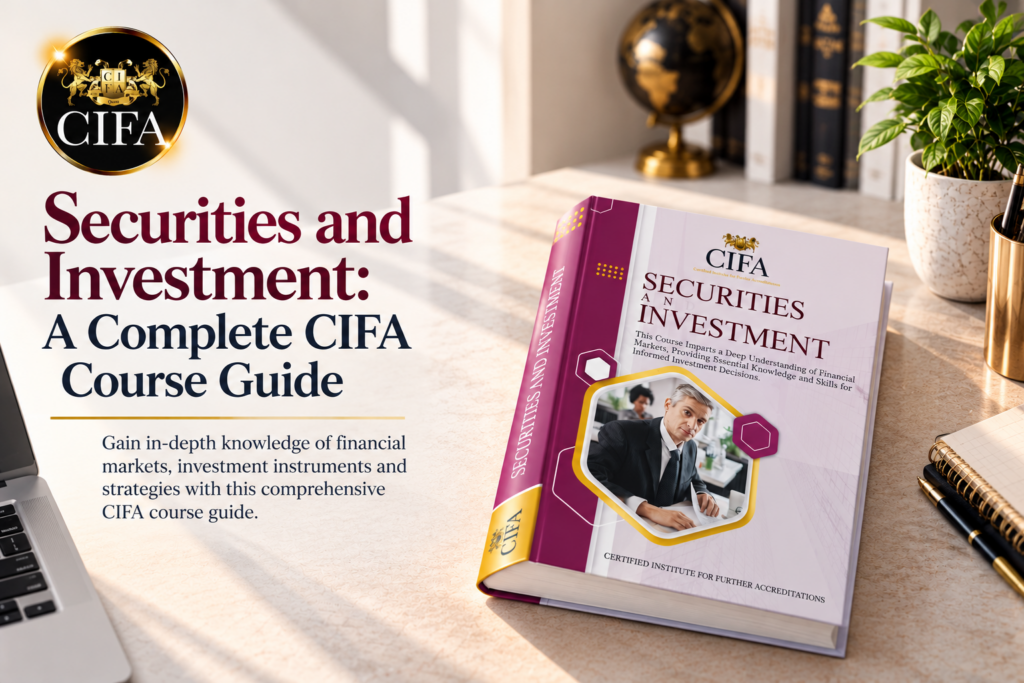
Securities and investment knowledge is essential to understanding how financial markets operate, how investment products are structured and how financial decisions are influenced by economic conditions, regulation and risk. From company shares and government bonds to investment funds and derivatives, different financial instruments serve different purposes and carry different responsibilities for investors and financial services professionals.
The CIFA Securities and Investment course provides structured education across these subjects, helping learners develop a broader understanding of investment markets and the financial services environment.
The programme is presented as CIFA Level 4 and Intermediate, with 53 CPD-verified study hours and an 11-chapter curriculum. It is offered in digital format, with a published enrolment price of £358. The course also lists chapter-based mock examinations, lifetime portal access and a Certificate of Achievement awarded following successful completion and passing of the examination.
For students, existing financial services employees and individuals considering further financial education, understanding the programme’s curriculum, assessment arrangements and additional costs is important before enrolling.
This guide explains what the course covers, how its subjects connect to real financial markets, who may benefit from studying it and what learners should consider when evaluating their next educational steps.
The Securities and Investment course is a structured financial education programme offered by CIFA. It introduces learners to the organisation of financial services, the characteristics of major investment instruments and the regulatory and professional considerations surrounding financial markets.
For individuals researching a Securities and investment course UK, the programme brings together several important areas of financial education within a single curriculum.
The official course is described as CIFA Level 4 and Intermediate. These are the provider’s course classifications and should not be interpreted as confirmation of equivalence to a particular external qualification framework.
As a Level 4 CPD securities and investment course, it carries a published learning commitment of 53 CPD hours. These hours describe the stated course duration rather than a guaranteed calendar completion period, as individual study requirements may vary.
The course covers 11 chapters, beginning with the financial services sector and economic conditions before examining equities, bonds, derivatives, investment funds, regulation, taxation, other financial products and financial advice.
This structure helps learners understand financial instruments within the wider context in which they are issued, traded, regulated and used.
Importantly, this is a CIFA programme, not a qualification awarded by the Chartered Institute for Securities & Investment (CISI). Completing the course does not automatically confer external professional status, regulated advisory permissions or eligibility for a particular financial services role.
The curriculum is designed to provide broad exposure to securities and investment subjects. Rather than concentrating exclusively on trading or portfolio management, it examines the financial services environment, investment instruments and the professional responsibilities associated with financial markets.
Chapter 1 introduces the Financial Services Sector, establishing the wider environment in which financial institutions, investment firms, intermediaries and market participants operate.
Financial services involve a range of activities, including banking, investment management, securities trading, financial administration and advisory services. Different institutions perform different functions, and understanding these distinctions helps explain how financial products reach investors and how financial markets support economic activity.
Chapter 2, The Economic Climate, considers the economic conditions that influence financial markets.
Interest rates, inflation, economic growth, employment conditions and monetary policy can affect borrowing costs, business performance and investor expectations. For example, rising interest rates can place downward pressure on the market value of existing fixed-rate bonds, although the actual impact depends on the bond’s characteristics.
Economic developments can also influence equity valuations, corporate financing decisions and demand for investment products.
Someone comparing a Financial markets course for beginners may recognise the importance of these foundational concepts. However, the CIFA programme is officially described as Intermediate, so prospective learners should consider their existing knowledge before enrolling.
Equities and bonds are among the most widely recognised instruments in financial markets, but they represent fundamentally different financial relationships.
Chapter 3 examines equities, commonly called shares. An equity investment generally represents an ownership interest in a company. Shareholders may benefit from increases in the market value of their holdings and, where declared, dividend distributions.
However, equity investments expose investors to business performance, changing market conditions and the possibility of capital losses. Dividends are discretionary and cannot be assumed to continue indefinitely.
Chapter 4 examines bonds, which generally represent debt obligations issued by governments, companies or other eligible entities.
Bond investors are creditors rather than shareholders. Depending on the bond’s terms, they may receive interest payments and repayment of principal at maturity. Nevertheless, bonds carry risks, including issuer default, interest-rate sensitivity, inflation and liquidity constraints.
An Equities and bonds course provides useful educational context for comparing ownership-based investments with debt-based instruments.
Understanding these distinctions is fundamental to Securities in finance, particularly when evaluating income characteristics, capital risk, market pricing and the different legal rights associated with financial instruments.
Neither asset class is universally safer or more profitable. The characteristics of an individual security and the circumstances in which it is held matter more than broad assumptions about its category.
Financial markets include a much wider range of arrangements than ordinary shares and conventional bonds.
Chapter 5, Other Markets and Investments, expands the learner’s perspective by introducing the broader investment environment.
Different markets may have different trading mechanisms, settlement arrangements, liquidity conditions and sources of risk. These characteristics can influence how securities are valued, traded and monitored.
For example, an investment traded frequently on an established exchange may have different liquidity characteristics from an instrument traded less regularly through negotiated transactions.
Understanding the existence of different market structures helps learners appreciate why financial instruments require careful evaluation rather than relying on general assumptions.
This chapter also provides a conceptual bridge between conventional securities and the more specialised investment subjects introduced later in the curriculum.
Derivatives are financial contracts whose value is linked to an underlying asset, interest rate, index, currency or another reference measure.
Examples include futures, options and swaps. These instruments can be used for different purposes, including hedging particular financial exposures, managing market risks and obtaining investment exposure.
A company facing uncertainty over future currency payments, for instance, may consider an appropriate derivative arrangement to manage part of its exchange-rate exposure.
However, derivatives can also introduce significant financial risks. Leverage, contractual complexity, counterparty exposure and changing market conditions can increase the potential for losses.
Understanding these characteristics is important because the risks of a derivative depend on its structure and use, rather than simply on its name.
For learners exploring an Investment funds and derivatives course, it is useful to recognise that derivatives and investment funds serve different functions, even though both belong to the wider investment landscape.
Those interested in more specialised study can consider the separate Introduction to Derivatives course offered by CIFA. This is an additional educational programme and is not automatically included in the Securities and Investment enrolment fee.
Investment funds allow capital from multiple investors to be pooled and invested according to a defined objective or strategy.
Depending on their structure and investment mandate, funds may provide exposure to equities, bonds or other eligible assets.
Pooled investment arrangements can offer diversification, but diversification does not eliminate investment risk. A fund may still experience losses when the value of its underlying investments declines.
Fund objectives, asset allocation, charges, liquidity and management arrangements are important considerations when examining how these products operate.
For example, a fund concentrating on one industry may behave differently from a broadly diversified fund holding securities across several markets.
Understanding investment funds also helps learners distinguish between direct ownership of individual securities and participation in a collective investment arrangement.
The educational value lies in recognising how fund structures work and how their characteristics may influence investment outcomes, rather than assuming that any particular fund is appropriate for every investor.
Financial regulation provides an important framework for the operation of financial markets and the conduct of financial services businesses.
Chapter 8 introduces the role of regulation and the professional responsibilities associated with financial activities.
In the United Kingdom, the Financial Conduct Authority (FCA) regulates the conduct of many financial services firms and markets. The Prudential Regulation Authority (PRA) supervises the prudential safety and soundness of certain financial institutions, including banks and insurers.
The regulatory requirements applying to a business depend on its activities, permissions and circumstances.
Professional integrity, appropriate disclosure, fair customer treatment and compliance with applicable rules are important considerations for financial services participants.
Learners seeking more focused education can explore the separate UK financial regulation and professional integrity course offered by CIFA.
Understanding financial regulation is not the same as receiving permission to undertake regulated activities. Professional qualifications, competence requirements and regulatory authorisations must be considered separately.
Taxation is an important consideration in investment planning because taxes can affect the income received from investments and the gains realised when assets are sold.
Chapter 9 examines Taxation, Investment Wrappers and Trusts, bringing together subjects that influence how investments may be held and treated under applicable rules.
Investment wrappers are arrangements through which eligible investments may receive particular legal or tax treatment. Trusts involve legal relationships in which assets are held and managed according to the terms of the arrangement and applicable law.
For learners interested in Investment wrappers and trusts UK, understanding the distinctions between investment ownership, legal structures and tax treatment is particularly relevant.
For example, the tax consequences of holding an investment directly may differ from those associated with holding an eligible investment within a particular wrapper.
However, tax treatment depends on individual circumstances, the type of investment and the rules in force. Tax legislation may also change.
CIFA offers a separate investment risk and taxation course for learners interested in further education on related subjects.
This is an additional learning option rather than an automatically included component of the Securities and Investment programme.
The chapter should be approached as financial education, not as a substitute for individual tax or legal advice.
Chapter 10 broadens the curriculum through its examination of Other Financial Products.
Financial services involve products with different contractual structures, purposes, financial obligations and risk characteristics.
Understanding this diversity helps learners recognise that financial products should be assessed according to their individual terms and intended functions.
Some products may primarily address financing requirements, while others may involve investment exposure, protection arrangements or broader financial planning considerations.
The published chapter title does not, by itself, establish that every specific product category is examined in detail. Prospective learners seeking coverage of a particular instrument should confirm the relevant syllabus content with CIFA.
The chapter nevertheless contributes to the overall curriculum by extending the learner’s perspective beyond the principal investment categories already discussed.
The final chapter introduces Financial Advice within the wider financial services environment.
Financial advice involves more than understanding investment products. It can require consideration of client objectives, financial circumstances, investment horizons, attitudes to risk and the potential consequences of different financial decisions.
Appropriate professional conduct and the application of relevant regulatory requirements are also important.
For example, a financial product that appears attractive based on its potential returns may be unsuitable for a particular individual because of liquidity requirements, risk tolerance or financial circumstances.
This illustrates why understanding products and understanding their potential suitability are separate considerations.
Learners interested in examining the subject more closely can consider the separate Financial Planning and Advice course offered by CIFA.
Studying financial advice does not automatically qualify or authorise a learner to provide regulated advice. Depending on the jurisdiction and activity, further qualifications, competence requirements, permissions and supervised experience may be necessary.
The Securities and Investment course may be relevant to several groups of learners, although suitability depends on their existing knowledge and educational objectives.
Finance students may use the curriculum to broaden their understanding of financial instruments and the environment in which investment markets operate.
Existing financial services employees may find the programme relevant when developing knowledge outside their immediate responsibilities, particularly in investment administration, client support, operations or other finance-related functions.
Individuals considering a transition into financial services may also find structured study useful when evaluating the knowledge required for different roles.
However, a learner comparing a Financial markets course for beginners should not assume that the programme has no prerequisites simply because it covers fundamental concepts.
The official course is described as Intermediate, and the available information does not establish a universal entry requirement.
Prospective learners who are uncertain about their background, technical knowledge or readiness for the curriculum should confirm suitability directly with CIFA.
The strongest reason to enrol is a clear connection between the programme’s subject coverage and the knowledge the learner wishes to develop.
The Securities and investment course online is offered as a digital learning product with a published study duration of 53 CPD-verified hours.
The course information lists an electronic course book, per-chapter mock examinations and lifetime portal access.
The chapter-based mock examinations provide opportunities for learners to review their understanding and identify subjects requiring further revision.
Digital delivery may be useful for individuals managing their education alongside professional or personal commitments. However, learners should confirm specific access conditions and delivery arrangements rather than assuming that every form of online learning support is included.
The published pricing information also identifies PowerPoint presentations and prerecorded webinars as additional paid learning resources.
These supplementary materials should not be treated as included benefits unless the applicable course package expressly provides them.
Assessment is an important distinction between studying course material and receiving formal recognition of successful completion.
The programme includes per-chapter mock examinations, while the Certificate of Achievement is awarded after the learner successfully completes and passes the required examination.
For individuals researching Securities and investment certification, it is important to understand precisely what the certificate represents.
A CIFA Certificate of Achievement records successful completion under the provider’s requirements. It should not be presented as equivalent to a CISI qualification or as automatic authorisation to perform regulated financial activities.
Prospective learners should confirm examination duration, passing requirements, booking arrangements and resit conditions directly with the provider where these details are not clearly established in the course description.
The CIFA Digital Profile is listed among the programme’s features.
It forms part of the provider’s digital educational offering and may be relevant to learners who wish to maintain information associated with their studies.
However, its inclusion does not establish guaranteed recognition by employers, recruitment opportunities, professional membership or employment outcomes.
The practical value of any educational profile depends on its features and how it is considered in the relevant professional context.
The published enrolment fee for the Securities and Investment course is £358.
The course listing identifies digital learning resources, mock examinations, lifetime portal access and the Digital Profile among its features, together with a Certificate of Achievement following successful examination completion.
Prospective learners should distinguish the standard enrolment package from separately charged supplementary materials and examination-related services.
The official CIFA pricing information lists a £72 supplementary package containing PowerPoint presentations and prerecorded webinars. It also lists separate examination-related charges, including a £149.99 first-attempt examination fee and charges for online invigilation and resits.
These amounts should be reviewed in the context of the current applicable fee schedule, rather than assumed to be included in the advertised enrolment price.
The CIFA course fees and pricing page provides a useful starting point for reviewing published charges.
Before purchasing, learners should confirm the total applicable cost, including any examination services or optional resources they intend to use.
The subjects covered by the Securities and Investment course are relevant to several areas of financial services.
Knowledge of equities, bonds, investment funds, derivatives and financial regulation may be useful when exploring investment operations, securities administration, financial analysis, client support or related functions.
Individuals researching Securities and investment jobs UK should distinguish between knowledge relevant to a role and the formal requirements needed to secure employment.
Employers may require specific qualifications, practical experience, technical competence or familiarity with particular systems and regulatory responsibilities.
Advisory roles and other regulated activities may involve additional professional qualifications, regulatory permissions, competence assessments or supervised experience.
For learners considering further education, the Investment Advisor Certification (IAC) is another programme offered by CIFA that may be worth reviewing.
It is a separate learning option, not an automatic progression route or guaranteed outcome of completing Securities and Investment.
Further study may also focus on financial planning, wealth management, taxation, investment risk or specialised market instruments.
The most appropriate pathway depends on the learner’s professional interests, existing qualifications and intended responsibilities.
CIFA provides educational programmes covering a range of financial subjects, allowing learners to explore investment markets alongside related areas such as financial planning, taxation, derivatives and regulation.
The Securities and Investment curriculum brings several of these subjects together, offering a broad foundation for continued financial education.
Learners who identify a particular area of interest can consider additional specialist courses and educational resources rather than assuming that one programme must meet every future learning requirement.
It is important to distinguish four separate outcomes: developing subject knowledge, completing educational material, passing an examination and meeting the professional requirements for a specific occupation.
A course can contribute to financial understanding and continuing professional development, while employment eligibility, professional recognition and regulatory permissions remain subject to separate requirements.
The Securities and Investment course offers structured education across financial services, economic conditions, equities, bonds, derivatives, investment funds, regulation, taxation and financial advice.
With 11 chapters, 53 CPD-verified hours and digital delivery, the programme may be relevant to finance students, existing financial services employees and individuals interested in broadening their understanding of investment markets.
It is classified as CIFA Level 4 and Intermediate, with a published enrolment fee of £358. The listed learning features include digital course materials, mock examinations, lifetime portal access and a Digital Profile, while the Certificate of Achievement is subject to successful examination completion.
Additional learning resources and examination-related services may involve separate charges.
Ultimately, the decision to enrol should reflect the learner’s existing knowledge, educational objectives and expectations regarding professional development.
Before enrolling, view the full CIFA Securities and Investment course details and confirm any outstanding questions about entry suitability, examination requirements, learning resources and applicable fees directly with the provider.
The Securities and Investment course is a CIFA Level 4 programme described as Intermediate. It includes 11 chapters covering financial services, economic conditions, equities, bonds, derivatives, investment funds, regulation, taxation and financial advice. The course carries 53 CPD-verified study hours and is offered as a digital learning product.
The curriculum covers the financial services sector, economic climate, equities, bonds, other markets, derivatives, investment funds, regulation, taxation, investment wrappers, trusts, other financial products and financial advice. CIFA also offers a related UK financial regulation and professional integrity guide for further reading.
The published course duration is 53 CPD hours, described as CPD verified. This indicates the stated learning commitment rather than a guaranteed completion period. Actual calendar time may vary according to previous knowledge, study habits, revision needs and the amount of time a learner can dedicate to preparing for the examination.
CIFA lists the enrolment fee as £358, with additional charges for examinations and optional learning resources. PowerPoint presentations and prerecorded webinars are separately priced. The article investment risk and taxation explained provides related educational reading, but it is not an official source for course fees.
The programme may be relevant to finance students, existing financial services employees and individuals exploring investment-related education. An Equities and bonds course can provide useful knowledge of financial instruments, but suitability depends on previous experience and learning goals. CIFA classifies this broader programme as Intermediate.
The course is described as Intermediate, but a universal entry requirement is not clearly established in the published information. Prospective learners should confirm their suitability directly with CIFA, particularly if they have limited finance knowledge. The Financial Planning and Advice course guide provides additional educational context.
The programme includes per-chapter mock examinations to support revision and preparation. A Certificate of Achievement is awarded only after successful completion and passing of the required examination. For those considering Securities and investment certification, it is important to confirm the examination arrangements, applicable fees and certificate conditions before enrolling.
Yes. The Securities and investment course online is listed as a digital product with 53 CPD-verified hours. Specific access arrangements should be confirmed with CIFA. Learners interested in broader financial education can also consult the separate Foundations in Wealth Management (FWM) guide, which is not an included course feature.
Equities represent ownership interests in companies, while bonds generally represent debt obligations issued by governments, businesses or other entities. Derivatives derive their value from underlying assets, rates or indices. Understanding these distinctions is essential when studying Securities in finance, because each instrument has different contractual features and risks.
Further learning may involve financial planning, wealth management, investment advice, regulation or specialised securities subjects. Learners exploring Securities and investment jobs UK should also consider relevant professional requirements. They can explore CIFA securities courses for additional educational options without assuming guaranteed employment or regulatory authorisation.
CIFA is a trusted education provider specializing in finance and compliance training. We empower learners with practical knowledge, industry-relevant skills, and accredited courses designed to build strong careers in financial services, risk management, and regulatory compliance.
© CIFA 2020-2025 ALL RIGHTS RESERVED