
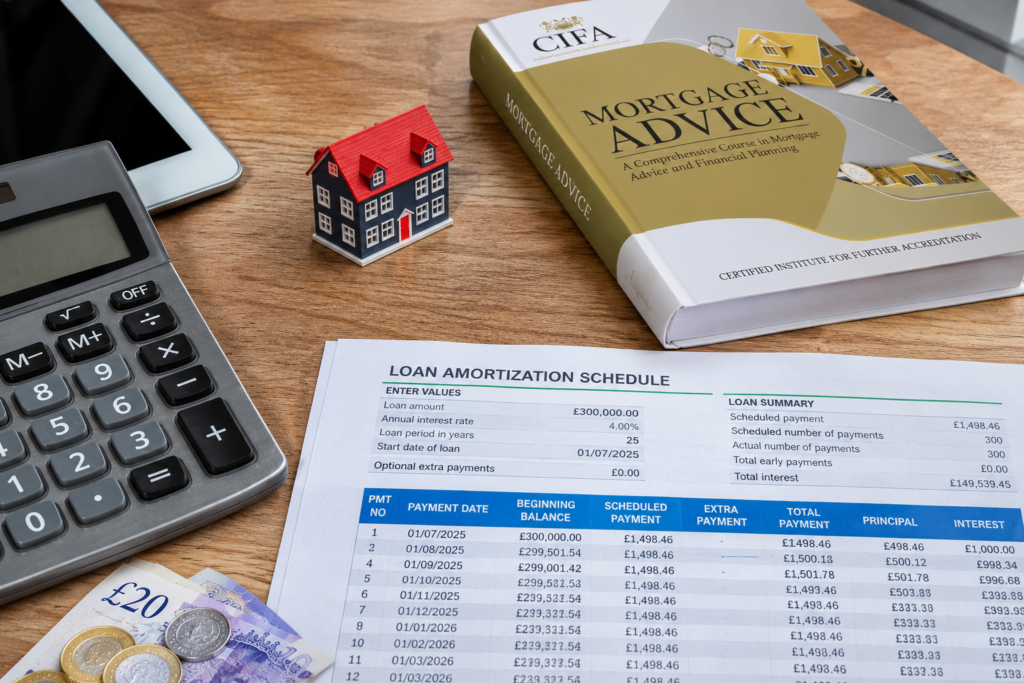
How much will you need to pay each month when buying a home, moving property or remortgaging? Understanding your borrowing costs before committing to a mortgage can help you establish a realistic property budget and avoid unexpected financial pressures.
A Mortgage Repayment Calculator UK helps you estimate monthly repayments, total interest and the overall amount repayable based on your mortgage balance, interest rate, deposit and repayment term. It also allows you to explore how different borrowing arrangements and overpayments could affect your long-term finances.
Whether you are a first-time buyer wondering how much will my mortgage cost, or an existing homeowner reviewing your current deal, understanding the numbers behind a mortgage is essential.
At CIFA, professional mortgage and financial education explores the principles behind borrowing decisions, financial products, affordability and responsible financial planning. This guide combines practical mortgage calculations with explanations of the financial factors that influence your borrowing costs.
Use the mortgage calculator UK tool to estimate how much you could pay towards your mortgage each month. Start with your property value and deposit, or enter your required mortgage amount directly.
Adjust the annual interest rate, mortgage term and repayment structure to compare different borrowing scenarios. You can also explore the potential effects of regular overpayments and an immediate lump-sum capital repayment.
The calculator distinguishes normal contractual repayments from optional overpayments. Its results show your estimated monthly payment, total interest, total amount repayable, original borrowing amount, deposit, loan-to-value ratio and projected outstanding balance.
For interest-only mortgages, the calculator identifies the interest payment and capital remaining outstanding. For capital repayment mortgages, additional payments can be modelled to estimate interest savings and potential reductions in the mortgage term.
Mortgage calculations are illustrative estimates only and do not constitute financial or mortgage advice. Actual repayments depend on the lender, mortgage product, applicable fees and individual circumstances.
Calculator results do not guarantee mortgage approval, affordability or access to a particular interest rate.
Property value represents the purchase price or estimated current market value of the home. Together with your deposit or existing equity, it helps determine the loan-to-value ratio and required borrowing amount.
Your deposit is the contribution you make towards the property purchase. A larger deposit reduces the mortgage principal and may improve access to different mortgage products.
For a new mortgage, the principal generally equals the purchase price minus the deposit. For remortgaging, the outstanding mortgage balance is normally the starting point.
Any additional borrowing or financed mortgage fees must be accounted for separately.
The interest rate determines the cost of borrowing the outstanding capital. Small differences in annual interest rates can produce substantial differences in lifetime mortgage costs.
The mortgage term is the agreed repayment period. A longer term generally reduces monthly repayments but can increase total interest. A shorter term usually requires larger monthly payments.
Capital repayment mortgages gradually repay the outstanding loan and interest. Interest-only mortgages cover interest while leaving capital outstanding unless separate repayments are made.
An overpayment is an additional amount paid beyond the contractual mortgage payment. When applied to outstanding capital, it may reduce future interest and shorten the repayment period.
A monthly mortgage repayment calculator uses the relationship between the amount borrowed, annual interest rate and number of scheduled payments.
For a standard capital repayment mortgage, the formula is:
Monthly repayment = P × r × (1 + r)ⁿ ÷ ((1 + r)ⁿ − 1)
Where:
P = Original mortgage principal.
r = Annual interest rate divided by 12 and expressed as a decimal.
n = Total number of monthly repayments.
For zero-interest borrowing, the monthly payment equals the principal divided by the number of monthly payments.
For an interest-only mortgage, the monthly interest payment equals the outstanding principal multiplied by the monthly interest rate.
Consider a £200,000.00 repayment mortgage over 25 years at an illustrative annual interest rate of 5%, excluding fees and overpayments.
The estimated monthly repayment is £1,169.18. The first month’s interest is approximately £833.33, leaving £335.85 to reduce the outstanding principal.
As the balance reduces, less interest is charged and more of the scheduled payment goes towards capital.
Over 300 monthly payments, the estimated total interest is £150,754.02 and the total amount repayable is £350,754.02.
This is the standard amortisation approach used to calculate mortgage repayments UK borrowers can compare when reviewing their financial commitments.
Increasing the mortgage principal increases repayments when the rate and term remain unchanged. Borrowing more also exposes the borrower to a greater absolute interest cost.
Loan-to-value (LTV) expresses the amount borrowed as a percentage of property value.
For example, a £240,000.00 mortgage against a £300,000.00 property produces an 80% LTV. Increasing the deposit to £90,000.00 reduces borrowing to £210,000.00 and LTV to 70%.
Different LTV bands may affect product eligibility and pricing.
A mortgage interest calculator UK comparison helps illustrate how changes in rates affect both monthly payments and total interest.
Interest rates are influenced by mortgage product terms, lender pricing, funding costs and wider economic conditions.
For those interested in understanding these wider financial risks, CIFA offers professional learning in investment risk and taxation, covering economic conditions, investment risk, taxation and financial products.
Extending a mortgage term reduces the capital repayment required each month but leaves interest accruing over a longer period. Evaluate the lifetime cost alongside the immediate monthly saving.
Fixed-rate mortgages maintain an agreed interest rate during a specified deal period. Tracker mortgages typically follow a specified reference rate plus or minus an agreed margin.
Other variable-rate products can change according to their particular terms. A lender’s standard variable rate (SVR) may change at its discretion within applicable contractual and regulatory requirements.
Further borrowing increases the amount owed and may increase monthly payments. Homeowners should consider whether additional debt remains affordable throughout the revised mortgage term.
Mortgage product fees paid upfront increase initial expenditure. Fees added to the mortgage increase the principal and may attract interest throughout the repayment period.
The following comparisons show estimated monthly mortgage payments UK borrowers could calculate under different borrowing assumptions.
All examples were calculated on 26 November 2026 using standard monthly amortisation, constant illustrative annual rates, capital repayment mortgages and no additional fees or overpayments.
The interest rates are not current lender quotations. Calculations retain full precision internally and round displayed amounts to two decimal places.
Mortgage | Rate | Term | Monthly repayment | Total interest | Total repayable |
£100,000 | 3% | 20 years | £554.60 | £33,103.42 | £133,103.42 |
£100,000 | 3% | 25 years | £474.21 | £42,263.39 | £142,263.39 |
£100,000 | 3% | 30 years | £421.60 | £51,777.45 | £151,777.45 |
£100,000 | 4% | 20 years | £605.98 | £45,435.28 | £145,435.28 |
£100,000 | 4% | 25 years | £527.84 | £58,351.05 | £158,351.05 |
£100,000 | 4% | 30 years | £477.42 | £71,869.51 | £171,869.51 |
£100,000 | 5% | 20 years | £659.96 | £58,389.38 | £158,389.38 |
£100,000 | 5% | 25 years | £584.59 | £75,377.01 | £175,377.01 |
£100,000 | 5% | 30 years | £536.82 | £93,255.78 | £193,255.78 |
£100,000 | 6% | 20 years | £716.43 | £71,943.45 | £171,943.45 |
£100,000 | 6% | 25 years | £644.30 | £93,290.42 | £193,290.42 |
£100,000 | 6% | 30 years | £599.55 | £115,838.19 | £215,838.19 |
At 5% over 25 years, borrowing £100,000.00 produces an estimated monthly repayment of £584.59. Extending the term to 30 years reduces the monthly payment but increases total interest by £17,878.77.
Mortgage | Rate | Term | Monthly repayment | Total interest | Total repayable |
£200,000 | 3% | 20 years | £1,109.20 | £66,206.85 | £266,206.85 |
£200,000 | 3% | 25 years | £948.42 | £84,526.79 | £284,526.79 |
£200,000 | 3% | 30 years | £843.21 | £103,554.90 | £303,554.90 |
£200,000 | 4% | 20 years | £1,211.96 | £90,870.56 | £290,870.56 |
£200,000 | 4% | 25 years | £1,055.67 | £116,702.10 | £316,702.10 |
£200,000 | 4% | 30 years | £954.83 | £143,739.01 | £343,739.01 |
£200,000 | 5% | 20 years | £1,319.91 | £116,778.75 | £316,778.75 |
£200,000 | 5% | 25 years | £1,169.18 | £150,754.02 | £350,754.02 |
£200,000 | 5% | 30 years | £1,073.64 | £186,511.57 | £386,511.57 |
£200,000 | 6% | 20 years | £1,432.86 | £143,886.91 | £343,886.91 |
£200,000 | 6% | 25 years | £1,288.60 | £186,580.84 | £386,580.84 |
£200,000 | 6% | 30 years | £1,199.10 | £231,676.38 | £431,676.38 |
For a £200,000.00 mortgage over 25 years, increasing the illustrative rate from 4% to 5% increases the estimated monthly payment by approximately £113.51.
Mortgage | Rate | Term | Monthly repayment | Total interest | Total repayable |
£300,000 | 3% | 20 years | £1,663.79 | £99,310.27 | £399,310.27 |
£300,000 | 3% | 25 years | £1,422.63 | £126,790.18 | £426,790.18 |
£300,000 | 3% | 30 years | £1,264.81 | £155,332.36 | £455,332.36 |
£300,000 | 4% | 20 years | £1,817.94 | £136,305.84 | £436,305.84 |
£300,000 | 4% | 25 years | £1,583.51 | £175,053.16 | £475,053.16 |
£300,000 | 4% | 30 years | £1,432.25 | £215,608.52 | £515,608.52 |
£300,000 | 5% | 20 years | £1,979.87 | £175,168.13 | £475,168.13 |
£300,000 | 5% | 25 years | £1,753.77 | £226,131.04 | £526,131.04 |
£300,000 | 5% | 30 years | £1,610.46 | £279,767.35 | £579,767.35 |
£300,000 | 6% | 20 years | £2,149.29 | £215,830.36 | £515,830.36 |
£300,000 | 6% | 25 years | £1,932.90 | £279,871.26 | £579,871.26 |
£300,000 | 6% | 30 years | £1,798.65 | £347,514.57 | £647,514.57 |
At 5% over 25 years, the estimated monthly repayment is £1,753.77. Choosing a 20-year term at the same rate increases monthly commitments but reduces estimated lifetime interest by £50,962.91.
Mortgage | Rate | Term | Monthly repayment | Total interest | Total repayable |
£400,000 | 3% | 20 years | £2,218.39 | £132,413.69 | £532,413.69 |
£400,000 | 3% | 25 years | £1,896.85 | £169,053.58 | £569,053.58 |
£400,000 | 3% | 30 years | £1,686.42 | £207,109.81 | £607,109.81 |
£400,000 | 4% | 20 years | £2,423.92 | £181,741.12 | £581,741.12 |
£400,000 | 4% | 25 years | £2,111.35 | £233,404.21 | £633,404.21 |
£400,000 | 4% | 30 years | £1,909.66 | £287,478.03 | £687,478.03 |
£400,000 | 5% | 20 years | £2,639.82 | £233,557.51 | £633,557.51 |
£400,000 | 5% | 25 years | £2,338.36 | £301,508.05 | £701,508.05 |
£400,000 | 5% | 30 years | £2,147.29 | £373,023.14 | £773,023.14 |
£400,000 | 6% | 20 years | £2,865.72 | £287,773.82 | £687,773.82 |
£400,000 | 6% | 25 years | £2,577.21 | £373,161.68 | £773,161.68 |
£400,000 | 6% | 30 years | £2,398.20 | £463,352.76 | £863,352.76 |
When asking how much will my mortgage cost, borrowers should compare lifetime interest as well as monthly commitments. At 6% over 30 years, the illustrative interest on a £400,000.00 mortgage exceeds the original amount borrowed.
A mortgage calculator with deposit UK comparison allows buyers to assess borrowing requirements before applying for a mortgage.
Consider a £300,000.00 property with a 25-year repayment mortgage at an illustrative rate of 5%.
With a 10% deposit of £30,000.00, the required mortgage is £270,000.00. Estimated monthly repayments are £1,578.39, total interest is £203,517.93 and total repayments are £473,517.93.
Increasing the deposit to 20%, equivalent to £60,000.00, reduces borrowing to £240,000.00. Monthly repayments fall to £1,403.02, total interest to £180,904.83 and total repayments to £420,904.83.
These examples exclude fees and overpayments. The larger deposit reduces monthly costs by approximately £175.38 at the same rate.
However, buyers should balance deposit size against emergency savings, purchase expenses and other financial commitments.
Each scheduled repayment covers interest and reduces outstanding capital. Assuming the agreed payment schedule is maintained, the mortgage is cleared by the end of its term.
Interest-only payments cover the cost of borrowing without automatically reducing the original principal.
Borrowers need a credible repayment strategy to clear outstanding capital when the mortgage ends. Investment-based strategies can involve uncertainty and therefore require ongoing review.
The following example uses £200,000.00 borrowed over 25 years at a constant illustrative rate of 5%, without fees or overpayments.
Cost comparison | Capital repayment | Interest-only |
Original mortgage | £200,000.00 | £200,000.00 |
Monthly payment | £1,169.18 | £833.33 |
Total interest | £150,754.02 | £250,000.00 |
Capital repaid through monthly payments | £200,000.00 | £0.00 |
Capital outstanding at term end | £0.00 | £200,000.00 |
Total including final capital repayment | £350,754.02 | £450,000.00 |
End-of-term responsibility | Mortgage cleared | Capital must be repaid |
An interest-only mortgage calculator UK comparison demonstrates why lower initial payments do not necessarily represent lower overall borrowing costs.
A repayment calculator estimates borrowing costs using selected mortgage assumptions. A mortgage affordability calculator UK tool may also consider income, expenditure, debts and other household circumstances.
Lenders conduct their own affordability and underwriting assessments. They may consider credit history, employment circumstances, dependants, regular expenditure and the potential effects of future interest-rate increases.
A mortgage that appears manageable in a repayment calculation may not satisfy a lender’s own criteria.
Households should account for insurance, utilities, council tax, maintenance, transport and emergency savings when reviewing their financial position.
CIFA‘s guide to mortgage affordability and personal financial planning provides wider personal finance context through budgeting and money management principles.
Regular overpayments can accelerate capital repayment and reduce the balance on which future interest is calculated.
Consider a £200,000.00 capital repayment mortgage over 25 years at a constant illustrative rate of 5%. Compare the original repayment schedule with an additional £100.00 monthly payment.
Mortgage calculation | Without overpayments | With £100 monthly overpayment |
Normal monthly repayment | £1,169.18 | £1,169.18 |
Monthly overpayment | £0.00 | £100.00 |
Combined monthly payment | £1,169.18 | £1,269.18 |
Estimated repayment period | 25 years | 21 years 6 months |
Total interest | £150,754.02 | £126,248.73 |
Total mortgage repayments | £350,754.02 | £326,248.73 |
Estimated interest saving | £0.00 | £24,505.30 |
Estimated term reduction | None | 3 years 6 months |
The revised schedule assumes additional payments reduce capital immediately, the normal contractual repayment is maintained and no early repayment charges apply.
A one-off capital repayment reduces the outstanding balance. Its long-term effect depends on the payment date, remaining term, applicable interest rate and how the lender adjusts subsequent repayments.
A mortgage overpayment calculator UK tool compares the original amortisation schedule with a revised schedule containing additional payments.
Interest is calculated on the remaining balance each month, rather than simply subtracting overpayments from the original mortgage amount.
Some mortgage products restrict the amount borrowers can repay early without incurring charges. Permitted allowances and charging arrangements vary by lender and contract.
Check your mortgage documentation before committing to substantial additional payments.
Estimated interest savings represent the difference between total interest under the original repayment schedule and total interest under the revised schedule.
Borrowers should also consider emergency savings, existing expensive debt and whether money used for mortgage overpayments will remain accessible.
When a fixed-rate period expires, borrowers may move onto their lender’s standard variable rate unless another arrangement has been agreed.
The replacement rate could be higher or lower than the previous fixed rate, changing monthly repayments.
For example, a £200,000.00 outstanding repayment mortgage with 25 years remaining would cost approximately £1,169.18 per month at 5%, compared with £1,288.60 at 6%.
Reviewing available options before expiry allows homeowners to assess potential changes in monthly commitments, product fees and contractual conditions.
Remortgaging involves replacing an existing mortgage with a new mortgage arrangement, commonly through another lender. Existing lenders may also offer customers a product transfer.
Homeowners may consider these options when a fixed-rate deal ends, their property value changes or they wish to review borrowing costs.
Compare the remaining balance, LTV, interest rate, outstanding mortgage term, product fees and early repayment charges.
A lower headline interest rate is not necessarily cheaper after fees are included. Extending the remaining term could also reduce monthly payments while increasing future interest.
A conventional repayment calculation focuses on capital and interest. It does not automatically include every expense associated with purchasing or financing a property.
Mortgage arrangement fees, valuation charges, legal and conveyancing costs, property surveys and applicable mortgage broker fees should be considered separately.
Property transaction taxes must also be included in the wider purchasing budget. England and Northern Ireland apply Stamp Duty Land Tax (SDLT), Scotland applies Land and Buildings Transaction Tax (LBTT), and Wales applies Land Transaction Tax (LTT).
According to GOV.UK information checked on 26 November 2026, the standard residential SDLT threshold in England and Northern Ireland is £125,000.00. Eligible first-time buyers can receive relief on purchases costing up to £500,000.00, with no SDLT on the first £300,000.00.
Additional property purchases and other circumstances may produce different tax liabilities.
If a mortgage product fee is added to borrowing, calculate repayments using the increased principal. Otherwise, include it separately when comparing total costs.
Understanding mortgage calculations is useful for borrowers, but professional mortgage knowledge extends into lending processes, product structures, affordability, client circumstances and regulatory responsibilities.
CIFA provides digital professional learning programmes covering mortgage advice and related financial subjects.
The standalone Mortgage Advice course provides professional mortgage repayment and mortgage advice education.
Its published learning structure covers the mortgage process, mortgage lending, the mortgage industry, elements of mortgage advice and mortgage solutions.
These subjects can help learners understand how mortgage products and borrowing considerations relate to wider professional responsibilities.
The structured mortgage adviser certification programme combines Mortgage Advice, Introduction to UK Financial Regulation and Professional Integrity, and Introduction to Investment, Risk and Taxation.
The digital bundle has an advertised duration of 415 hours.
Unlike the standalone mortgage course, MAC provides a broader combination of mortgage education, regulatory knowledge and financial risk concepts.
Mortgage commitments should be evaluated alongside wider household financial objectives.
CIFA‘s financial planning and advice training for long-term financial decisions covers financial planning principles, financial protection and retirement planning.
These subjects offer wider educational context for understanding financial commitments beyond immediate monthly repayments.
Consumer protection, professional conduct and regulatory responsibilities are essential considerations within financial services.
The UK financial regulation and professional integrity course covers professional ethics, financial markets, regulatory organisations and relevant aspects of financial services governance.
Learners interested in professional mortgage education can also explore a detailed guide to mortgage adviser certification and learning requirements.
Completing a professional education programme does not automatically grant FCA authorisation, permission to provide regulated mortgage advice or exemption from applicable qualification requirements.
The official course listings and price schedule checked on 26 November 2026 identify the following current enrolment and examination costs.
The standalone Mortgage Advice course costs £358.00, while the three-course Mortgage Advisor Certification bundle costs £897.00.
The constituent financial regulation and investment risk courses are individually priced at £358.00, as is Financial Planning and Advice.
The published first-attempt examination fee is £149.99 per course, with an additional US$16.00 online invigilation charge per examination.
For the standalone Mortgage Advice course, the indicative total is £507.99 plus US16.00forenrolmentandonefirst-attemptexamination.Optionalstudysupportcosts£72.00,increasingthistotalto£579.99plusUS16.00 if selected.
For the three-course MAC bundle, enrolment and three first-attempt examination fees produce an indicative total of £1,346.97 plus US$48.00.
Optional MAC study support costs £180.00, bringing the indicative total to £1,526.97 plus US$48.00 if selected.
The official price schedule separately lists examination resits at US$16.00 per examination. Confirm applicable conditions, currency conversion costs, certification requirements and current charges before enrolling.
The 415-hour MAC bundle duration should not automatically be interpreted as its accredited CPD allocation.
Prospective learners can explore CIFA’s finance and mortgage learning options to compare relevant educational pathways and course-specific arrangements.
A Mortgage Repayment Calculator UK provides a practical foundation for comparing borrowing amounts, monthly payments, interest rates, repayment terms and potential overpayment savings.
However, the monthly repayment represents only one part of the financial commitment. Consider lifetime interest, purchase expenses, lender affordability requirements and potential changes in future interest rates.
For individuals interested in understanding mortgages beyond numerical calculations, CIFA offers professional learning across mortgage products, financial regulation, investment risk and financial planning. These subjects can support wider financial understanding and continuing professional development.
Review your borrowing figures carefully, compare the complete financial implications of different mortgage arrangements and seek appropriately qualified mortgage advice before making an actual borrowing decision.
Monthly repayments are calculated using the mortgage principal, annual interest rate and repayment term. A monthly mortgage repayment calculator applies amortisation to estimate scheduled payments. CIFA covers mortgage-related financial principles through professional education. Actual lender calculations may differ because of payment dates, fees and interest conventions.
A £100,000.00 repayment mortgage over 25 years at an illustrative annual rate of 5% costs approximately £584.59 per month. Total interest is £75,377.01, excluding fees and overpayments. CIFA mortgage education provides wider context for understanding mortgage products. Actual payments depend on the lender, agreed interest rate and individual borrowing terms.
At an illustrative interest rate of 5% over 25 years, a £200,000.00 repayment mortgage costs £1,169.18 monthly, with total interest of £150,754.02 before fees. For wider product knowledge, explore CIFA’s mortgage adviser certification and learning overview. Actual borrowing costs depend on the agreed mortgage terms.
A £300,000.00 capital repayment mortgage at 5% over 25 years requires estimated monthly payments of £1,753.77. Total interest is £226,131.04, excluding fees and overpayments. CIFA provides professional education relating to mortgage products and financial decisions. These illustrative figures do not represent guaranteed lender quotations or mortgage approval.
A larger deposit reduces your mortgage principal and loan-to-value ratio, potentially lowering monthly repayments and influencing product eligibility. A mortgage calculator with deposit UK comparison can illustrate these changes. Explore CIFA’s financial planning education guide for wider context on managing financial commitments and planning ahead.
At the same interest rate, a 25-year repayment mortgage usually costs less overall than a 30-year mortgage, although monthly payments are higher. At 5%, borrowing £200,000.00 over 25 years saves approximately £35,757.54 in interest compared with 30 years. CIFA education covers financial principles relevant to understanding these longer-term borrowing commitments.
Repayment mortgages gradually clear capital and interest, while interest-only payments leave the capital outstanding unless separately repaid. An interest-only mortgage calculator UK comparison illustrates the difference. Read CIFA’s guidance on entering the UK mortgage advice profession to explore the wider professional knowledge involved in mortgage advice.
Higher rates generally increase repayments on variable-rate mortgages or when a new deal is agreed. A £200,000.00 repayment mortgage over 25 years rises from £1,169.18 at 5% to £1,288.60 at 6%. Explore CIFA’s financial planning and professional learning guidance to understand the wider importance of financial knowledge and planning.
A mortgage overpayment calculator UK estimates savings through revised amortisation. Paying an extra £100.00 monthly on a £200,000.00 mortgage at 5% over 25 years saves approximately £24,505.30 in interest, assuming no charges. Explore CIFA’s financial adviser certification guide for wider professional financial learning.
A standard repayment calculator usually estimates mortgage capital and interest, excluding legal costs, surveys, broker fees and property transaction taxes. Fees added to borrowing must be included in the principal separately. CIFA provides financial education relevant to understanding wider borrowing commitments and the importance of considering total costs.
CIFA is a trusted education provider specializing in finance and compliance training. We empower learners with practical knowledge, industry-relevant skills, and accredited courses designed to build strong careers in financial services, risk management, and regulatory compliance.
© CIFA 2020-2025 ALL RIGHTS RESERVED