
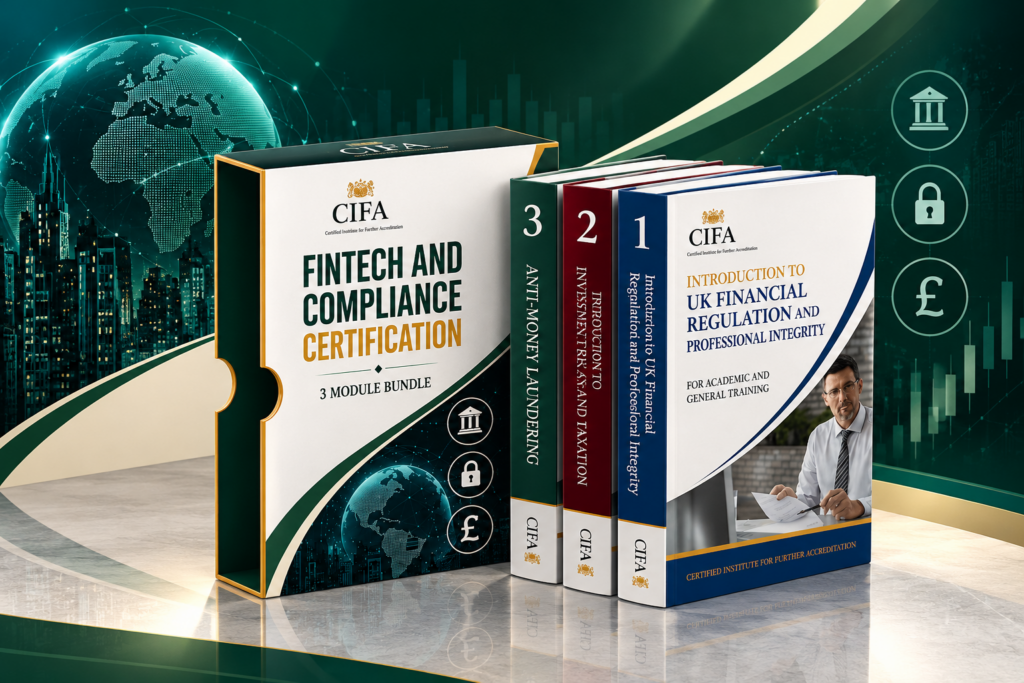
Working in FinTech compliance involves helping financial technology businesses understand regulatory obligations, manage financial-crime risks and maintain appropriate controls. CIFA offers the FinTech and Compliance Certification (FCC), a three-course educational bundle covering UK financial regulation and professional integrity, anti-money laundering, and investment, risk and taxation.
The programme is designed to develop foundational financial-services knowledge. It is not a dedicated technical FinTech course and does not teach software development, payment-system engineering or digital banking architecture.
For someone exploring compliance-related careers, the important questions are what employers expect, which roles are accessible, and whether a course provides knowledge relevant to those requirements. The official FCC bundle currently lists three digital courses, 410 study hours and a price of £897.
This guide explains the work, career opportunities, skills, programme content, costs and realistic steps towards entering the UK FinTech compliance sector.
FinTech compliance concerns the systems, processes and professional responsibilities that help financial technology businesses operate within applicable laws, regulations and regulatory expectations.
A FinTech company might provide payment services, lending, investment technology, digital financial accounts or another financial product. The requirements applying to it depend on the activities it undertakes, its legal structure, its customers and the regulatory framework involved.
FCA regulation for FinTech firms is therefore not a single standard licence. Some businesses need FCA authorisation, others may require registration, and certain activities may operate under another permitted arrangement. A technology supplier providing software to a financial institution is not automatically regulated in the same way as the institution using that software.
The Financial Conduct Authority supervises relevant financial-services activities and publishes rules and guidance addressing consumer protection, conduct, governance and other regulatory matters.
Compliance professionals help businesses identify which requirements apply and establish suitable procedures for meeting them.
Financial-crime prevention is an important area of compliance. Anti-money laundering (AML) controls aim to reduce the risk that financial services are used to conceal criminal proceeds.
Know Your Customer (KYC) processes generally involve establishing and verifying relevant customer information. Customer Due Diligence (CDD) uses information about customers and relationships to support risk assessment. Enhanced Due Diligence (EDD) involves additional scrutiny where applicable rules and higher-risk circumstances require it.
Sanctions screening, transaction monitoring, fraud controls and suspicious activity reporting may also form part of a firm’s financial-crime framework.
These controls are not interchangeable. Their legal basis and implementation depend on the firm and the activities involved.
For learners considering AML and KYC training for FinTech, the aim should be to understand why information is collected, how risks are assessed and when concerns need escalation.
CIFA provides additional educational context in its UK financial regulation guide and ICAM course guide.
Compliance extends beyond financial crime. A business may need procedures for customer communications, complaints, conflicts of interest, record-keeping, outsourcing, operational resilience and other matters.
Effective governance establishes who makes decisions, who monitors compliance and how problems are reported.
For example, a digital payments business might need to review customer onboarding procedures, monitor financial-crime risks and maintain records showing how identified issues were investigated.
Some controls are mandatory under applicable legislation or regulatory rules. Others are internal risk-management measures adopted to support compliance or operational effectiveness. Understanding the distinction is part of sound professional judgement.
People researching FinTech compliance jobs UK will encounter positions with different responsibilities, experience requirements and levels of authority.
Job titles are not standardised across the industry. One employer’s compliance analyst may focus on monitoring controls, while another employer may place similar duties within a regulatory operations team.
A compliance assistant commonly supports administrative and monitoring work. Responsibilities may include maintaining records, reviewing internal documentation, following up on outstanding information and helping prepare evidence for compliance reviews.
A compliance analyst may undertake more detailed assessments, such as reviewing whether a business process follows relevant policies or investigating identified control weaknesses.
These roles can provide exposure to regulatory procedures, although even junior vacancies may require experience or knowledge of a particular financial-services activity.
AML analysts help assess activity that may indicate money laundering or other financial crime.
Depending on the organisation, their work can include reviewing alerts, examining customer information, documenting findings and escalating potentially suspicious activity through established procedures.
Financial-crime analyst positions may also involve sanctions, fraud or other financial-crime risks.
A course can introduce relevant concepts, but employers may additionally expect experience using monitoring systems, applying internal policies and handling sensitive information.
KYC and CDD analysts support customer identification, verification and risk-assessment processes.
They may examine documents, investigate inconsistencies, review ownership information and request additional evidence where necessary.
Some positions focus on onboarding new customers. Others involve periodic reviews of existing relationships.
Accuracy matters because incomplete or incorrect customer information can affect the organisation’s ability to assess risk.
The FinTech compliance officer role is generally broader than routine document checking.
Depending on seniority, a compliance officer may interpret relevant requirements, maintain policies, advise colleagues, coordinate monitoring activities, identify control weaknesses and support regulatory reporting.
Some compliance officers specialise in particular areas, such as payments regulation, consumer conduct or financial crime.
The responsibilities attached to the title vary significantly. A senior compliance officer may be expected to exercise judgement and provide advice based on substantial previous experience.
Risk and controls analysts examine how businesses identify, assess and manage operational or regulatory risks. They may help test controls, document findings and monitor corrective actions.
Regulatory operations specialists support processes such as maintaining regulatory records, coordinating reporting information and managing compliance workflows.
At senior levels, organisations may employ compliance managers, heads of financial crime, heads of compliance or individuals performing specific regulatory functions.
These positions commonly require significant experience, leadership ability and knowledge of the relevant regulatory framework.
The central distinction is that learning about compliance is not the same as demonstrating professional competence. A certificate may evidence structured study, but employers also assess practical experience, judgement, communication, reliability and role-specific requirements.
Is FinTech in high demand is a reasonable question, but it needs a more precise answer than a general claim that financial technology is growing.
The UK has a substantial financial-services sector that includes banking, insurance, payments, investment businesses and FinTech. However, sector-wide employment figures do not directly measure vacancies for FinTech compliance specialists.
A 2026 Skills England financial-services assessment, drawing on HM Treasury analysis, estimates that the sector employed approximately 1.364 million people in 2025. It projects growth of around 130,000 positions across ten selected priority occupations between 2025 and 2035.
Those projections relate to selected financial-services occupations, including several digital and technical roles. They should not be interpreted as a forecast of 130,000 new FinTech compliance jobs.
A more directly relevant industry report published in 2026 by Morgan McKinley and Vacancysoft forecasts approximately 14% growth in UK FinTech vacancies during 2026, following reported growth of 28% in 2025.
Importantly, the same report suggests a mixed picture within compliance-related recruitment. It forecasts a decline of approximately 4% in the broader Legal, Risk & Compliance vacancy category for 2026, while identifying stronger prospects in certain AML and risk-related specialisms.
These are recruitment-market estimates and forecasts, not guaranteed outcomes. Different categories and reporting methods may also produce different results.
Relevant employers can include payment service providers, digital banks, financial platforms, investment businesses, lending companies and established financial institutions developing digital services.
A payments provider might require staff who understand transaction monitoring and customer risk. An investment platform may need people familiar with conduct requirements and investment-related controls. A digital lender may seek knowledge of consumer credit obligations and customer treatment.
Some organisations recruit dedicated compliance specialists. Smaller businesses may combine responsibilities across risk, operations and compliance.
Location also matters. London remains an important centre for financial-services employment, but relevant positions can exist elsewhere in the UK, including in hybrid and remote arrangements where employers offer them.
Candidates should avoid assuming that all compliance jobs are entry-level or that every employer accepts the same qualifications.
The evidence supports continued activity and changing skills needs in the wider sector. It does not establish a universal shortage of FinTech compliance professionals or guarantee that a particular certificate will secure employment.
Strong FinTech compliance skills combine regulatory understanding with careful analysis, accurate documentation and professional judgement.
The precise combination depends on the employer, but several capabilities are relevant across many compliance-related positions.
Candidates should understand the purpose of relevant UK financial regulation and recognise that different financial activities carry different obligations.
Foundational AML knowledge is useful for roles involving customer onboarding, monitoring and financial-crime prevention.
This includes understanding CDD, customer risk, sanctions considerations, suspicious activity indicators and the importance of following escalation procedures.
A beginner does not need to claim expertise in every regulation. Being able to explain fundamental concepts accurately is more valuable than presenting an exaggerated list of technical terms.
Compliance staff frequently need to identify discrepancies, compare information and assess whether circumstances require further investigation.
For example, a KYC analyst might notice inconsistencies between customer documents and declared business activities. The appropriate response is to follow established procedures, document the issue and escalate it where required.
Sound judgement includes recognising the limits of one’s authority. Junior employees should not independently make decisions reserved for authorised or experienced colleagues.
Investment-related knowledge may also be useful in some roles. CIFA‘s investment risk guide provides further educational background on financial risk and investment concepts.
Clear records help demonstrate what information was considered, which checks were performed and why a decision was reached.
Poor documentation can make it difficult for colleagues, auditors or supervisors to understand how a case was handled.
Communication is equally important. Compliance staff may need to request missing information, explain concerns to colleagues or prepare concise written summaries.
Confidentiality and professional integrity matter because compliance teams frequently work with sensitive customer and business information.
Some FinTech compliance roles involve screening platforms, case-management software, transaction-monitoring systems, spreadsheets or data-analysis tools.
Familiarity with these systems may be useful, but requirements differ between employers.
The FCC programme should not be described as teaching software development, blockchain engineering, digital banking infrastructure or technical product architecture.
Learners who want to become developers or technical FinTech specialists should assess dedicated technical programmes separately.
The official CIFA listing identifies the FCC as a digital bundle containing three courses with a combined published duration of 410 hours.
The course listings display Level 4 alongside the instructor information. That label should not, without further evidence, be treated as confirmation of a government-regulated Level 4 qualification.
The programme combines three subject areas that may be relevant to understanding financial-services compliance.
The UK financial regulation course introduces the UK regulatory environment and the responsibilities associated with professional conduct.
Published topics include financial-services ethics, UK capital markets, risk, the roles of regulatory bodies, governance, FCA and PRA frameworks, and financial-crime regulation.
For someone considering compliance-related employment, these subjects help establish why financial organisations operate under formal regulatory and ethical expectations.
The course is educational. It does not confer FCA authorisation or automatically satisfy every qualification requirement applying to regulated professional activities.
The AML learning module focuses on financial-crime prevention.
Its published curriculum includes AML fundamentals, risk assessment, CDD, suspicious activity reporting, compliance programmes, sanctions and terrorist financing.
These areas are particularly relevant to understanding the terminology and processes associated with AML, KYC and financial-crime operations.
However, studying the concepts does not establish that a learner can independently undertake complex investigations or perform every responsibility of an experienced AML specialist.
The investment risk course covers investment and financial-risk concepts.
Published chapters include asset classes, the macroeconomic environment, risk and return, taxation, investment products, portfolio construction and investment strategies.
This material can help learners understand financial products and risks that may be relevant in some regulated financial-services environments.
It does not independently qualify someone to provide regulated investment advice.
Together, the courses provide a foundation across regulatory understanding, financial crime and investment-related risk.
That combination may suit someone seeking broad introductory knowledge rather than a narrow focus on one operational function.
A candidate targeting KYC onboarding may find the AML material particularly relevant. Someone interested in investment-platform compliance may also value the investment and risk component.
Nevertheless, a FinTech compliance course UK online should be evaluated against actual job requirements, not simply the breadth of its title.
FCC is not a technical FinTech qualification, does not guarantee employment and does not grant FCA authorisation.
Cost is an important consideration because learners need to understand the full financial commitment, not merely the headline bundle price.
The official CIFA pages currently display the following prices and study durations.
Study option | Included courses | Displayed price | Published duration | What the comparison means |
FCC bundle | UK Financial Regulation, AML, Investment/Risk/Taxation | £897 | 410 hours | Three-course regulatory and financial knowledge pathway |
ICAM bundle | UK Financial Regulation and AML | £799 | 200 hours | More focused compliance and financial-crime pathway |
Three FCC courses individually | Same three FCC courses purchased separately | £1,215 | 410 hours as the FCC combined bundle duration | £318 more than the FCC bundle |
The published standalone prices are:
The combined standalone cost is £1,215.
Purchasing the FCC bundle at £897 therefore represents a £318 difference, approximately 26.2% below the combined standalone enrolment prices.
The ICAM course bundle is listed at £799, making FCC £98 more expensive.
However, ICAM contains two courses rather than three. FCC adds Investment, Risk and Taxation and has a published duration 210 hours longer than ICAM.
Neither option is universally better. The relevant question is whether the additional subject matter matches the learner’s intended work.
The published CIFA course fees list charges beyond the headline enrolment price.
For FCC, the price list displays an additional study support package of £180, covering prerecorded webinars and presentation materials.
It also lists a £149.99 first-attempt examination fee per course, a $16 online proctoring charge per examination, and a $16 examination resit charge per examination.
For a learner taking first-attempt examinations in all three constituent courses, the listed examination fees would total £449.97, before proctoring charges.
Using the published figures, an illustrative breakdown is:
FCC cost component | Amount |
FCC bundle enrolment | £897.00 |
Optional additional study support | £180.00 |
Three first-attempt examination fees, at £149.99 each | £449.97 |
Three online proctoring charges, at $16 each | $48.00 |
Bundle plus three examination fees, excluding optional support and proctoring | £1,346.97 |
Bundle, optional support and three examination fees, excluding proctoring | £1,526.97 |
The dollar-denominated proctoring charges are shown separately because the final sterling amount depends on the payment conversion and any applicable charges.
These totals are illustrative calculations based on the published price list, not a personalised checkout quotation. Learners should confirm the number of examinations required, the current charges and any applicable payment conditions before enrolling.
The FCC course listing states that learners receive a digital certificate after successfully passing their examinations and completion of proctoring.
It also states that printed certificates can be requested for an additional delivery cost and that its certificates have no expiry date.
CIFA provides an online service to verify a CIFA certificate using the certificate identification number.
Certificate authenticity, however, is different from the regulatory recognition required for a particular profession.
The provider describes its courses as accredited and publishes CPD-related information. Readers can consult its CIFA accreditation guide for its explanation of CPD recognition.
CPD accreditation should not be confused with a government-regulated qualification, FCA authorisation or universal acceptance by employers.
If a role requires a particular qualification, the learner should confirm that requirement directly with the employer or relevant professional or regulatory body.
Similarly, published study hours do not automatically establish that all those hours count towards every professional CPD obligation.
How to start a career in FinTech compliance depends on the role you want, your existing skills and the recruitment requirements of the employers you approach.
A practical route involves seven steps.
Start by deciding whether you are most interested in AML, KYC, compliance monitoring, risk support or regulatory operations.
This helps you identify the knowledge and experience most relevant to your applications.
Build an understanding of UK financial regulation, professional integrity, financial-crime risks and customer due diligence.
Focus on explaining concepts correctly rather than memorising terminology without understanding its purpose.
Candidates should compare course content, assessment arrangements, duration, price and employer expectations.
The CIFA FCC bundle may suit someone seeking broader foundational learning across regulation, AML and investment risk.
ICAM may be more directly focused for someone primarily interested in regulation and AML.
People searching for the Best FinTech certification UK or the Best compliance qualification in the UK should avoid assuming that one programme is suitable for every career.
The appropriate choice depends on the intended job and whether any particular professional qualification is required.
Completed courses can demonstrate commitment to learning.
Describe the subjects studied and relevant knowledge acquired, but do not present classroom or online learning as professional work experience.
For example, someone who has studied CDD can state that they have completed introductory learning in customer due diligence. They should not claim to have conducted live investigations unless they have actually done so.
Look for appropriate junior positions, supervised work, internships or adjacent financial-services operations roles.
Previous experience in customer service, administration, banking operations, audit support or documentation may provide transferable skills.
Explain how those skills relate to the specific vacancy.
Compare several current vacancies in your target specialism.
Identify recurring requirements for regulatory knowledge, systems, experience, qualifications and communication.
Some employers may require practical knowledge of monitoring software or previous experience in a regulated environment.
These requirements should guide your next development priorities.
Training is an ongoing process, particularly in areas affected by regulatory and technological change.
Build your knowledge, seek feedback, improve documentation and analytical skills, and remain aware of developments relevant to your role.
A certificate can support this process, but employment and progression depend on more than completing a single programme.
After completing foundational study, the next learning decision should depend on the responsibilities you want to pursue.
For someone particularly interested in customer due diligence, AML controls and financial-crime prevention, the compliance and AML bundle offers a more concentrated two-course option.
Someone interested in investment-related financial-services knowledge may instead examine the investment adviser pathway, which includes regulation, investment risk and derivatives-related learning.
That pathway has a different educational focus and does not independently provide permission to give regulated investment advice.
Learners can also explore CIFA courses to compare programmes against their professional objectives.
The most useful decision is not necessarily to take more courses. It is to identify the next genuine knowledge or competence gap and choose an appropriate way to address it.
FinTech compliance involves understanding applicable regulation, managing financial-crime risks, maintaining accurate records, applying appropriate controls and communicating concerns responsibly.
Relevant jobs exist across different financial-services organisations, but entry requirements vary by employer, role, specialism and experience.
CIFA‘s FCC programme combines Introduction to UK Financial Regulation & Professional Integrity, Anti Money Laundering, and Introduction to Investment, Risk and Taxation.
This combination may help learners build foundational knowledge across regulatory responsibilities, financial crime and financial risk.
It is not a dedicated technical FinTech programme, does not guarantee employment and does not provide FCA authorisation.
Before enrolling, review the official FCC bundle, compare its curriculum and 410-hour study commitment with your goals, and confirm the latest price, examination arrangements and any additional requirements.
The FCC is a three-course educational bundle offered by CIFA, covering UK financial regulation, anti-money laundering and investment-related risk. It may support foundational knowledge for FinTech compliance jobs UK, but it is not a technical FinTech qualification. The official FCC bundle provides current course details, duration and pricing.
CIFA‘s FCC combines Introduction to UK Financial Regulation & Professional Integrity, Anti Money Laundering, and Introduction to Investment, Risk and Taxation. These subjects support AML and KYC training for FinTech and broader financial-services understanding. The UK financial regulation course explains one component in greater detail.
The FCC is a compliance and financial-services education bundle, not a technical development programme. CIFA combines regulation, AML and investment-risk learning, without promising software engineering or blockchain development. Anyone seeking a FinTech compliance course UK online should compare these subjects with the knowledge required by their intended employer.
FinTech compliance jobs UK can include compliance assistant, AML analyst, KYC analyst, financial-crime analyst and regulatory operations positions. Duties vary but may involve checking information, documenting findings and escalating risks. CIFA provides foundational education, while employers assess applicants against their actual experience, judgement and role-specific requirements.
Important FinTech compliance skills include regulatory awareness, AML knowledge, customer due diligence, risk assessment, accurate documentation and professional communication. CIFA introduces relevant financial-crime concepts through its AML learning module. Employers may also expect practical experience, analytical judgement and familiarity with specific systems.
CIFA currently lists FCC at £897 for three digital courses and 410 study hours. The individual courses total £1,215, making the bundle £318 less expensive before additional charges. The CIFA course fees page separately lists examination, proctoring and optional study-support costs. Check these before enrolling in a FinTech compliance course UK online.
FCC may suit aspiring compliance professionals, financial-services employees, career changers and learners seeking introductory regulatory knowledge. CIFA combines financial regulation, AML and investment risk rather than technical development. Someone comparing the Best FinTech certification UK should first examine target job descriptions and determine whether this curriculum addresses their actual learning needs.
The published CIFA FCC description identifies aspiring professionals, graduates and career changers among its intended audiences, but a specific mandatory prior-experience rule was not confirmed. Ask the provider about current eligibility before enrolling. Those researching How to start a career in FinTech compliance should also distinguish course entry conditions from employers’ recruitment requirements.
CIFA states that FCC learners receive a digital certificate after successful examinations and proctoring. It describes its courses as accredited, but this does not establish FCA authorisation or universal employer acceptance. People comparing the Best compliance qualification in the UK should verify any required recognition, professional standards and examination conditions before enrolling.
Begin by identifying target roles, learning regulatory and AML fundamentals, and reviewing real vacancies for required skills and experience. CIFA offers foundational study, while its ICAM course guide explains a more focused compliance route. For FinTech compliance jobs UK, relevant education can support applications but cannot guarantee interviews or employment.
CIFA is a trusted education provider specializing in finance and compliance training. We empower learners with practical knowledge, industry-relevant skills, and accredited courses designed to build strong careers in financial services, risk management, and regulatory compliance.
© CIFA 2020-2025 ALL RIGHTS RESERVED