
Understanding financial markets requires more than recognising investment products or following economic news. Professionals working with financial information must also understand regulatory responsibilities, investment risks, taxation and the instruments used across different markets. Structured education can help bring these subjects together and develop a more informed approach to financial analysis.
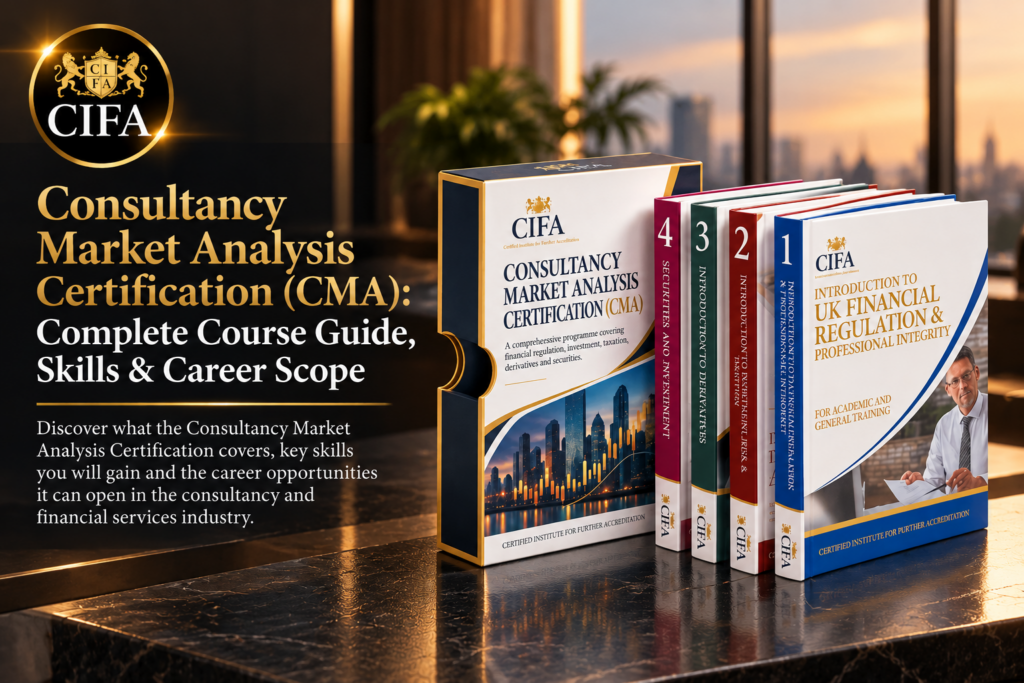
The Consultancy Market Analysis Certification offered by CIFA combines four related areas of financial education: UK Financial Regulation and Professional Integrity, Investment Risk and Taxation, Introduction to Derivatives, and Securities and Investment.
Designed as a Level 4 programme, the certification provides a structured learning option for graduates, aspiring finance professionals and existing practitioners seeking broader financial-market knowledge.
For individuals researching a Market analysis certification UK programme or an Online finance certification UK option, understanding the syllabus, assessment arrangements, fees and accreditation is essential before enrolling.
This guide examines the CIFA programme, its curriculum, the knowledge learners may develop and the professional pathways associated with financial-market analysis.
The Consultancy Market Analysis Certification is a four-module financial education programme offered by CIFA. It combines financial regulation, professional integrity, investment risk, taxation, derivatives and securities within a connected course structure.
The programme is advertised as a Level 4 Consultancy and Markets Analysis Certification, commonly abbreviated to CMA. It should not be confused with other qualifications using the same abbreviation, including those associated with management accounting.
Within financial services, consultancy and markets analysis involve understanding financial instruments, interpreting relevant information, recognising uncertainty and considering the regulatory environment surrounding financial decisions.
A market analyst might examine how economic conditions affect securities, while an investment-support professional may need to understand the risks associated with particular financial products. Someone working in compliance may focus on whether activities meet applicable regulatory expectations.
The CIFA CMA certification introduces knowledge relevant to these different activities without suggesting that one programme automatically qualifies learners to perform every professional function.
Learners can explore the official Level 4 Consultancy Market Analysis Certification to review the programme structure and enrolment information.
Unlike a course concentrating exclusively on investment products or financial regulation, the CMA programme connects four subjects that frequently overlap in professional financial analysis.
The CIFA programme consists of four specialist modules. Each addresses a different part of financial-market knowledge, while contributing to a broader understanding of investment analysis and professional responsibility.
The curriculum moves from the rules governing financial services towards the practical considerations involved in assessing investments, derivatives and securities.
Financial regulation establishes the standards and responsibilities that financial-services organisations and relevant professionals must consider when conducting regulated activities.
The UK Financial Regulation and Professional Integrity module introduces learners to the UK regulatory environment and the importance of ethical professional behaviour.
The Financial Conduct Authority (FCA) regulates the conduct of financial-services firms and markets within its remit, focusing on consumer protection, market integrity and effective competition.
The Prudential Regulation Authority (PRA), part of the Bank of England, supervises the safety and soundness of banks, insurers and certain other financial institutions. Its responsibilities differ from those of the FCA, although some firms are regulated by both authorities.
Understanding this distinction helps learners recognise why financial organisations may face different supervisory requirements.
Professional integrity is equally relevant. Transparency, fair treatment, responsible communication and the management of conflicts of interest contribute to appropriate professional conduct.
These principles are particularly relevant to Consultancy analyst skills, where financial information must be interpreted responsibly and communicated without misleading clients or colleagues.
Learners seeking additional background can consult the UK financial regulation and professional integrity guide.
This module provides the regulatory context needed to understand the investment-related subjects covered elsewhere in the CMA programme.
Investment decisions involve uncertainty. Different assets carry different exposures, and understanding these exposures is essential when evaluating potential outcomes.
The Investment Risk and Taxation course introduces risk considerations and the role taxation may play in financial planning and investment analysis.
Market risk refers to the possibility of losses resulting from changes in market prices, interest rates or other financial variables.
Credit risk concerns the possibility that a borrower or counterparty may fail to meet its financial obligations.
Liquidity risk arises when an investment cannot be sold or converted into cash promptly without a significant price concession.
These risks can interact. For example, deteriorating economic conditions may affect asset prices, borrowers’ creditworthiness and market liquidity simultaneously.
Learners also encounter the relationship between investment risk and potential return. Investments offering higher expected returns may expose investors to greater uncertainty, although higher risk does not guarantee higher returns.
Taxation introduces another consideration. Income tax, capital gains tax and other applicable tax rules can influence investment outcomes, depending on the investor’s circumstances and prevailing legislation.
The module supports the foundational knowledge associated with an Investment analysis qualification, particularly the ability to consider risk and tax implications alongside potential investment returns.
For further educational context, the investment risk and taxation explained article explores related concepts.
The objective is to understand how these considerations affect analysis, rather than to provide personalised investment or tax advice.
Derivatives are financial contracts whose value depends on an underlying asset, benchmark, interest rate or another reference variable.
The Introduction to Derivatives course covers important derivative instruments, including futures, forwards, options and swaps.
A futures contract generally establishes an agreement to buy or sell an underlying asset at a specified price on a future date, using standardised terms traded through an exchange.
A forward contract serves a similar economic purpose but is typically negotiated privately between counterparties.
An option provides its buyer with a contractual right, rather than an obligation, to buy or sell an underlying asset under specified conditions.
Swaps involve agreements to exchange cash flows, such as payments linked to fixed and floating interest rates.
These instruments can be used for hedging, which involves managing exposure to financial risks. They may also be used to obtain market exposure or pursue speculative strategies.
For example, a business exposed to changing exchange rates may use a suitable derivative contract to reduce uncertainty surrounding future currency payments.
However, derivatives can introduce leverage, counterparty exposure, liquidity concerns and potentially substantial losses. Their complexity means they require careful analysis.
The CIFA module introduces the analytical principles, market structures and risk-management applications associated with derivatives. Studying these concepts does not, by itself, establish advanced trading competence or authorisation to provide regulated advice.
Securities are financial instruments representing ownership interests, debt obligations or other investment rights.
The Securities and Investment course develops understanding of financial-market instruments and investment considerations.
Shares represent ownership interests in companies. Their values may be influenced by business performance, earnings expectations, interest rates and broader market conditions.
Bonds generally represent debt obligations under which issuers agree to make payments according to contractual terms. Bond prices can respond to changes in interest rates, creditworthiness and investor expectations.
Collective investment arrangements, including investment funds, allow investors to obtain exposure to portfolios of assets, subject to the structure and investment strategy of the particular product.
Understanding these instruments supports the evaluation of investment objectives, diversification, market conditions and potential risks.
Diversification involves spreading investments across different exposures to reduce concentration risk. It does not eliminate the possibility of financial loss.
A Financial markets analysis course becomes more useful when learners can connect product characteristics with the regulatory, taxation and risk concepts introduced elsewhere in the programme.
For additional background, the securities and investment course guide examines related learning areas.
Together, the four modules provide a connected introduction to how financial instruments operate, how their risks may be assessed and why professional standards matter.
The CMA programme can help learners develop subject knowledge and analytical awareness relevant to financial-services activities.
One important area is financial interpretation. Understanding the characteristics of securities, derivatives and investment risks can help learners approach financial information with greater structure.
Another is risk awareness. Financial analysis requires identifying potential sources of loss, recognising uncertainty and understanding why different instruments may behave differently under changing market conditions.
Regulatory awareness also matters. Professionals working with financial information need to recognise that product analysis and commercial objectives operate within legal, regulatory and ethical boundaries.
The programme’s emphasis on professional integrity can support an understanding of transparency, responsible judgement and appropriate professional conduct.
These areas contribute to Consultancy analyst skills, including evaluating information, recognising limitations and communicating reasoned conclusions.
For example, an analyst examining a bond investment may consider credit exposure, interest-rate sensitivity, liquidity and the investor’s objectives rather than concentrating exclusively on the advertised yield.
Similarly, someone supporting investment operations may benefit from understanding the difference between a conventional security and a derivative contract.
However, acquiring theoretical knowledge is not identical to demonstrating professional competence.
Employers may expect practical experience, financial modelling ability, workplace communication skills, knowledge of relevant systems and familiarity with their organisation’s procedures.
The CIFA certification can contribute to a learner’s educational foundation, while practical experience and further role-specific development remain important.
The Consultancy analyst career path is not a single standardised progression. It can involve several professional directions depending on an individual’s education, experience, interests and the requirements of prospective employers.
People exploring a Consultancy analyst certification UK programme may be interested in financial research, investment analysis support, investment operations, compliance or wealth-management support.
Investment analysis support may involve gathering financial information, reviewing securities, preparing research materials and assisting more experienced analysts.
Financial research roles can involve examining market developments, economic indicators, company information and investment trends.
Investment operations positions may focus on the administration, processing and oversight of investment transactions and related activities.
Compliance support roles involve helping organisations maintain appropriate processes, records and controls while operating within applicable regulatory requirements.
Wealth-management support can involve assisting teams responsible for investment administration, client documentation and portfolio-related activities.
Financial consultancy offers another possible direction, although responsibilities vary considerably between organisations and may require substantial experience or additional qualifications.
Learners interested in investment-related professional development can also examine the Investment Advisor Certification career guide for further context.
Completing the CMA programme does not guarantee eligibility for any particular position. Employers may require relevant degrees, technical competencies, professional experience or recognised qualifications beyond the course.
Regulated advisory activities may also involve specific qualification and competence requirements that cannot be satisfied merely by completing a general financial education programme.
A sensible career-development approach involves comparing the course syllabus with actual job descriptions and identifying any additional requirements.
The programme may appeal to learners seeking a broad introduction to connected areas of financial-market knowledge.
Graduates exploring finance-related careers may find the combination of regulation, securities, risk and derivatives useful for understanding the different responsibilities found within financial organisations.
Professionals already working in administration, operations or related financial-services functions may wish to broaden their understanding of investment products and regulatory considerations.
Career changers may also find structured learning useful when evaluating whether financial analysis or investment-support work matches their interests.
For those comparing a Level 4 consultancy certification with other educational options, the advertised level should be considered alongside the actual syllabus, assessment requirements and accreditation status.
A Level 4 designation does not automatically mean that a provider-issued certificate is equivalent to a regulated qualification on the UK qualifications framework.
The CIFA programme is therefore best assessed through its stated learning content and its relevance to an individual’s objectives.
Prospective learners should confirm any formal entry requirements directly with the provider before enrolment rather than assuming that a particular degree, age or period of work experience is mandatory.
Practical considerations are essential when evaluating an educational programme. Learners should understand the likely study commitment, full costs, examination arrangements and certification process before purchasing.
CIFA presents the CMA as an online financial education programme, allowing learners to access digital study resources.
The provider describes its learning arrangements as flexible and self-paced, making them potentially suitable for people balancing study with employment or other commitments.
Although the programme is promoted to graduates, aspiring professionals and existing practitioners, learners should confirm any applicable enrolment conditions directly with CIFA.
The provider advertises 610 CPD hours for the complete programme.
These hours represent the programme’s stated learning volume and should not be interpreted as a guaranteed calendar completion period.
Actual completion time depends on study availability, previous knowledge, learning pace and assessment preparation.
The advertised CMA bundle price is £1,249 for the four-module programme.
Each included course is separately listed at £358, meaning that purchasing all four individually would total £1,432 at the advertised prices.
The difference between these amounts is £183.
However, the bundle fee should not automatically be treated as covering every possible study-support or examination expense.
The published CIFA course fees and study-support costs list additional support packages of £72 for each individual module, covering prerecorded webinars and PowerPoint materials.
The same price list publishes a first-attempt examination fee of £149.99 per course, together with separate proctoring and resit charges denominated in US dollars.
Learners should confirm which charges apply to the CMA bundle, whether examinations are included and whether optional resources are required for their preferred study approach.
These details are particularly relevant when comparing the overall cost of an Online finance certification UK programme with other learning options.
CIFA describes online proctored examinations as part of its assessment arrangements.
Proctoring involves supervising or verifying an examination process remotely, helping providers establish examination integrity.
The provider states that successful candidates receive a digital certificate after the relevant examinations have been passed and proctored.
Printed certificates may also be available by post, with additional costs to be confirmed through customer service.
The individual course pages also advertise digital profiles, mock examinations and access to online learning resources.
Before enrolling, candidates should confirm examination fees, assessment requirements, resit arrangements, available support and the conditions for receiving the complete CMA certification.
Continuing Professional Development, commonly called CPD, refers to learning activities undertaken to maintain or improve professional knowledge and capability.
CIFA advertises its CMA programme as CPD accredited, with 610 CPD hours associated with the complete four-module structure.
A CPD-accredited consultancy course may provide useful evidence of structured professional learning, particularly for individuals maintaining development records or expanding their knowledge of financial markets.
However, CPD accreditation must be distinguished from other forms of recognition.
It does not automatically establish that a programme is a university degree, an Ofqual-regulated qualification or a professional licence.
Likewise, a provider’s Level 4 designation should not be interpreted as confirmation of formal qualification-framework regulation unless that status is independently established.
The CIFA CPD accreditation information provides the appropriate starting point for reviewing the provider’s published accreditation details.
Professionals should also check whether the programme satisfies the specific learning requirements of their employer, professional association or regulatory role.
An advertised number of CPD hours does not necessarily mean that every hour will qualify towards every individual’s annual professional-development obligations.
Choosing between a broad certification programme and a specialist course depends on the learner’s intended direction.
The CMA programme combines regulation, investment risk, taxation, derivatives and securities. This structure can be useful for individuals seeking an interconnected understanding of financial markets.
A specialist course may be more appropriate when a learner already possesses substantial financial knowledge and needs to develop expertise in a narrower subject.
For example, someone interested primarily in financial planning may prefer to investigate financial planning and advice training.
A learner focused on financial crime prevention and compliance may instead consider anti-money laundering and compliance training.
These are separate educational options offered by CIFA and are not additional modules included in the CMA bundle.
Learners should compare course content, entry conditions, assessments, costs and professional relevance rather than assuming that a broader programme is necessarily more suitable.
The principal feature of the CIFA CMA programme is its combination of four related financial subjects within one structured certification.
Instead of studying regulation, risk, derivatives and securities entirely independently, learners can examine how these areas influence one another.
The published programme also provides identifiable course modules, online learning arrangements, advertised CPD hours and a stated bundle price.
Digital certification and online examinations may be convenient for learners who prefer remote study, although assessment arrangements and associated charges should be confirmed before purchase.
The course’s value ultimately depends on how closely its content matches the learner’s professional objectives.
Prospective candidates should review the detailed module descriptions, compare the total costs with their budget and establish whether the programme provides the specific knowledge or recognition they require.
Before enrolling, consider whether your main objective is to understand financial markets broadly or to obtain a particular professional qualification.
If your interest lies in financial regulation, investment risk, derivatives and securities, the CMA syllabus offers a connected educational route across these subjects.
If you need eligibility for a regulated advisory position, specialist technical role or formal qualification requirement, investigate the relevant professional standards before choosing a course.
It is also worth assessing your existing knowledge. Beginners may need additional time to understand financial terminology, while experienced practitioners may find some material familiar.
Review the advertised learning hours realistically, allowing sufficient time for reading, revision and examination preparation.
Finally, confirm the complete financial commitment, including examination fees and optional study-support materials.
These considerations help establish whether the programme represents an appropriate investment in your professional development.
The Consultancy Market Analysis Certification brings together four important areas of financial education: UK regulation and professional integrity, investment risk and taxation, derivatives, and securities and investment.
Through this structure, learners can develop a broader understanding of how financial products, regulatory responsibilities and investment risks interact.
The CIFA programme may support professional development for individuals exploring financial research, investment operations, compliance support and related areas.
Nevertheless, course completion does not guarantee employment, promotion or authorisation to provide regulated financial advice.
The most useful decision is one based on the actual syllabus, confirmed costs, assessment arrangements and the requirements of the learner’s intended professional direction.
Prospective candidates can review the official CMA programme information to determine whether its learning objectives align with their needs.
The Consultancy Market Analysis Certification is a four-module financial education programme from CIFA covering regulation, investment risk, taxation, derivatives and securities. The CIFA CMA certification supports structured financial-market learning. Review the Consultancy Market Analysis Certification programme for the full curriculum and enrolment details.
Yes. CIFA advertises its CMA programme as a Level 4 certification covering four financial subjects. The Level 4 consultancy certification designation describes the provider’s advertised course level, but does not automatically establish Ofqual regulation or degree equivalence. Check the CIFA Level 4 CMA course details and confirm any recognition required for your intended role.
The CIFA CMA certification combines UK Financial Regulation and Professional Integrity, Investment Risk and Taxation, Introduction to Derivatives, and Securities and Investment. These subjects provide connected knowledge of regulation, financial instruments and risk. The four CMA course modules are described on the official CIFA programme page, where learners can review their content.
The programme may suit graduates, aspiring finance professionals, career changers and existing practitioners seeking broader financial-market knowledge. CIFA combines regulation, risk and investment subjects in one programme. A Market analysis certification UK option is worth considering when its curriculum aligns with your learning objectives, experience and intended professional direction.
CIFA presents the programme to learners with different professional backgrounds, including aspiring finance professionals and existing practitioners. Previous experience may help with technical subjects, but applicants should confirm formal eligibility requirements before enrolling. Those considering an Online finance certification UK course should also assess their familiarity with financial terminology.
CIFA advertises 610 CPD hours for the complete CMA programme. These represent the stated learning volume rather than a fixed completion period. The online format allows flexible study, but actual progress depends on previous knowledge, available study time and examination preparation. Learners considering a Financial markets analysis course should plan a realistic study schedule.
CIFA currently advertises the four-module CMA bundle at £1,249, compared with £358 per module when purchased individually. Additional study-support, examination and proctoring charges may apply. Before purchasing this Level 4 consultancy certification, consult the current CIFA course fees and confirm the total payable amount, including any assessment costs.
The CIFA programme can help learners understand financial regulation, investment products, taxation, derivatives and risk assessment. Relevant Consultancy analyst skills include interpreting financial information, recognising investment risks and applying ethical principles. However, professional competence also depends on practical experience, further learning and role-specific technical requirements.
The Consultancy analyst career path may involve investment research support, financial operations, compliance assistance, wealth-management support or related analytical activities. CIFA provides relevant subject knowledge, but certification alone does not guarantee employment or professional authorisation. Actual opportunities depend on previous qualifications, practical experience and employer requirements.
CIFA advertises its CMA programme as CPD accredited, with 610 CPD hours. A CPD-accredited consultancy course can support professional learning records, but accreditation does not automatically establish Ofqual regulation, degree status or universal employer recognition. Review the CIFA CPD accreditation information and confirm whether the programme meets your specific professional requirements.
CIFA is a trusted education provider specializing in finance and compliance training. We empower learners with practical knowledge, industry-relevant skills, and accredited courses designed to build strong careers in financial services, risk management, and regulatory compliance.
© CIFA 2020-2025 ALL RIGHTS RESERVED