
Understanding commercial finance requires considerably more than recognising different types of business loans. A sound lending decision depends on why a business needs funding, how it generates income, whether it can afford repayments and how its financial circumstances align with a lender’s requirements.
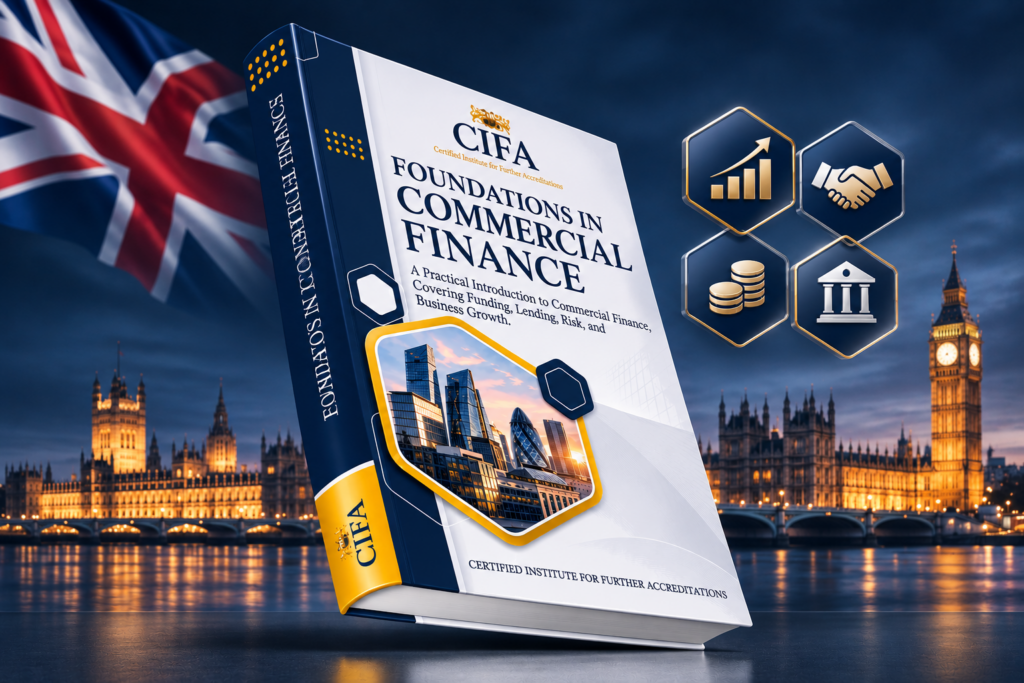
For individuals seeking structured financial education, CIFA offers the Foundation to Commercial Finance course, covering eight chapters that connect business lending principles with financial analysis, cash flow forecasting, credit assessment, funding proposals, regulation and transaction management.
The programme is currently advertised as a Level 4, Intermediate digital course carrying 40 CPD hours. Its curriculum introduces the analytical and professional considerations involved in evaluating business finance requirements.
Whether you are researching a Commercial finance course UK option, developing existing finance knowledge or exploring commercial lending as a professional subject, understanding the course content, assessment arrangements and total costs is essential before enrolling.
Commercial finance refers to funding arrangements used by businesses to support their activities, manage financial commitments and pursue commercial objectives.
A manufacturer might require finance to purchase machinery, while a retailer may need additional working capital before a seasonal increase in sales. Another business might seek funding to expand its premises or manage the period between issuing invoices and receiving payment.
Although these situations involve borrowing, their financial requirements are different.
Business lending explained begins with recognising that the appropriate funding arrangement depends on the purpose of borrowing, the financial condition of the business and its expected ability to repay.
Commercial finance also differs from personal borrowing in its purpose and assessment considerations. Business lenders may examine trading performance, business assets, existing liabilities, management information and projected cash flow. Personal borrowing assessments generally focus more directly on the individual’s financial circumstances.
However, regulatory treatment depends on the actual borrower, agreement and transaction rather than the description of the loan alone.
The first chapter of CIFA‘s programme establishes the principles underlying commercial borrowing.
Learners explore why businesses seek finance, how funding supports commercial activities and why lenders evaluate applications before providing facilities.
An important distinction is the difference between a business needing money and a business demonstrating that borrowing is financially sustainable.
For example, purchasing equipment may improve production capacity, but the business must still consider the repayments, installation costs, maintenance expenditure and time required before the investment generates additional revenue.
This chapter provides the conceptual foundation for the financial analysis and lending assessment subjects developed later in the course.
Financial statements provide important evidence about a business’s performance, financial position and ability to meet its obligations.
Understanding these documents is central to commercial lending because borrowing decisions should be informed by financial information rather than revenue figures or business projections alone.
Financial statement analysis for lending involves examining financial information to understand profitability, financial stability, existing obligations and potential repayment capacity.
The income statement reports revenue, expenses and profit over a particular accounting period. It helps explain whether the business generates an operating surplus and how its costs affect profitability.
The balance sheet presents assets, liabilities and equity at a particular date. Lenders may examine working capital, outstanding borrowing, available assets and the relationship between short-term obligations and resources.
The cash flow statement explains how cash enters and leaves the business through operating, investing and financing activities.
These statements should be considered together.
A profitable business may have substantial outstanding customer invoices, while another may report modest accounting profits but maintain consistent cash receipts.
Financial ratios can support analysis, but no single ratio or accounting period independently determines whether a business qualifies for finance.
Learners who want to strengthen their underlying accounting knowledge can explore the Accounting and Finance for Business course, which is a separate educational option rather than a stated compulsory prerequisite.
The Accounting and Finance for Business guide also provides related subject context.
Profitability and cash availability are not interchangeable.
A business may record revenue when a sale occurs but receive the corresponding payment several weeks later. Meanwhile, wages, rent, suppliers and loan repayments may require immediate settlement.
Cash flow forecasting for business finance involves estimating future cash receipts and payments to understand whether sufficient funds are likely to be available when obligations become due.
A useful forecast considers expected customer payments, operating expenditure, taxation where relevant, existing borrowing, seasonal fluctuations and planned investments.
Affordability assessment then considers whether proposed repayments can be supported without undermining normal business operations.
For example, a business forecasting £20,000 in monthly receipts cannot automatically afford a £5,000 repayment. Its operating costs, existing commitments, payment timing and available cash reserves must also be considered.
Forecasts depend on assumptions. Changes in sales, delayed customer payments or unexpected expenses may materially alter the outcome.
The chapter therefore encourages understanding the relationship between projected cash generation, financial uncertainty and sustainable borrowing rather than relying on a universal affordability formula.
Commercial lending involves matching funding requirements with appropriate financial arrangements and evaluating the risks associated with repayment.
Business funding solutions UK providers offer different forms of finance for different commercial purposes.
Term loans may support defined investments or expansion expenditure, with repayments structured over an agreed period.
Working capital facilities may help businesses manage short-term operational requirements, although their suitability depends on the facility’s terms and the business’s cash cycle.
Asset finance can support the acquisition or use of equipment, vehicles and other qualifying business assets.
Invoice finance may allow eligible businesses to access funds against qualifying unpaid invoices, subject to the provider’s requirements and contractual arrangements.
The important question is not simply which facility is available. It is whether its structure, repayment obligations, costs and conditions suit the business’s actual requirements.
This chapter explains funding solutions educationally. It does not establish that CIFA provides these lending facilities or guarantees access to them.
Credit assessment training introduces the factors lenders may consider when evaluating a business finance application.
These can include the purpose and amount of borrowing, trading history, financial statements, cash flow, existing debt, management information and repayment affordability.
Where relevant, lenders may also consider security, guarantees and the financial circumstances of individuals providing them.
Lender criteria for business finance vary between providers. A lender specialising in established businesses may have different requirements from one considering newer enterprises or asset-backed transactions.
Documentation standards, acceptable risks, lending limits and security requirements can also differ.
A Commercial lending course should help learners understand these distinctions without suggesting that every application follows the same decision-making process.
Risk awareness is relevant to financial assessment more broadly. CIFA offers a separate investment risk and taxation course, which examines investment-related risk and taxation rather than commercial credit approval.
The investment risk and taxation guide provides further background on that subject.
Although investment risk and lending risk both require analytical judgement, they concern different financial decisions.
Completing the commercial finance course does not authorise a learner to approve loans or act on behalf of a lender.
Financial knowledge becomes more useful when it is connected to a clear understanding of a client’s commercial circumstances.
Client fact-finding involves gathering information needed to understand a business’s borrowing requirements.
This may include its activities, ownership structure, trading history, financial performance, existing borrowing and intended use of funds.
The amount required, expected timing and reasons for borrowing should be established accurately.
For example, a business requesting £100,000 for expansion may need to explain how that figure was calculated, when the expenditure will occur and what financial benefits are reasonably expected.
A funding proposal can then present the relevant facts, supporting documents, borrowing purpose and financial information in an organised format.
Good fact-finding reduces the risk of relying on unsupported assumptions about eligibility or affordability.
Once a funding requirement has been identified, the transaction may involve documentation requests, clarification of financial information, communication with relevant parties and monitoring progress.
Transaction management requires attention to accuracy, deadlines and expectations.
A professional involved in coordinating information should distinguish between what has been requested, what has been submitted and what has actually been approved.
Clear communication also helps prevent clients from misunderstanding indicative discussions as confirmed lending decisions.
The course introduces these responsibilities as educational subjects. It does not guarantee client placements, live transactions, lender-panel access or authority to submit or approve applications.
Individuals interested in broader financial analysis may separately investigate CIFA‘s Consultancy Market Analysis Certification. CMA concerns a different educational pathway and should not be confused with commercial finance transaction management.
Professional integrity is important throughout the commercial finance process, particularly when handling financial information, discussing funding options and communicating with clients.
Responsible conduct includes providing accurate information, avoiding misleading representations, treating client information appropriately and being transparent about relevant costs and limitations.
The UK regulatory framework also requires careful interpretation.
The Financial Conduct Authority explains that some business lending to sole traders and small partnerships falls within the consumer credit regulatory perimeter, particularly certain borrowing arrangements of £25,000 or less.
Much other commercial lending, including many arrangements involving limited companies, falls outside that perimeter. The applicable position depends on the transaction and relevant legal provisions.
The Financial Conduct Authority’s SME finance review provides official context on the scope of its regulation.
Commercial credit broking can also require regulatory permission where the activity falls within the regulated perimeter. The FCA’s guidance for primary credit brokers explains relevant authorisation considerations.
CIFA‘s course develops regulatory awareness but does not automatically make a learner FCA-authorised, an authorised finance broker, a regulated lender or a financial adviser.
For additional education, the UK financial regulation course addresses regulation and professional conduct as a separate subject.
The UK financial regulation guide offers related reading.
Regulatory awareness should support responsible professional behaviour, not replace transaction-specific legal or compliance advice.
The programme’s eight chapters form a connected learning sequence.
Commercial Finance Fundamentals introduces the purpose and principles of business borrowing.
Financial Statement Analysis develops understanding of financial performance and position, while Cash Flow Forecasting and Affordability considers the timing and sustainability of repayments.
Business Funding Solutions introduces different financing structures. Credit Assessment and Lender Criteria examines how applications may be evaluated.
Client Fact Finding and Funding Proposals addresses the collection and presentation of relevant business information.
Regulation and Professional Integrity introduces professional responsibilities and regulatory awareness.
Finally, Transaction Management and Client Relationships examines the coordination and communication involved in progressing funding arrangements.
Together, these subjects develop knowledge relevant to Commercial finance skills, particularly financial interpretation, lending analysis and client-focused communication.
The published learning resources include a capstone assessment, practical templates, glossary, knowledge-check answers, extended workshop and case answer guidance, references and optional further reading.
The course description also identifies practical case studies.
These resources can help learners consolidate concepts, practise structured reasoning and review their understanding.
A practical template, for example, may illustrate how information can be organised, while a case study can encourage consideration of financial circumstances and possible lending implications.
However, the published resources should not be interpreted as guaranteed live client work, supervised professional practice or separate live teaching sessions.
CIFA currently identifies the programme as Level 4, Intermediate, with 40 CPD hours.
Its delivery format is digital, and the listed language is English.
An important distinction concerns the course title. Although Foundation to Commercial Finance includes the word Foundation, its published level is Intermediate.
The title should therefore not be interpreted as confirmation that the programme is designed for complete beginners.
The course page does not clearly specify formal entry requirements. Prospective learners should confirm their eligibility and recommended preparation directly with CIFA.
The 40 CPD hours represent the published learning allocation. They do not guarantee completion within a particular number of days or weeks.
As a Commercial finance CPD course, the programme may be relevant to individuals maintaining or developing finance-related knowledge, subject to any requirements imposed by their own employer or professional body.
The official course information identifies CPD verification, mock examinations for each chapter, lifetime portal access and a Digital Profile.
The portal provides access to the digital learning environment, while chapter mock examinations support preparation and knowledge review.
The Digital Profile is an additional published feature, although its inclusion should not be confused with employment placement or professional authorisation.
Readers can review the provider’s CIFA CPD accreditation information for further context.
CPD recognition does not automatically make the course a university degree, an Ofqual-regulated qualification or an FCA-approved professional licence.
Understanding the complete financial commitment is important because enrolment, examination and optional study support are not necessarily covered by a single payment.
The official course page currently lists Foundation to Commercial Finance at £425.
It also displays a previous price of £599 and an advertised discount of 29%.
These are published website prices rather than permanent guarantees. Learners should confirm the amount payable at checkout.
The enrolment price covers the digital course offering, including the learning materials and resources described on its official page.
The general CIFA price list describes course enrolment as including an e-book, mock examinations, a Digital Profile and careers panel access. However, the Foundation course does not currently appear as a separate row on that price list, so the applicability of every general price-list feature should be confirmed.
The course page independently identifies chapter mock examinations, lifetime portal access and a Digital Profile.
The published general examination price list identifies a first-attempt examination fee of £149.99 per course.
A separate online examination proctoring charge of $16 per examination is listed.
The examination resit charge is also listed as $16 per examination. Learners should confirm how proctoring charges apply to any resit.
Using the currently displayed Foundation course price and the general first-attempt examination fee, the GBP subtotal is:
£425 + £149.99 = £574.99
This excludes the separate $16 proctoring charge and any other applicable charges.
The general price list also displays a £72 additional study-support package for various individual courses. This package includes prerecorded webinars and PowerPoint presentations.
However, because Foundation to Commercial Finance is not separately listed in that pricing table, availability of the £72 package for this particular course requires confirmation.
If CIFA confirms that the package is available at £72, the GBP subtotal would be:
£425 + £149.99 + £72 = £646.99
The separate $16 proctoring charge would still apply where required.
The dollar-denominated charges have not been converted into pounds because the applicable exchange rate and payment arrangements may vary.
The included study resources should also be distinguished from the optional prerecorded webinar and presentation package. The latter should not be assumed to be part of the £425 enrolment price.
The programme includes mock examinations per chapter and identifies a Certificate of Achievement as its completion credential.
According to the published course information, the certificate is awarded after successfully completing and passing the examination.
Purchasing the course, accessing the materials or completing practice questions alone does not guarantee certification.
Prospective learners should confirm the current examination booking process, applicable charges and any assessment conditions before making payment.
The course may interest individuals exploring business finance, commercial lending, credit assessment, financial analysis and funding proposals.
It may also be relevant to existing finance professionals who want a more structured understanding of commercial borrowing and the relationship between business performance and lending decisions.
For someone already familiar with accounting or business operations, the course provides an opportunity to examine those subjects from a lending perspective.
Individuals with limited finance experience should consider the advertised Intermediate level carefully.
The official information does not clearly establish whether previous qualifications or professional experience are required. Consequently, suitability for complete beginners cannot be guaranteed.
Prospective learners should contact CIFA to clarify eligibility, expected prior knowledge and the level of preparation appropriate to their circumstances.
The curriculum provides educational knowledge relevant to finance-related activities. It does not establish guaranteed employment, promotion, salary outcomes or independent professional authority.
Further study depends on which areas of finance a learner wishes to understand more deeply.
Accounting and Finance for Business can support additional knowledge of accounting information, financial reporting and business financial analysis.
Investment Risk and Taxation explores different financial risks and taxation considerations, although its subject matter is distinct from commercial lending decisions.
UK Financial Regulation and Professional Integrity provides a separate opportunity to study regulatory principles and professional responsibilities.
CIFA also offers the Consultancy & Markets Analysis Certification, known as CMA.
The CMA information currently published across CIFA‘s pages is not fully consistent. The live bundle page displays three courses and 410 hours at £1,249, including Foundation to Commercial Finance, while other official CMA educational material describes four modules and 610 CPD hours.
The four-module description covers UK Financial Regulation and Professional Integrity, Investment Risk and Taxation, Derivatives, and Securities and Investment.
Because these descriptions differ, learners should obtain confirmation of the current bundle contents, hours and price directly from CIFA before enrolling.
CMA should be treated as a separate programme, not as an automatic continuation of Foundation to Commercial Finance.
None of these additional subjects establishes automatic admission, credit transfer, exemptions or guaranteed professional progression.
A distinguishing feature of the published course is the way its eight chapters connect commercial lending principles with practical financial analysis and professional responsibilities.
Rather than examining funding products in isolation, the curriculum moves from understanding business borrowing to interpreting financial statements, assessing cash flow and considering lender requirements.
It then addresses client information, proposal preparation, regulatory awareness and transaction coordination.
The programme is currently listed as a digital Level 4, Intermediate course with 40 CPD hours.
Published resources include chapter mock examinations, practical templates, case studies, a glossary and assessment guidance, alongside lifetime portal access and a Digital Profile.
The Certificate of Achievement is conditional on successfully completing and passing the examination.
These features may make the programme worth considering for individuals whose learning objectives align with commercial finance and lending analysis.
However, the value of the course should be assessed against its actual curriculum, cost, study requirements and the learner’s intended use of the knowledge.
Commercial finance requires an understanding of how businesses operate financially, why they borrow and whether proposed funding arrangements are sustainable.
Financial statements, cash flow forecasts, affordability, lender criteria and client requirements all contribute to a more informed assessment of business lending.
The Foundation to Commercial Finance course from CIFA brings these subjects together through eight chapters covering commercial finance fundamentals, financial analysis, cash flow, funding solutions, credit assessment, client fact-finding, professional integrity and transaction management.
The course is currently advertised as Level 4, Intermediate, with 40 CPD hours and an enrolment price of £425.
The general first-attempt examination fee of £149.99 produces a GBP subtotal of £574.99, before the separate $16 proctoring charge. A potential £72 optional support package would increase the GBP subtotal to £646.99, subject to confirmation that it is available for this course.
Prospective learners should review the curriculum, confirm entry expectations and clarify all applicable charges before enrolling.
For those seeking structured knowledge of commercial finance and business lending, the programme offers a defined educational syllabus through which to assess their learning objectives.
CIFA offers a Level 4 course introducing commercial finance, business lending, financial analysis, cash flow, credit assessment and transaction management. Anyone researching a Commercial finance course UK option can review the official Foundation to Commercial Finance course to examine its published curriculum and learning resources.
The CIFA programme contains eight chapters covering commercial finance fundamentals, financial statement analysis, cash flow forecasting, business funding solutions, credit assessment, client fact-finding, regulation and transaction management. These subjects develop knowledge of Commercial finance skills, including financial interpretation, funding requirements and professional communication.
This Commercial lending course may interest people exploring business lending, financial analysis, credit assessment and commercial finance. CIFA advertises the programme at Intermediate level rather than explicitly as a beginner course. Since specific entry requirements are not clearly published, prospective learners should confirm their eligibility and recommended preparation directly with the provider.
CIFA currently lists enrolment at £425 for this Commercial finance course UK option. Its general price list shows a £149.99 first examination fee and separate $16 proctoring charge. A £72 optional support package requires course-specific confirmation. Review course fees and exam costs and confirm all charges before paying.
The official CIFA course page currently lists 40 CPD hours and identifies the programme as Level 4, Intermediate. As a Commercial finance CPD course, it provides a published learning allocation rather than a guaranteed completion timetable. The actual calendar time required will depend on the learner’s existing knowledge, study arrangements and preparation for the examination.
The official CIFA course page does not clearly specify a mandatory prior-experience requirement, although the programme is advertised at Intermediate level. Individuals considering Credit assessment training should therefore confirm eligibility, expected financial knowledge and recommended preparation directly with the provider. Suitability for complete beginners should not be assumed.
CIFA provides chapter mock examinations and awards a Certificate of Achievement after successful completion and passing the examination. Examination and proctoring charges are separate. Learners developing Commercial finance skills can also review how to verify your certificate through the provider’s certificate ID verification facility.
Commercial finance involves funding arrangements businesses may use for equipment, working capital, expansion or operational needs. Suitable Business funding solutions UK options depend on financial circumstances and repayment capacity. For broader education, CIFA readers can consider the Consultancy Market Analysis guide, which concerns a separate programme, not a commercial lending module.
Credit assessment involves reviewing financial performance, cash flow, existing commitments, affordability and the purpose of borrowing to understand lending risk. Lender criteria for business finance differ according to each provider’s policies and risk appetite. CIFA introduces these principles educationally, but completing its course does not authorise a learner to approve loans or make decisions for a lender.
After studying commercial finance with CIFA, learners may explore accounting, investment risk, taxation or financial regulation according to their interests. Financial statement analysis for lending can connect naturally with further accounting education. Consider reviewing CIFA‘s accountancy courses, recognising that admission, exemptions and progression are not automatic.
CIFA is a trusted education provider specializing in finance and compliance training. We empower learners with practical knowledge, industry-relevant skills, and accredited courses designed to build strong careers in financial services, risk management, and regulatory compliance.
© CIFA 2020-2025 ALL RIGHTS RESERVED