
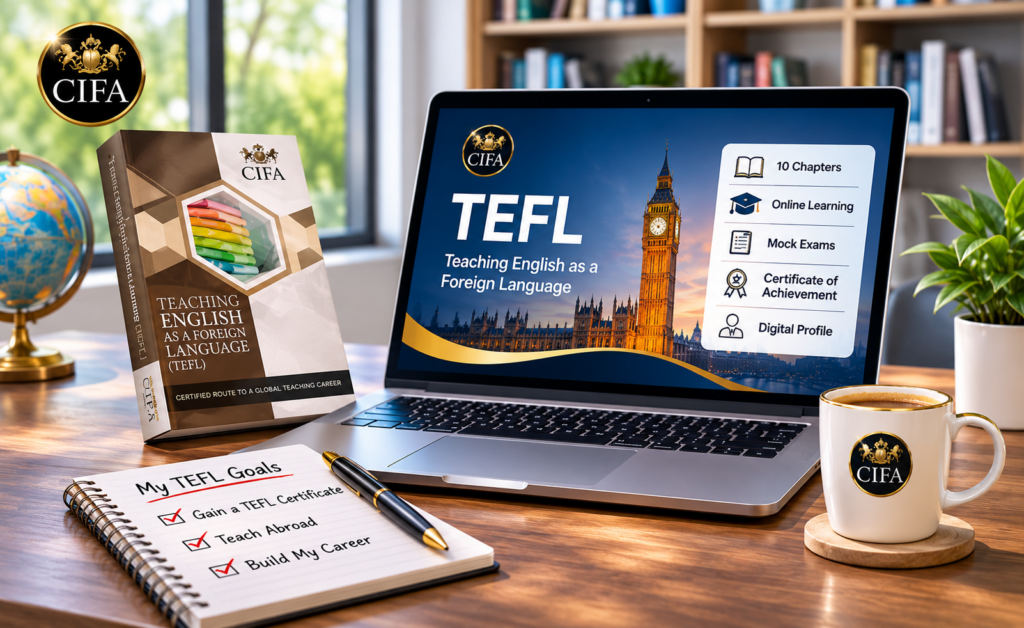
Teaching English to speakers of other languages is one of the most accessible ways to build an international career. Whether you dream of working in a language school abroad, tutoring students online from your living room, or simply adding a valuable skill to your CV, a TEFL course online can be your first step.
The challenge is choosing the right course. Prices vary, content varies, and not every provider explains clearly what you will learn or who the course suits. That is why CIFA publishes its course details openly. In this guide, we explain the curriculum, the cost, the entry requirements and the kind of learner who gets the most from the CIFA Teaching English as a Foreign Language course.
By the end, you will know exactly what is included, what is not, and whether this course fits your goals.
TEFL stands for Teaching English as a Foreign Language. It refers to teaching English to learners whose first language is not English, usually in a country where English is not the main language. Millions of people worldwide study English for work, travel and education, and that demand creates opportunities for trained teachers.
Common reasons people choose a TEFL certificate include:
A TEFL qualification gives you a structured foundation in how to teach: how to plan lessons, explain grammar, develop speaking and listening, and manage a classroom. Without that foundation, even fluent English speakers often struggle to explain why the language works the way it does.
CIFA is an online education provider based in London, built around one mission: bridging the gap between education and employment. Our TEFL course follows the same approach as every CIFA programme.
The course is delivered digitally with lifetime portal access, so you study when and where it suits you. You can fit chapters around work, family or travel without any fixed class timetable.
Each chapter includes a mock exam, helping you test your understanding before the final assessment. This keeps you confident and makes revision far more efficient.
CIFA’s online exams can be taken from home, using facial recognition to verify your identity. You will find clear guidance on the exam information page before you book.
After you pass the exam, you receive a Certificate of Achievement. You also get a personal digital profile to showcase your learning to employers, schools and recruiters.
Here are the key facts, taken directly from the course page.
Detail | Information |
Course | Teaching English as a Foreign Language (TEFL) |
Level | Beginner |
Price | £240 |
Language | English |
Format | Digital, online |
Chapters | 10 |
Included | Mock exams per chapter, lifetime portal access, Certificate of Achievement after passing the exam, personal digital profile |
Optional extras | Webinars and PowerPoint slides for each chapter (additional charge) |
Entry requirement | A Level 3 qualification (A level or equivalent) and fluency in reading, writing and speaking English |
You can compare this with other options on the CIFA course price list.
The CIFA TEFL curriculum is organised into ten chapters that take you from the basics of English teaching to confident classroom practice. Here is what each chapter covers.
This opening chapter introduces the world of teaching English as a foreign language: what TEFL is, where teachers work and what the role involves day to day. It gives you the context you need before moving into practical skills.
Learners are not all at the same stage. This chapter explains how English ability is described in levels and introduces the exams your students may be preparing for. Understanding levels helps you pitch lessons at the right difficulty.
Good teaching starts with a good plan. You learn how to set clear aims, structure a lesson and choose activities that help students progress. Strong lesson planning is one of the skills employers value most.
Many learners feel nervous about teaching grammar. This chapter builds your confidence in explaining how English works, so you can answer student questions clearly and accurately.
Pronunciation and vocabulary are at the heart of speaking fluently. Here you explore how sounds work in English and how to help learners build and remember new words.
Every student learns differently. This chapter looks at learning styles and the role of a growth mindset, helping you motivate students and support those who lack confidence.
Modern English teaching focuses on real communication. You learn how to create classroom activities that get students speaking, listening and interacting rather than sitting silently.
Reading, writing, listening and speaking are the four core skills. This chapter shows how to develop each one and how to balance them within your lessons.
How do you know if your students are improving? This chapter introduces ways to assess learners fairly and give feedback that helps them move forward.
Even the best lesson plan fails without a well-managed classroom. This final chapter covers strategies for keeping students engaged, organised and respectful, in a real or online classroom.
Together, these chapters give you the core knowledge behind most English teaching jobs. The mock exams that follow each chapter help you check your progress as you go.
Price is one of the first things learners ask about. TEFL courses vary widely in cost, so it pays to understand exactly what you are paying for.
The CIFA TEFL course costs £240. For that price you receive:
Optional extras, including webinars and PowerPoint slides for each chapter, are available for an additional charge if you prefer more guided support.
CIFA publishes its fees openly, and you can see every course on the CIFA price list. To explore the wider catalogue of English and language courses, visit the English teaching courses section.
This course suits a wide range of learners. You might be a good fit if you are:
The course asks for a Level 3 qualification (A level or equivalent) and fluency in reading, writing and speaking English. You do not need previous teaching experience, which is why the course is rated at beginner level.
A TEFL certificate can support several different routes:
Remember that every country, school and visa route has its own rules. Some employers ask for specific TEFL hours or a particular type of qualification, so always check job requirements before you enrol.
CIFA supports your job search with a video resume, a scannable QR code you can add to your CV, and a place where employers can hire candidates directly. For tips on presenting yourself well, read our guide to the Employability Accelerator Package.
At CIFA we believe in being transparent. The TEFL course page lists the chapters, the price, the entry requirement and what is included. It does not state a total number of study hours or an external accreditation specific to this course.
Because TEFL jobs differ so much, we recommend you check what your target employer or country requires before you buy any TEFL course. Some roles ask for a minimum number of training hours, while others simply want proof that you have studied teaching methods. If you are unsure, contact CIFA and our team will help you understand whether the course matches your plans.
You can also read about CIFA’s wider standing in our guide, Is CIFA Recognised in the UK?, and learn more about our approach on the CPD accreditation page.
With so many providers, here is a simple checklist to help you compare options.
CIFA’s certificates can be confirmed using our certificate verification tool, so anyone you share your results with can check they are genuine.
Studying online gives you freedom, but it also needs discipline. These habits will help:
Teaching English and learning English often go hand in hand. If you want to improve your own skills or support students preparing for tests, explore our IELTS course and our blog guide, IELTS Course Online: A Complete Guide for Beginners. Understanding how exams like IELTS work will help you teach with more confidence.
If you are interested in the bigger picture of what CIFA offers across finance, healthcare, language and professional development, start with What is CIFA? and our student support guide.
Many learners rush into a course and regret it later. Avoid these common errors:
If you are comparing several options, the CIFA language courses section is a good place to see what else is available alongside TEFL.
Beyond the certificate itself, the course develops practical skills that transfer into many roles:
These skills are useful far beyond English teaching. They support careers in training, tutoring, education support, customer service and team leadership.
Many learners choose TEFL so they can teach from home. If online tutoring is your goal, prepare a few practical things alongside your CIFA studies:
Putting these pieces in place while you study means you can start applying for teaching roles as soon as you pass your exam.
Starting is easy:
Have questions first? Visit our FAQs, learn more about CIFA, or browse more helpful guides on the CIFA blog.
A TEFL course online is a practical, affordable way to start teaching English. With ten chapters, mock exams, lifetime access and exams you can sit from home, the CIFA course gives beginners a clear path into English language teaching. It costs £240, asks for a Level 3 qualification and fluent English, and comes with a Certificate of Achievement and a digital profile to help you stand out.
Just remember to check your target employer’s requirements first, so the course fits your plans perfectly. When you are ready, explore the CIFA TEFL course, browse all CIFA courses, or visit cifa.blog for more guides to help your career grow.
It is a course that teaches you how to teach English to speakers of other languages, delivered over the internet. You study lesson planning, grammar, pronunciation, skills and classroom management at your own pace.
The course costs £240. Webinars and PowerPoint slides for each chapter are optional extras available for an additional charge. See the price list for current fees.
The course has ten chapters: Introduction to TEFL, EFL Levels and Exams, Lesson Planning, Grammar, Phonology, Pronunciation and Vocabulary, Learning Styles and Growth Mindset, Communicative Classrooms, The Four Language Skills, Assessment and Classroom Management.
No. The course is at beginner level. You need a Level 3 qualification (A level or equivalent) and fluency in reading, writing and speaking English.
Yes, as long as you meet the entry requirement of fluency in reading, writing and speaking English, and hold a Level 3 qualification or equivalent.
You sit the exam online from home, and CIFA uses facial recognition to verify your identity. Read the online exams page for details.
After you successfully complete the course and pass the exam, you receive a Certificate of Achievement, and you also have a personal digital profile to share with employers.
It can support your application by showing you have studied teaching methods, but we cannot guarantee a job. Employers and countries set their own requirements, so check them before you enrol.
The course page does not state a total number of study hours or an external accreditation specific to this course. If your target employer asks for a set number of hours, confirm this before buying.
Register for a free account, find the TEFL course in the catalogue and add it to your cart. You can start from the TEFL course page or contact the team with any questions.
CIFA is a trusted education provider specializing in finance and compliance training. We empower learners with practical knowledge, industry-relevant skills, and accredited courses designed to build strong careers in financial services, risk management, and regulatory compliance.
© CIFA 2020-2025 ALL RIGHTS RESERVED