
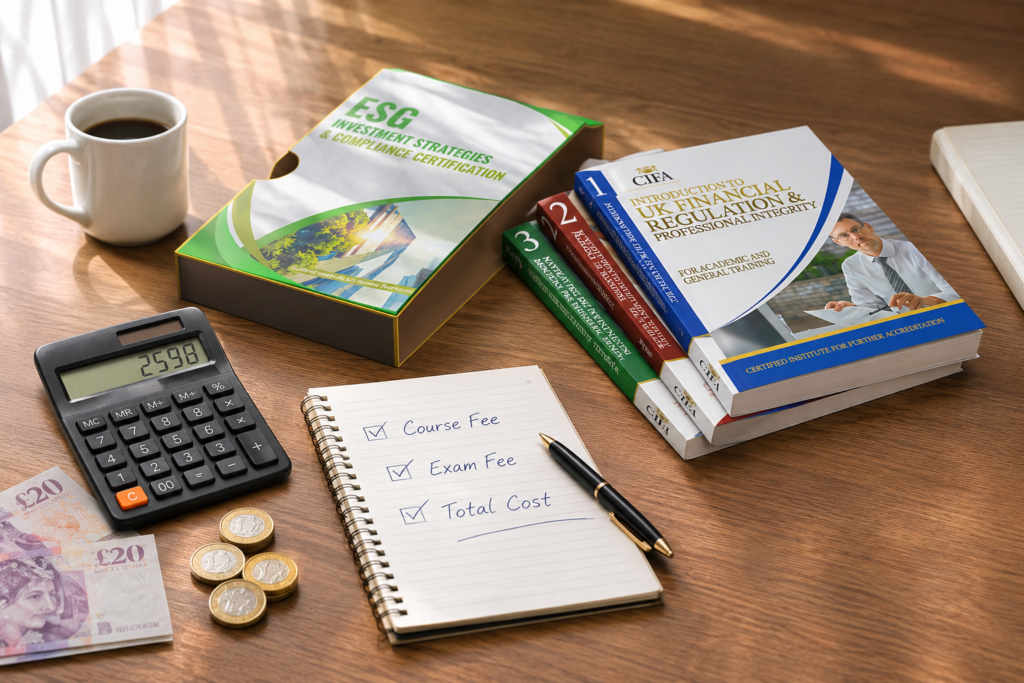
The ESG Certification Cost UK depends on more than the price advertised when enrolling. At CIFA, the standalone ESG course costs £358, while the three-course ESG Investment Strategies & Compliance Certification bundle costs £897. However, examination fees, online proctoring charges and optional study support can increase the amount a student needs to budget.
For the standalone course, the published first-attempt examination fee is £149.99, with a separate $16 online proctoring charge. This creates an illustrative first-attempt total of £507.99 plus $16, before optional study support.
Students can choose the Navigating ESG Investments course for dedicated ESG learning or the ESG certification bundle for three courses covering ESG, UK financial regulation, investment, risk and taxation.
The important distinction is that CIFA lists examination charges separately from enrolment. The exact examination billing arrangement for the three-course bundle also requires confirmation before its final payable cost can be established.
This article explains CIFA‘s published fees, included learning resources, examination expenses, optional support packages and realistic total-cost scenarios. It focuses on these specific products rather than attempting to estimate the prices charged by every ESG certification provider in the UK.
For students asking How much does an ESG certification cost, the first step is to separate the enrolment fee from the cost of completing the examination process.
The published ESG course price for CIFA‘s standalone Navigating ESG Investments: Strategies for Sustainable Success course is £358. This covers the listed digital learning resources but does not include the separately charged first-attempt examination.
The three-course ESG Investment Strategies & Compliance Certification bundle has an enrolment price of £897. It provides access to three different courses rather than only the standalone ESG programme.
The published ESG course fees UK comparison therefore begins with £358 for standalone enrolment and £897 for bundle enrolment. These figures should not be confused with examination-inclusive totals.
The official price list identifies a £149.99 first-attempt examination fee per course, a separate $16 online proctoring charge per examination and a $16 resit charge. Optional study support is priced at £72 for the standalone course and £180 for the bundle.
A student’s final expenditure depends on the chosen enrolment route, applicable examination billing, number of examination attempts and whether additional support materials are purchased.
The £358 standalone enrolment fee provides access to the digital ESG learning programme and its listed educational resources.
According to the official CIFA course price list, enrolment resources include an e-book, mock examinations, a Digital Profile and careers panel access. The standalone course page also lists chapter-level mock exams and lifetime portal access.
The e-book provides structured learning material that students can use to develop their understanding of ESG investment concepts. Chapter mock examinations offer opportunities to practise questions and identify areas that require further revision before booking the final assessment.
Lifetime portal access is a listed feature of the standalone course, although students should review the applicable enrolment terms to understand the precise access conditions.
The Digital Profile allows students to maintain information about their education and professional background. Careers panel access is another listed resource, but it should not be interpreted as a guarantee of employment or recruitment assistance leading to a particular outcome.
The course is presented as an intermediate-level digital programme in English, with 80 CPD hours and CPD verification.
The standalone course page lists a Certificate of Achievement, but it is not issued simply because a student has paid the enrolment fee.
Students must satisfy the applicable course requirements and successfully pass the examination. CIFA‘s FAQs also explain that digital certificates are issued after the final examination has been passed and the proctoring process has been completed.
This distinction matters when comparing ESG courses with certificate options. A course may include certificate eligibility as part of its learning pathway while charging separately for the examination needed to obtain that certificate.
The £358 fee should therefore be understood as the enrolment price, not the complete cost of obtaining a certificate through the required assessment process.
The ESG Investment Strategies & Compliance Certification bundle combines three separate areas of financial education within one digital enrolment.
Its first component, Introduction to UK Financial Regulation & Professional Integrity, provides background in regulatory structures, ethical responsibilities and professional conduct. Students can review the separate UK financial regulation course to understand this component before selecting the bundle.
The second component, Introduction to Investment, Risk and Taxation, addresses investment fundamentals, risk considerations and taxation-related concepts. The investment risk and taxation course is also available as an individual enrolment.
The third component is Navigating ESG Investments: Strategies for Sustainable Success, which concentrates on ESG considerations in investment analysis, sustainable strategies, governance and related risks.
CIFA lists the complete bundle at £897, with three courses and a combined duration of 450 hours.
Each of the three courses is listed at £358 when purchased individually.
Purchasing all three separately would cost £358 + £358 + £358 = £1,074.
The combined bundle enrolment is £897, producing an enrolment-price difference of £177.
This £177 difference is specific to the published enrolment prices. It is not a guaranteed saving after examination fees, proctoring charges and optional study support.
For anyone comparing ESG bundle vs standalone course enrolment, the main financial question is whether the additional subjects are relevant enough to justify the higher initial expenditure.
Readers seeking a detailed explanation of the ESG component can consult the Navigating ESG Investments guide. The separate ESG bundle course guide explains the wider learning pathway.
These resources provide additional course context, while the financial comparisons below focus on the cost of enrolment and assessment.
The ESG exam fee is a separate expense from the course enrolment fee.
CIFA‘s published examination pricing identifies a first-attempt fee of £149.99 per course. It also lists a $16 proctoring service charge for each online examination.
These are two different charges.
The £149.99 examination fee relates to the first assessment attempt. The $16 proctoring charge relates to the online invigilation service used during the examination process.
Consequently, a standalone student budgeting for one first attempt should allow for £149.99 plus $16, in addition to the £358 course enrolment fee.
The amounts are shown in separate currencies because the published examination fee is in pounds sterling and the proctoring charge is in US dollars. They should not be combined into a single GBP figure using an assumed exchange rate.
CIFA provides online examinations through a separate examination platform. Its published information describes remote invigilation and identity-verification arrangements, including facial recognition.
Students should review the CIFA online examinations information and the instructions supplied when booking their assessment.
The examination platform may require a separate registration from the main learning portal. Students should also check the applicable identity-verification requirements, technical instructions and assessment rules before booking.
The official FAQs explain that examination booking takes place after course purchase and that certificates are issued following successful assessment and completion of the proctoring process.
CIFA‘s examination information lists a $16 charge per examination resit. Its FAQs clarify that students are required to pay the proctoring service charge when resitting an examination.
This means the published resit expense is $16 per resit, rather than an automatically repeated £149.99 first-attempt examination fee.
For example, a standalone student requiring one resit would have an additional $16 proctoring expense beyond the initial examination scenario.
Students should still confirm the current resit arrangements before booking, particularly if examination policies or charges have changed since enrolment.
This is an important question because the ESG bundle contains three courses, while the published examination price is expressed per course.
CIFA‘s official price list states that the first-attempt examination fee is £149.99 per course. Its FAQs separately confirm that examination fees are not included in the course fee.
However, the publicly available information reviewed does not conclusively establish how first-attempt examination fees are billed for this particular three-course ESG bundle.
It would therefore be inaccurate to promise that the bundle requires only one £149.99 examination payment. Equally, the fact that it contains three courses should not be treated as direct confirmation that three separate examination fees will necessarily be charged.
If CIFA confirms that each of the three bundle courses requires a separately charged first-attempt examination, the calculation would be:
£149.99 × 3 = £449.97.
If all three examinations also incur the published $16 proctoring charge, the corresponding proctoring calculation would be:
$16 × 3 = $48.
These are conditional estimates, not confirmed bundle examination charges.
Before purchasing the bundle, students should ask CIFA how many separately chargeable examinations apply, whether the published per-course examination fee applies to every component and how many proctoring charges they should expect.
Until those details are confirmed, no examination-inclusive bundle total should be represented as a guaranteed payable amount.
CIFA offers an Additional Study Support Package alongside its standard enrolment resources.
The published price is £72 for the standalone ESG course and £180 for the ESG certification bundle.
The price list describes the package as including prerecorded webinars and PowerPoint presentations. The FAQs also describe additional learning assistance, with other support features subject to availability and applicable arrangements.
These materials are separate from the e-book and mock examinations already included in the standard enrolment package.
A learner who prefers listening to recorded explanations or revising from presentation slides may find the additional resources useful. Someone who is comfortable studying independently from the included materials may decide that the package is unnecessary.
For the standalone ESG course, purchasing support increases the enrolment-related expenditure from £358 to £430, before examination and proctoring charges.
For the bundle, adding the £180 package increases enrolment-related expenditure from £897 to £1,077, again before applicable examination expenses.
The support package is optional. It should not be described as a compulsory examination requirement or a guarantee of passing.
Students should confirm the precise materials and support available for their selected product before adding the package to their purchase.
The standalone course requires a lower initial enrolment payment, but it also covers a narrower range of subjects.
At £358, it may be appropriate for someone whose primary objective is to study ESG investment strategies without purchasing additional training in UK regulation, investment risk and taxation.
The £897 bundle costs £539 more than standalone ESG enrolment, but it includes two additional courses.
The relevant comparison changes when a student intends to purchase all three courses. Three separate enrolments cost £1,074, compared with the bundle’s £897 enrolment price.
The resulting £177 difference reflects the published enrolment pricing, not a verified reduction in every possible cost associated with completing the programme.
The same distinction applies to the Additional Study Support Packages.
Three individual course support packages would cost £72 × 3 = £216.
The published bundle support package costs £180, a difference of £36.
Students purchasing all three courses separately with individual support packages would therefore face £1,290 in enrolment and support charges combined.
The equivalent published bundle enrolment and bundle support prices total £1,077, a difference of £213 across those two cost categories.
These comparisons exclude examinations and proctoring. Students should also verify the exact coverage of the bundle support package before assuming it is identical to purchasing three separate support packages.
The sensible choice depends on the subjects a learner actually needs, not simply the size of the apparent enrolment discount.
The following scenarios use the published prices checked on 12 November 2026. They distinguish standalone calculations from conditional bundle estimates and keep sterling charges separate from dollar-denominated proctoring.
A student choosing the standalone course and completing one first-attempt examination would pay £358 for enrolment and £149.99 for the examination.
The combined sterling amount is:
£358 + £149.99 = £507.99.
The published online proctoring charge adds $16.
The illustrative total is therefore £507.99 plus $16.
This assumes one first-attempt examination, no optional study support and no resit.
A student purchasing the £72 support package would pay £358 for enrolment, £72 for additional learning resources and £149.99 for the first-attempt examination.
The calculation is:
£358 + £72 + £149.99 = £579.99.
Online proctoring adds $16.
The illustrative total becomes £579.99 plus $16.
The difference between the two standalone scenarios is exactly £72, representing the optional support package.
The bundle enrolment fee is £897.
If CIFA confirms that all three component courses require separate £149.99 first-attempt examination payments, the examination fees would total £449.97.
Under that assumption:
£897 + £449.97 = £1,346.97.
If each of the three examinations also incurs a $16 online proctoring charge, the separate dollar amount would be $48.
The conditional estimate is £1,346.97 plus $48.
This is not a confirmed final bundle price. It applies only if the three separate first-attempt examination fees and three proctoring charges are payable as assumed.
Students must confirm the bundle-specific billing arrangement with CIFA before relying on this calculation.
Adding the published £180 bundle support package increases the expenditure under the same three-examination assumption.
The calculation would be:
£897 + £449.97 + £180 = £1,526.97.
Three $16 online proctoring charges would add a separate $48.
The conditional estimate is £1,526.97 plus $48.
Again, this is not a guaranteed amount payable. It assumes three separately charged first-attempt examinations, three online proctoring charges and the purchase of the optional bundle support package.
If CIFA confirms a different examination billing arrangement, the total must be recalculated accordingly.
The published resit charge is $16 per examination, described in the FAQs as the proctoring service charge.
For a standalone student who needs one resit, the additional published expense is therefore $16. A student who requires two resits would incur $32 in additional proctoring charges at the stated rate.
For bundle students, the number of resits would depend on individual examination results. There is no reason to assume that every student will need one.
The current official instructions should always be checked before resit booking. No additional sterling resit examination fee has been included in these scenarios because the reviewed official FAQ specifies the $16 proctoring charge.
Enrolment scenario | GBP amount | Separate USD charge |
Standalone, one first attempt | £507.99 | $16 |
Standalone, with optional support | £579.99 | $16 |
Bundle, assuming three first-attempt fees | £1,346.97 | $48 |
Bundle, assuming three fees and support | £1,526.97 | $48 |
The two bundle rows are conditional estimates and require confirmation of the applicable examination billing arrangement. The standalone rows assume one first-attempt examination and the published fees remaining applicable at payment.
The enrolment route is the first major factor. A student purchasing only the standalone ESG course starts with a £358 fee, while someone choosing the three-course bundle starts with £897.
Examination arrangements are the second factor. The standalone calculation uses one first-attempt examination, whereas the bundle requires clarification about how its component examinations are charged.
Optional study support also changes the budget. The £72 standalone package and £180 bundle package are separate purchases, not automatic requirements.
Resits introduce another possible expense. The published $16 resit proctoring charge applies when a student needs another attempt, but it should not be included as an unavoidable cost for every learner.
The distinction between GBP and USD also matters. The published dollar charges remain separate from sterling totals because no particular conversion rate has been established for these scenarios.
Finally, published prices and terms may change. Students should verify the applicable fees, examination instructions and purchase conditions at the time of enrolment rather than treating a previously published calculation as a permanent quotation.
The question Is an ESG certification worth it UK is best answered by comparing the learning objectives with the full expected expenditure.
The standalone course may suit a finance professional who already understands investment principles and wants to develop ESG-specific knowledge. Its 80 CPD hours, intermediate level, digital delivery and included revision resources provide a defined professional-development pathway.
For someone exploring an ESG CPD course online UK, the published CPD verification is relevant. It indicates the course’s stated continuing professional development status, but it does not automatically establish a regulated qualification or universal employer recognition.
Students searching for an ESG qualification UK should distinguish CPD-verified learning from an Ofqual-regulated qualification, a university degree or a professional licence. These are different forms of educational and professional recognition.
The wider bundle may be more relevant where a learner needs ESG knowledge alongside financial regulation, professional integrity, investment risk and taxation. Its 450-hour listed duration also represents a greater study commitment than the standalone course.
For those comparing ESG certification online options, the digital learning format and included resources may be important considerations. However, the value of a programme also depends on available study time, prior knowledge and whether the material addresses a genuine professional learning need.
A Certificate of Achievement can document successful completion of the applicable requirements, but it does not guarantee employment, promotion, higher earnings or authorisation to undertake regulated financial activities.
The most useful assessment combines the full expected cost with the relevance of the learning content, examination requirements, time commitment and any recognition criteria imposed by the student’s employer or intended professional body.
A sensible budget begins with the published enrolment fee, followed by the examination expenses that apply to the chosen programme.
For the standalone course, a student can use £507.99 plus $16 as the published first-attempt calculation without optional support. Adding the £72 support package produces £579.99 plus $16.
For the bundle, students should not simply assume that the £897 enrolment fee covers all assessments. They should ask CIFA whether each component has a separately charged first-attempt examination and how many online proctoring payments will apply.
Once that information is confirmed, the student can calculate the relevant examination amount and decide whether to add the £180 optional support package.
It is also reasonable to consider the possibility of a resit without assuming that one will be necessary. The published $16 resit charge provides a reference point for this potential expense.
Before paying, students should confirm the current checkout amount, any applicable tax treatment, examination booking arrangements and relevant cancellation or refund conditions directly with CIFA wherever the published information does not fully answer their questions.
A clear budget should distinguish compulsory charges from optional purchases and conditional expenses. This prevents the initial enrolment price from being mistaken for the entire cost of completing the certification pathway.
CIFA provides two different routes for learners considering ESG-focused financial education: the £358 standalone course and the £897 three-course certification bundle.
The standalone option concentrates on ESG investment learning, while the bundle adds financial regulation, professional integrity, investment, risk and taxation.
Prospective students should compare the published learning objectives, available resources and study commitments before choosing. They should also confirm the current examination fees, online proctoring arrangements and any optional support costs before making payment.
For questions about bundle examination billing or individual enrolment requirements, CIFA lists student support contact details on its official website, including [email protected].
Understanding the complete financial commitment before enrolling makes it easier to choose a programme that matches both educational needs and an available budget.
The ESG Certification Cost UK for CIFA begins at £358 for standalone ESG course enrolment or £897 for the three-course ESG Investment Strategies & Compliance Certification bundle.
These are enrolment prices, not guaranteed examination-inclusive totals.
For the standalone course, the published first-attempt calculation is £507.99 plus $16 for online proctoring, or £579.99 plus $16 when optional study support is included.
The bundle’s examination-inclusive cost remains conditional until CIFA confirms how the published per-course examination fee applies to its three components.
Students should review the latest official prices, confirm the applicable examination arrangements and consider optional study support before enrolling. A reliable cost comparison accounts for the full learning and assessment pathway, rather than only the advertised course fee.
UK ESG certification prices vary by provider, course structure and assessment requirements. CIFA lists standalone ESG enrolment at £358 and its three-course bundle at £897. These are not all-inclusive totals. When comparing ESG course fees UK, review the examination, proctoring and optional support charges separately before deciding which route fits your budget.
The standalone CIFA ESG course costs £358 to enrol, while the three-course bundle costs £897. Both are published enrolment prices, not guaranteed final totals including examinations. For the latest ESG course price, review the selected product details and confirm the applicable assessment charges with CIFA before completing your purchase.
CIFA lists an e-book, mock examinations, a Digital Profile and careers panel access among its enrolment resources. The standalone ESG course also advertises lifetime portal access. Its Certificate of Achievement requires successful completion and passing the examination, followed by the applicable proctoring process. Enrolment alone does not earn the certificate.
The published ESG exam fee at CIFA is £149.99 for a first attempt per course, with a separate $16 online proctoring charge. These amounts are charged in different currencies and should be budgeted separately. For additional background on the provider’s examination-cost structure, see how examination costs work, noting that this resource discusses another certification.
CIFA states that examination fees are excluded from course enrolment. Its published first-attempt fee is £149.99 per course, but the exact billing arrangement for the three-course ESG bundle has not been confirmed. If all three fees apply, they total £449.97 before proctoring. Confirm the number of payable examinations with CIFA before budgeting a final bundle total.
CIFA lists optional Additional Study Support at £72 for the standalone ESG course and £180 for the bundle. It includes prerecorded webinars and PowerPoint presentations to complement standard study resources. The package is not compulsory and does not guarantee examination success. Students should review their learning preferences and the available support materials before purchasing.
Three individual CIFA course enrolments cost £1,074, compared with £897 for the ESG bundle. The £177 difference applies to enrolment fees only, not necessarily the complete certification cost. For an ESG bundle vs standalone course comparison, consider which subjects you need and confirm examination billing separately before treating the difference as a final saving.
For one standalone first attempt, CIFA‘s published fees produce £507.99 plus $16 proctoring, excluding optional support. If three separate £149.99 examinations apply to the bundle, its conditional total is £1,346.97 plus $48 proctoring. This bundle amount is not confirmed. Review CIFA terms and conditions and confirm the examination billing before paying.
CIFA‘s official resit information lists a $16 proctoring charge per examination resit. The FAQs explain that students only need to pay this service charge for another attempt. No additional £149.99 resit fee is assumed in these calculations. Review the CIFA frequently asked questions and confirm the current instructions before booking another examination.
For learners considering Is an ESG certification worth it UK, the answer depends on professional objectives, existing knowledge and the complete budget. CIFA lists its standalone ESG course as CPD verified with 80 CPD hours. CPD learning is not automatically a regulated qualification or professional licence. Review CIFA CPD accreditation when assessing its relevance to your goals.
CIFA is a trusted education provider specializing in finance and compliance training. We empower learners with practical knowledge, industry-relevant skills, and accredited courses designed to build strong careers in financial services, risk management, and regulatory compliance.
© CIFA 2020-2025 ALL RIGHTS RESERVED