
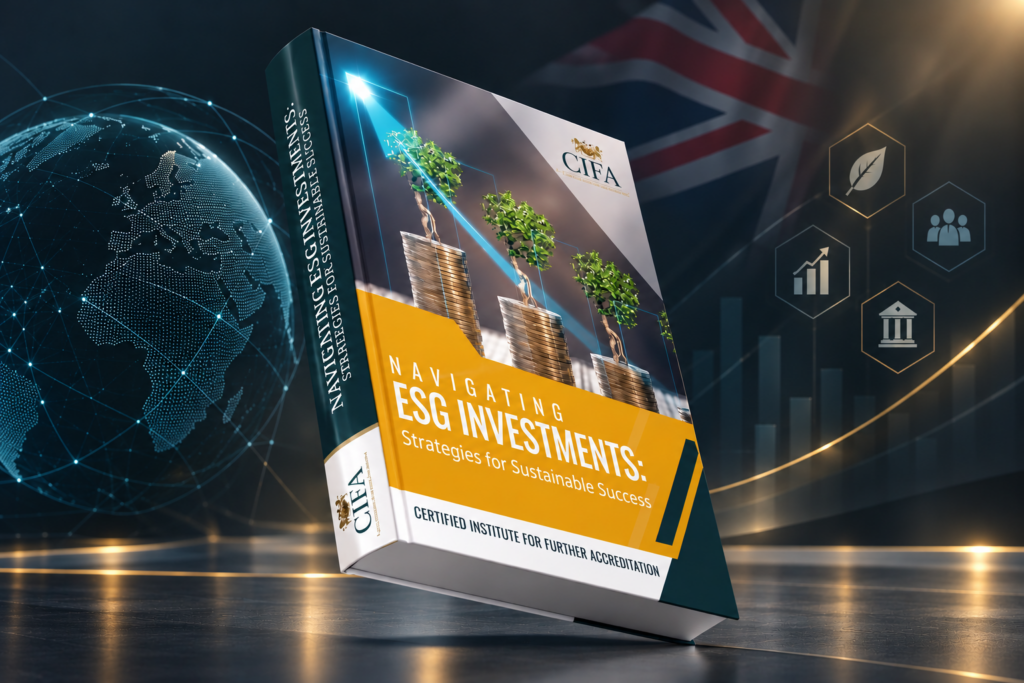
Environmental, social and governance (ESG) considerations have become an important part of investment analysis, helping finance professionals assess risks, business practices and long-term investment characteristics alongside traditional financial measures. Understanding how these factors interact with investment decisions requires more than recognising sustainability terminology. It involves evaluating evidence, interpreting disclosures and distinguishing between different investment objectives.
Navigating ESG Investments provides a structured approach to developing this understanding. The Navigating ESG Investments course, offered by CIFA, is a standalone digital programme designed for finance professionals seeking to strengthen their knowledge of ESG investment principles and applications.
The course is classified as Intermediate, carries 80 CPD hours and has a published enrolment fee of £358. Its 14 chapters examine ESG analysis, sustainable real estate, green bonds, renewable energy, corporate governance, private equity, environmental risk and regulatory reporting.
For professionals considering structured ESG education in the UK, understanding the curriculum, learning arrangements and distinction between the standalone course and wider certification options is essential before enrolling.
ESG investing involves considering environmental, social and governance information when assessing investments. These factors can provide additional insight into an organisation’s operations, management practices, exposure to risks and potential long-term resilience.
Environmental factors concern how organisations interact with the natural environment. Relevant considerations may include greenhouse gas emissions, energy consumption, resource efficiency, pollution, climate exposure and the environmental implications of business activities. Investors may examine whether these factors create operational costs, regulatory exposure or opportunities for business adaptation.
Social factors focus on relationships between organisations and people. Employee welfare, workplace safety, human rights, customer protection, supply-chain practices and community relationships can influence business continuity and reputation. Weak management of these issues may create legal, financial or operational consequences.
Governance factors relate to how organisations are directed and controlled. Board accountability, executive oversight, transparency, shareholder rights, ethical conduct and internal controls are relevant when evaluating management quality and decision-making.
ESG integration does not necessarily mean selecting investments that deliver measurable positive environmental or social outcomes. An investor may consider ESG information primarily to understand financial risks and opportunities. Impact investing, by contrast, intentionally seeks measurable positive outcomes alongside financial returns.
Data quality is central to both approaches. ESG ratings from different providers may vary because they use different methodologies, indicators, information sources and weightings. A strong rating from one provider should therefore not replace independent analysis.
A structured ESG course online UK can help professionals develop the knowledge needed to interpret these distinctions and examine ESG considerations within an investment context.
The standalone course offered by CIFA follows a 14-chapter curriculum covering the foundations of ESG investing through to investment strategies, asset-specific applications, risk assessment and reporting.
The programme’s published details are:
The digital format provides access to structured learning materials through the course portal. The e-book chapters establish the main educational content, while chapter-based mock examinations support knowledge review.
Importantly, PowerPoint presentations and prerecorded webinars are listed as additional-charge learning resources. They should not be assumed to form part of the standard £358 enrolment fee.
The course is positioned for finance professionals and classified as Intermediate rather than specifically designed for complete beginners. Readers should review their existing financial knowledge and confirm any entry expectations before enrolling.
The curriculum progresses from ESG principles to investment analysis, asset classes, portfolio risks and reporting considerations. Each chapter contributes a different perspective on applying sustainability-related information to investment decisions.
The opening chapter establishes the foundations of ESG investing and introduces the environmental, social and governance considerations that may influence investment decisions.
Understanding these foundations helps investors distinguish ESG analysis from conventional investment selection and recognise where the two approaches overlap.
For example, a company’s energy consumption may affect operating expenditure, while its governance arrangements may influence confidence in financial reporting and management accountability.
The central principle is that ESG information should be considered in the context of an investment’s characteristics rather than treated as an automatic indication of quality or performance.
The second chapter introduces ESG investment analysis and its relationship with traditional financial evaluation.
Investors may examine company disclosures, industry-specific risks, governance arrangements and sustainability-related performance indicators alongside profitability, cash flow, valuation and financial stability.
Materiality is particularly important. An environmental issue that significantly affects one industry may have a different financial relevance in another.
Data limitations must also be considered. Incomplete disclosures, inconsistent reporting periods and differing measurement methods can reduce comparability between investments.
Effective analysis requires examining the relevance and reliability of information rather than relying exclusively on a single ESG indicator.
Real estate provides a practical example of how environmental characteristics can influence investment analysis.
A sustainable real estate investment assessment may consider building energy efficiency, operational emissions, water consumption, construction materials, physical climate exposure and the costs associated with improving environmental performance.
Energy-efficient buildings may have different operating-cost characteristics from less efficient properties, but their financial attractiveness still depends on acquisition costs, financing, occupancy, maintenance and market conditions.
Investors may also assess flood exposure, building resilience, tenant requirements and governance arrangements affecting property management.
The chapter introduces sustainable real estate as an investment consideration without assuming that environmentally efficient properties will always generate superior returns.
Green bonds are debt instruments generally intended to finance or refinance eligible environmental projects.
With green bonds explained in the context of fixed-income investing, it becomes important to distinguish the environmental purpose of a bond from its financial characteristics.
Investors may assess the issuer’s creditworthiness, coupon arrangements, maturity, interest-rate sensitivity and repayment risks alongside the stated use of proceeds.
They may also examine whether environmental projects are clearly identified, how proceeds are allocated and whether the issuer provides credible reporting.
A green label does not eliminate credit risk or guarantee that environmental objectives will be achieved.
Readers wishing to strengthen their understanding of conventional debt instruments can explore the separate Securities and Investment course offered by CIFA.
The Securities and Investment course guide provides additional background on securities education and related investment concepts.
Impact investing involves intentionally seeking measurable environmental or social outcomes alongside financial returns.
Renewable energy provides an illustrative area because investments may support electricity generation from sources such as solar, wind or other renewable technologies.
However, investment evaluation still requires consideration of project economics, financing structures, operational performance, contractual arrangements and relevant risks.
A renewable energy project may pursue environmental objectives without necessarily delivering attractive financial returns. Equally, an investment associated with sustainability does not automatically qualify as impact investing unless its intended impact can be appropriately assessed.
An impact investing course perspective is therefore useful for understanding the difference between considering ESG characteristics and deliberately pursuing measurable outcomes.
ESG metrics are used to assess aspects of an organisation’s environmental, social and governance performance.
Examples may include emissions intensity, workplace safety indicators, board composition and governance-related disclosures.
ESG metrics and scoring can help organise information, identify potential concerns and support comparisons. However, scores depend on the methodology used.
Different providers may assign different importance to environmental exposure, governance arrangements or social performance. Data gaps and estimation methods can also influence results.
Investors should therefore understand what a score measures, how it is calculated and whether its underlying information is relevant to their investment objectives.
Corporate governance examines the structures and practices through which organisations are managed, supervised and held accountable.
The relationship between corporate governance and investing is important because weak oversight can contribute to financial misreporting, ineffective risk management, conflicts of interest and poor strategic decisions.
Investors may consider board independence, management accountability, internal controls, ethical standards and the transparency of corporate disclosures.
Governance assessment is not simply a question of whether formal policies exist. Their implementation, effectiveness and consistency also matter.
Understanding accountability helps investors evaluate how organisations identify risks and respond to challenges.
Socially responsible investing involves selecting or excluding investments according to specified ethical, environmental or social criteria.
An investor might apply exclusionary screening to avoid certain activities, use positive screening to identify organisations meeting selected standards or adopt a best-in-class approach within an industry.
The appropriate method depends on investment objectives and the criteria being applied.
A responsible investing course perspective helps clarify that socially responsible investing and impact investing are related but distinct.
Socially responsible investing may focus on the characteristics of investments selected for a portfolio. Impact investing specifically seeks measurable positive outcomes alongside financial returns.
Neither approach removes the need for financial analysis.
Environmental risks can affect individual assets and overall portfolio exposure.
Physical climate risks include flooding, extreme weather, heat and other environmental events that may disrupt operations or damage assets.
Transition risks may arise from technological changes, evolving customer preferences, energy-market developments and changes in policy or regulation.
Resource scarcity, environmental liabilities and reputational concerns may also influence financial performance.
Assessing these risks requires consideration of geography, sector, business models and investment time horizons. Broad assumptions about entire industries can overlook significant differences between individual companies.
For wider portfolio risk principles, CIFA offers a separate investment risk and taxation course.
The related investment risk and taxation guide provides further educational context for evaluating investment risk and financial decision-making.
Private equity investment analysis may incorporate ESG considerations during due diligence, acquisition decisions, ownership and ongoing business monitoring.
Understanding ESG in private equity involves examining how environmental exposure, workforce practices, governance arrangements and operational risks may affect a privately held business.
For example, investors may review regulatory compliance, supply-chain dependencies, management controls or potential environmental liabilities before acquiring a company.
During ownership, ESG information may inform operational priorities and long-term planning.
The relevance of individual factors depends on the business, industry and transaction. A standardised checklist cannot replace investment-specific analysis.
Climate-related investment analysis distinguishes between mitigation and adaptation.
Mitigation concerns activities intended to reduce greenhouse gas emissions or their sources. Adaptation focuses on adjusting operations, infrastructure and systems to manage actual or anticipated climate-related effects.
The connection between climate change and investing includes assessing physical exposure, business continuity, infrastructure resilience and the financial implications of adaptation measures.
For instance, a business operating in a flood-prone location may need to consider protective infrastructure, insurance availability and operational disruption.
Investors should evaluate the costs, effectiveness and limitations of adaptation strategies rather than assuming that climate-related expenditure automatically improves investment performance.
ESG reporting concerns how organisations communicate relevant sustainability-related information, policies, risks and performance.
Reliable disclosures can support transparency, accountability and more informed investment decisions.
Regulatory obligations vary according to jurisdiction, organisation type and applicable requirements. Investors and compliance professionals must distinguish mandatory reporting obligations from voluntary disclosures and broader industry practices.
Reporting quality also matters. Inconsistent definitions, unsupported claims and incomplete information may make investment comparisons difficult.
Professionals seeking broader knowledge of financial regulation and ethical responsibilities may consider the separate UK financial regulation course.
This provides related educational context but is not an additional module automatically included in the standalone ESG course.
The penultimate chapter brings together the major themes of ESG investing and considers their continuing relevance to investment analysis.
It connects environmental and social considerations with governance, asset-specific investment approaches, portfolio assessment and reporting.
A central lesson is that ESG practices should be evaluated through evidence and investment context, rather than assumptions about sustainability labels.
The final chapter consolidates the course’s principal learning themes.
These include ESG fundamentals, investment analysis, sustainable asset classes, scoring systems, responsible investment strategies, governance, environmental risks and reporting.
Taken together, the 14 chapters provide a structured basis for understanding how ESG considerations may inform professional investment decisions.
A useful way to apply ESG knowledge is to recognise that sustainability considerations operate differently across investment strategies and asset classes.
In real estate, analysis may focus on physical assets, building performance, climate exposure and operating costs. For green bonds, attention may centre on the issuer’s creditworthiness, the intended use of proceeds and environmental reporting.
Renewable energy investments may require assessment of project financing, technology, operational assumptions and intended environmental outcomes. Private equity investments can involve detailed due diligence and governance considerations throughout the ownership period.
Investment approaches also differ.
ESG integration incorporates relevant environmental, social and governance information into conventional investment analysis. Exclusionary screening removes investments that do not meet defined criteria. Impact investing intentionally pursues measurable environmental or social outcomes alongside financial returns.
These methods can overlap, but they should not be treated as interchangeable.
An ESG investing course can help professionals understand the analytical distinctions between these approaches and assess their relevance to different investment objectives.
Ultimately, investment suitability depends on risk tolerance, financial objectives, investment horizon, available evidence and the characteristics of the underlying assets.
The standalone CIFA course is published at an enrolment fee of £358, with 80 CPD hours, Intermediate-level classification and English-language digital delivery.
Its core learning resources include e-book chapters and per-chapter mock examinations. The course also lists lifetime portal access and a Digital Profile.
The Certificate of Achievement is conditional upon successful course completion and passing the exam. Enrolment or payment alone does not result in the certificate being awarded.
The published course fees and pricing information identifies an additional study-support package costing £72 for this course. This package covers prerecorded webinars and PowerPoint presentations and is separate from the standard enrolment fee.
The same fee schedule separately lists examination-related charges, including a first-attempt examination fee of £149.99 per course. Prospective learners should review all applicable assessment charges and payment terms before making a purchase.
Readers should also confirm the latest assessment arrangements directly with CIFA, rather than assuming a particular examination duration, pass mark or question format.
CIFA offers both the individual ESG course and a wider certification bundle.
The standalone option concentrates on the 14 ESG chapters and is listed at £358 with 80 CPD hours.
The full ESG certification bundle includes three courses:
Each individual course is listed at £358, giving a combined standalone enrolment price of £1,074.
The bundle is published at £897, representing a £177 difference compared with purchasing all three courses separately, before optional study support and other applicable charges.
The bundle page lists a duration of 450 hours, whereas the standalone ESG course lists 80 CPD hours. These figures describe different products and should not be treated as interchangeable.
The wider bundle may be relevant to professionals seeking education across ESG investing, financial risk, taxation, regulatory principles and professional integrity.
By contrast, someone whose immediate objective is to study ESG investment concepts may find the standalone course more closely aligned with their needs.
The ESG certification bundle guide offers supporting information for readers considering the broader programme.
The appropriate choice depends on the learner’s existing knowledge, intended subject coverage, available study time and budget.
Continuing Professional Development, commonly known as CPD, refers to ongoing learning that helps professionals maintain and develop relevant knowledge and skills.
The standalone ESG course published by CIFA carries 80 CPD hours. This figure relates specifically to the individual programme and should not be confused with the duration of a wider certification bundle.
The official CIFA CPD accreditation page explains the provider’s approach to continuing professional development and its relationship with the CPD Certification Service.
CPD participation may provide evidence of structured professional learning. However, the acceptance of a particular certificate or learning activity depends on the requirements of the relevant employer, professional organisation or regulatory body.
Readers seeking additional background can consult the CIFA accreditation guide.
Before relying on CPD hours for a specific professional requirement, learners should confirm whether the relevant organisation accepts the programme and how those hours may be recorded.
The standalone programme is positioned primarily for finance professionals who want to develop their understanding of ESG-related investment considerations.
Investment analysts and portfolio managers may find the coverage of ESG analysis, asset classes and environmental portfolio risks relevant to their work.
Sustainability practitioners may benefit from understanding how sustainability-related information is interpreted within financial decision-making.
Risk managers and compliance professionals may be interested in the chapters addressing governance, environmental risk assessment and regulatory reporting.
Corporate finance professionals, wealth managers and financial advisers may also find the investment principles relevant when evaluating organisations, financial products or portfolio considerations.
However, the Intermediate classification should be considered carefully. Prospective learners who are uncertain about their preparation should contact CIFA to clarify entry expectations.
For readers seeking broader education in financial markets and wealth-management principles, Foundations in Wealth Management is a separate programme worth reviewing.
The ESG course should be viewed as an educational development opportunity, not as a guarantee of employment, professional authorisation or investment-advisory competence.
Navigating ESG Investments provides a structured introduction to the analytical and practical considerations involved in ESG-focused investment decisions.
Through 14 chapters, the CIFA programme addresses ESG fundamentals, sustainable real estate, green bonds, renewable energy, scoring methodologies, governance, socially responsible investment strategies, private equity, climate-related risks and regulatory reporting.
Its published £358 enrolment fee, 80 CPD hours, Intermediate classification, digital learning materials and chapter-based mock examinations provide a clear basis for evaluating the programme. A Certificate of Achievement is available after successful completion and passing the exam.
Professionals seeking ESG-specific education may prefer the standalone course, while those interested in additional investment risk, taxation and regulatory subjects may wish to compare the wider certification bundle.
Readers can explore CIFA’s course catalogue to understand the available learning options and their respective subject areas.
For a practical next step, review the official Navigating ESG Investments course, confirm the current fees and assessment terms, and consider whether its curriculum matches your professional learning objectives.
The Navigating ESG Investments course is a standalone ESG investing course offered by CIFA for finance professionals seeking structured knowledge of sustainability-related investment analysis. It covers ESG principles, investment strategies, risk assessment and reporting. Readers can check the official course page for its current curriculum and enrolment details.
CIFA structures the course around 14 chapters covering ESG fundamentals, investment analysis, sustainable real estate, green bonds, renewable energy, governance, private equity, climate risk and reporting. ESG metrics and scoring are also covered, helping learners understand how sustainability-related information may support investment evaluation and portfolio decisions.
The CIFA programme is classified as Intermediate and is intended for finance professionals. It may also interest investment analysts, portfolio managers, sustainability practitioners, risk specialists and compliance professionals. This responsible investing course is particularly relevant to readers seeking structured ESG knowledge rather than introductory financial education alone.
CIFA currently lists the standalone course at £358. Its optional additional study-support package costs £72 and covers prerecorded webinars and PowerPoint materials. Anyone comparing an ESG course online UK should review the official course fees and pricing information, including separate examination charges, before enrolling or purchasing extra resources.
The standalone CIFA course lists 80 CPD hours, reflecting its published professional development duration. These hours relate to the individual ESG investing course, not the wider certification bundle. Learners can consult the official CIFA CPD accreditation information and confirm whether the hours meet their employer’s or professional body’s requirements.
CIFA classifies the programme as Intermediate and identifies finance professionals as its intended audience. However, the published course information does not establish a universal minimum experience requirement. Before choosing this ESG course online UK, readers who are unsure about their existing financial knowledge should contact CIFA to clarify entry expectations.
Yes. CIFA states that its ESG investing course includes an examination and awards a Certificate of Achievement after successful course completion and passing the exam. The certificate is not automatic upon enrolment. Prospective learners should review the official course assessment and certificate details and confirm applicable examination fees.
Yes. CIFA lists the programme as a digital product delivered in English, with e-book chapters, per-chapter mock examinations and lifetime portal access. This ESG course online UK offers a digital learning format for professionals reviewing sustainability-related investment concepts. Learners should confirm any additional support arrangements and assessment requirements before enrolling.
ESG investing considers environmental, social and governance factors when evaluating investment risks, opportunities and business practices. Impact investing intentionally seeks measurable positive environmental or social outcomes alongside financial returns. CIFA explores this distinction within its curriculum, making the subject relevant to readers considering an impact investing course.
The standalone CIFA ESG investing course costs £358 and lists 80 CPD hours. The full ESG certification bundle costs £897 and combines ESG investing with Introduction to Investment, Risk and Taxation and Introduction to UK Financial Regulation & Professional Integrity. The bundle lists 450 hours. Compare both official options before enrolling.
CIFA is a trusted education provider specializing in finance and compliance training. We empower learners with practical knowledge, industry-relevant skills, and accredited courses designed to build strong careers in financial services, risk management, and regulatory compliance.
© CIFA 2020-2025 ALL RIGHTS RESERVED