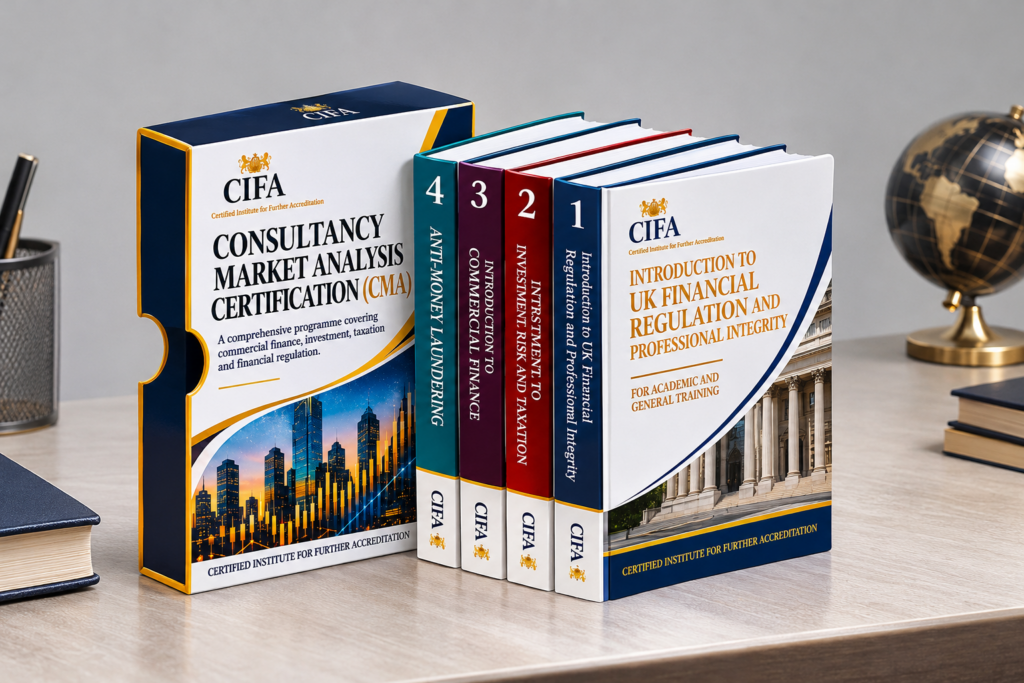
If you want to work in financial consultancy, compliance or market analysis but are not sure where to begin, the Level 4 Consultancy and Markets Analysis Certification from CIFA gives you a clear, structured starting point. It is a CPD accredited bundle of four connected courses covering UK financial regulation, investment, risk, commercial finance and anti-money laundering, all delivered online through CIFA.
This guide explains what the certification is, what CIFA students study, who it suits, how the online exams work and what it costs. If you would like to compare it with other pathways first, you can browse the full CIFA course catalogue or read more guides on the CIFA Blog.
Financial services employers in the UK want people who understand more than one subject. A junior consultant is expected to read a regulatory requirement, judge an investment risk, understand how a business is funded and spot signs of financial crime, often on the same project. Yet most learners study these topics separately, if at all.
CIFA built the Consultancy and Markets Analysis Certification (CMA) to close that gap. Instead of asking you to piece together a qualification from unrelated courses, CIFA’s CMA bundle groups four Level 4 courses into one pathway. You enrol once, study at your own pace and finish with a broad, practical foundation in how UK financial markets and regulation work.
The Level 4 Consultancy and Markets Analysis Certification is an online professional certification delivered by CIFA. It is a bundle rather than a single course, made up of four Level 4 courses, and it is CPD accredited. CIFA states that it supports the annual professional development requirement of 35 CPD hours.
A few points are worth making clear:
This certification is also different from the US management accountant credential that shares the same three-letter abbreviation. CIFA’s CMA is a UK-focused certification in consultancy and markets analysis, built around regulation, investment, risk, commercial finance and financial crime prevention.
CIFA is a UK-based education provider that specialises in finance and compliance training. The organisation works with academics and industry experts to design certifications for people at different stages of their careers, from entry-level learners building their first foundation to professionals who need recognised CPD. You can read more about the organisation on the About CIFA page.
What sets CIFA students apart is the way learning is packaged. Courses are available online, exams can be taken remotely, study materials stay accessible so you can fit learning around work, and certificates can be verified by employers. The same approach runs through the CMA bundle.
The certification contains four courses. Each one can be bought individually, but together they form a complete pathway.
This is the starting point for the CIFA CMA pathway. It introduces how financial services are regulated in the UK and why professional integrity sits at the centre of every finance role. Understanding who regulates the industry, what firms are expected to do and how individuals are held to professional standards is essential background for any consultant, analyst or compliance professional.
You can view the course on the Introduction to UK Financial Regulation & Professional Integrity page, priced at £358 when bought on its own. If you want a plain-English look at the regulators involved, the CIFA Blog also explains the FCA and PRA investment risk fundamentals.
The second CIFA course builds your understanding of how investments work, how risk is identified and assessed, and how taxation affects financial decisions. Anyone advising a business or client needs to understand that a good return is not the only measure of a good decision. Risk and tax shape the outcome too.
The course is listed on CIFA’s Introduction to Investment, Risk and Taxation page at £358. For a deeper look at the learning outcomes, read the CIFA Blog guide on what you will learn in Introduction to Investment, Risk and Taxation.
Commercial finance is how businesses are funded and how lenders decide whether to support them. This CIFA course introduces business lending, credit assessment and the financial principles behind commercial decisions. It is a useful subject for anyone who wants to advise companies, work in lending support or understand how organisations manage cash and growth.
The course is available on the Foundation to Commercial Finance page at £425. The CIFA Blog also covers it from two angles: a guide to the Foundation to Commercial Finance course in the UK and a practical article on starting a commercial finance career with no experience.
Anti-money laundering knowledge is now expected across the financial sector, not only in specialist compliance teams. This CIFA course covers how financial crime is detected and prevented and what firms and individuals are responsible for. It is one of the most practical subjects in the bundle because the skills apply in banks, advisory firms, fintech businesses and consultancies alike.
It is listed on the CIFA Anti Money Laundering course page at £499. A full walkthrough is available in the CIFA Blog’s complete Anti Money Laundering course guide.
Studying the courses as one pathway matters because real finance work rarely stays inside one topic. Consider how the four subjects connect:
A consultant who understands all four can see a client’s situation from several sides. That is what the CIFA Consultancy and Markets Analysis Certification is designed to develop. It is also why many learners choose the bundle over individual courses.
The certification suits a wide range of learners. CIFA students typically include:
Because the programme builds knowledge from the ground up, you do not need years of finance experience to begin. If you are still deciding between finance directions, the CIFA Blog’s Level 4 Certification in Compliance roadmap is a helpful companion read.
One of the main reasons learners choose CIFA is flexibility. The CMA bundle is a digital product, so you can start studying as soon as you enrol and continue at a pace that suits your schedule. There is no need to attend a physical classroom, which makes it realistic to study around a full-time job or other commitments.
Exams are taken online. With a stable internet connection you can sit them from home or another suitable location. CIFA also keeps learning materials accessible so you can return to them whenever you need to revise. Online assessment has become a normal way for employers and education providers to recognise skills, and it removes the travel and scheduling barriers that put many people off further study.
If you have questions about the enrolment process, the CIFA support and FAQ page and the CIFA contact page are the best places to start.
Cost is a practical concern for most learners, so here is how the numbers work.
Bought separately, the four courses add up to £1,640:
The CIFA CMA bundle costs £1,249, which is a saving of 24%. If you intend to complete all four courses, the bundle is the more economical route. If you only need one subject, a single course may be enough. You can compare every option on the CIFA price list before you decide.
CPD stands for Continuing Professional Development. It is a way of recording the learning you complete to keep your skills current. Many professions and employers expect a set number of CPD hours each year, and CIFA states that this certification supports the annual requirement of 35 CPD hours.
For learners, CPD accreditation brings three benefits:
CPD accreditation is not a guarantee of employment, but it does tell employers you have invested time in structured, recognised study.
The CMA is a foundation certification. It will not replace practical experience, but it prepares you to apply for and perform well in entry-level and support roles, such as:
The combination of regulation, risk, commercial finance and AML knowledge also gives you options. You can lean towards consultancy, compliance, lending or research as your experience grows. If you want extra help turning your certificate into job applications, CIFA’s Employability Accelerator Package guide explains how to stand out to UK finance recruiters.
A certificate is only useful if an employer can trust it. CIFA offers a certificate verification service, so employers can confirm that your qualification is genuine. CIFA also provides a CIFA Digital Profile with a QR code, giving you a simple way to share your achievements with recruiters.
The CIFA Employers Panel supports this by working to bridge the gap between education and employment. Together, these features turn your study into proof that is easy to share and easy to check.
Both options are valid, and the right choice depends on your goal.
Choose the bundle if:
Choose an individual course if:
Many learners start with one course and then move to the bundle once they are sure. If you are weighing up other CIFA pathways, the FinTech and Compliance Certification guide and the ICAM compliance and anti-money laundering overview show how other CIFA bundles are structured.
The Level 4 Consultancy and Markets Analysis Certification is a good fit if you want a structured, flexible and UK-focused way to build finance knowledge, you value CPD accreditation, and you are comfortable studying and sitting exams online. It is less suitable if you are looking for a regulated degree-level qualification or a guaranteed job outcome, because no short certification can promise that.
What it can do is give you credible knowledge, a verifiable certificate and a clear story to tell employers: that you understand UK regulation, risk, commercial finance and financial crime prevention and have studied them through a recognised provider. For many beginners, that is exactly the foundation they need.
If you are ready to take the next step, visit the Consultancy Market Analysis Certification (CMA) page on CIFA to see the full course list, fees and enrolment options. You can also explore the wider CIFA course range or keep reading on the CIFA Blog for more guides to building a UK finance career.
Ready to begin? Explore the CIFA Level 4 Consultancy and Markets Analysis Certification today.
It is a CPD accredited online certification from CIFA made up of four Level 4 courses. It covers UK financial regulation and professional integrity, investment, risk and taxation, commercial finance and anti-money laundering.
The bundle includes Introduction to UK Financial Regulation & Professional Integrity, Introduction to Investment, Risk and Taxation, Foundation to Commercial Finance and Anti Money Laundering.
The bundle is priced at £1,249. Buying the four courses separately would cost £1,640, so the bundle saves 24%.
Yes. CIFA lists the Consultancy and Markets Analysis Certification as CPD accredited, and it supports the annual professional development requirement of 35 CPD hours.
No. The certification is designed to build foundation knowledge, so beginners, graduates and career changers can all start without prior finance experience.
Yes. Each of the four courses is listed separately on CIFA, so you can buy one at a time. The bundle is simply the cheaper option if you want all four.
Exams are taken online, so you can sit them from home or another suitable place with a stable internet connection.
No. CIFA’s CMA stands for Consultancy and Markets Analysis. It is a separate, UK-focused certification and should not be confused with the US management accounting credential.
It supports entry-level and support roles such as junior financial consultant, compliance support officer, AML support analyst, markets research assistant and commercial finance support officer. It builds knowledge and credibility but does not guarantee a job.
Employers can confirm your qualification through CIFA’s online certificate verification service, and you can share your achievements through your CIFA Digital Profile and QR code.
CIFA is a trusted education provider specializing in finance and compliance training. We empower learners with practical knowledge, industry-relevant skills, and accredited courses designed to build strong careers in financial services, risk management, and regulatory compliance.
© CIFA 2020-2025 ALL RIGHTS RESERVED